
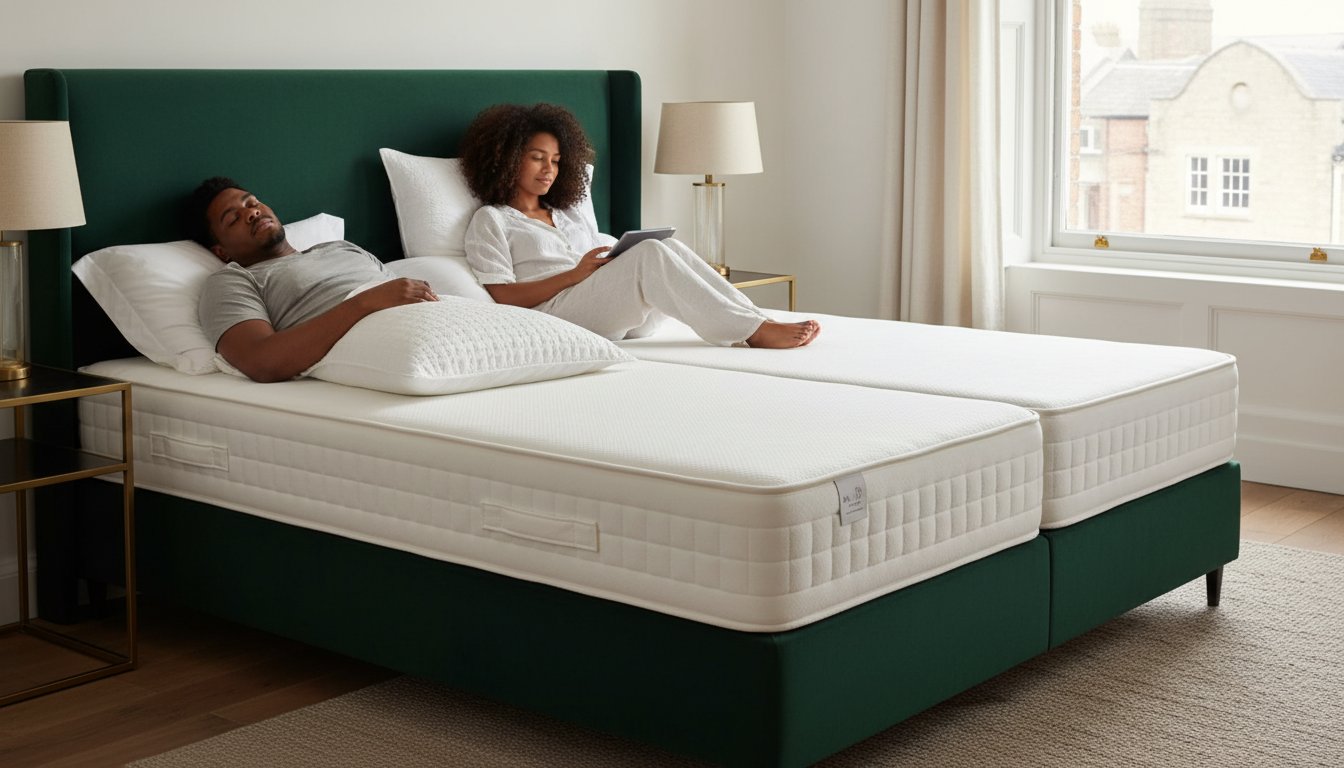
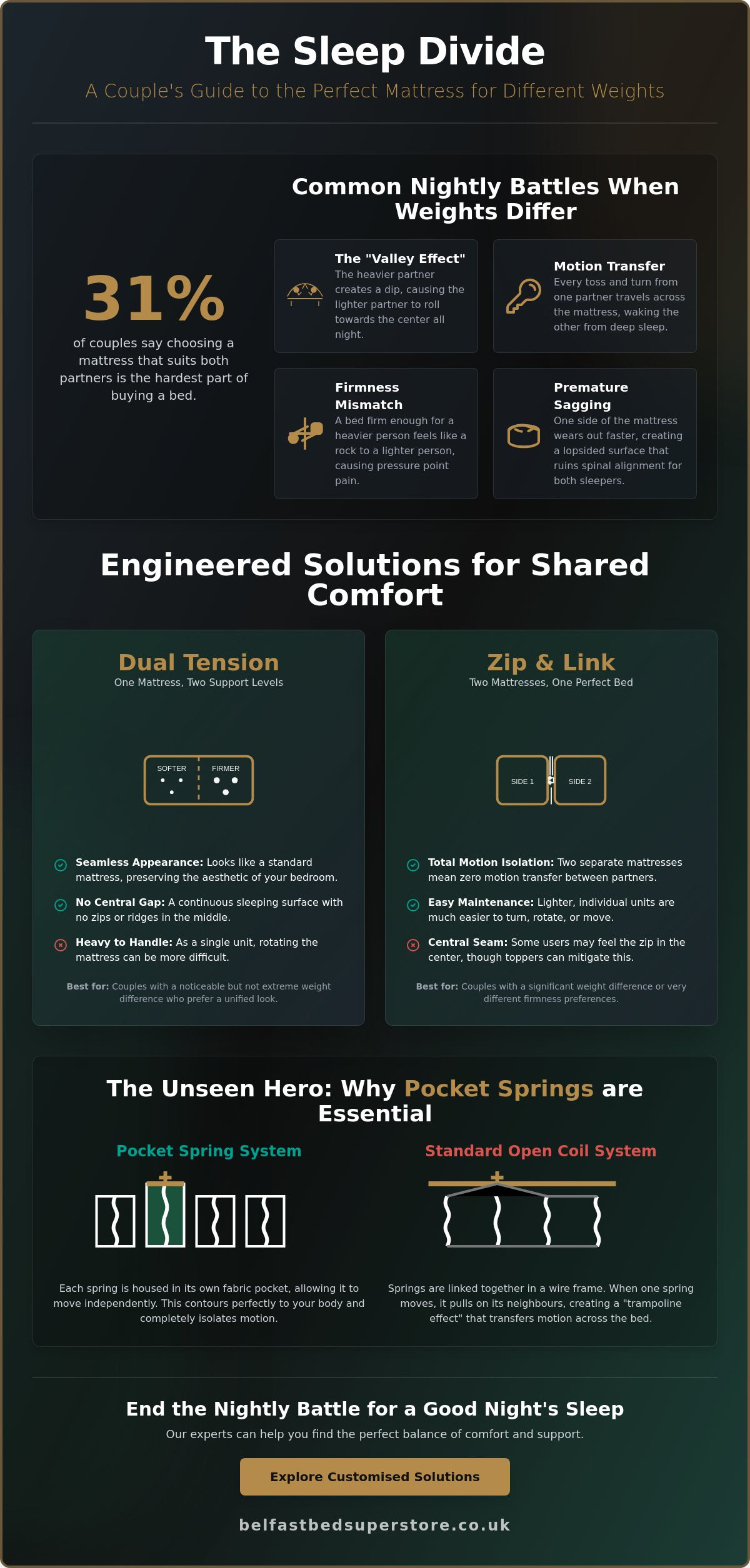
Did you know that 31% of couples find that the hardest part of buying a new bed is choosing one that actually works for both people? If you have ever felt like you are rolling into a trench in the middle of the night, you are not alone. Finding a mattress for couples with different weights often feels like a constant battle between one person needing deep support and the other wanting a softer touch. We understand how frustrating it is to deal with premature sagging or being jolted awake every time your partner moves an inch.
The good news is that you don't have to settle for a bed that only suits one of you. Our team is here to help you discover how to eliminate roll-together and achieve perfect individual support while keeping that shared sense of comfort. We will walk you through the latest 2026 solutions, including dual-tension systems and zip and link designs from heritage brands like Hypnos and Sealy, to ensure you find a bed with zero motion transfer and the lasting durability you deserve.
Key Takeaways
- Learn how to stop the "valley effect" from pulling you into the center of the bed so you both enjoy a full night of undisturbed rest.
- Understand the practical differences between dual-tension and zip-and-link systems to choose the best mattress for couples with different weights.
- Discover why pocket springs and natural fillings are the gold standard for providing individualised support that doesn't sag over time.
- Follow our simple guide to matching your firmness levels based on your specific weight difference and preferred sleeping positions.
- Find out why investing in high-quality engineering from brands like Hypnos or Relyon is the key to a mattress that remains comfortable for years to come.
Why Weight Differences Create Sleep Challenges for Couples
Sharing a bed should be a source of comfort, but when there is a significant weight gap between partners, the physics of the mattress can work against you. This often leads to what we call the "Valley Effect." A heavier partner naturally displaces more of the mattress material, creating a literal dip in the surface. This slope pulls the lighter partner toward the middle all night long, leaving them feeling like they are climbing uphill just to stay on their side. Finding the right mattress for couples with different weights is about more than just picking a brand; it's about finding a system that resists this gravitational pull.
We often find that customers are surprised by how much "perceived firmness" varies between two people. It is a simple reality of physics: a mattress that feels like a supportive, contouring cloud to a 15-stone sleeper might feel like a rigid, unforgiving brick to someone who weighs 8 stone. If you choose a bed that is firm enough to support the heavier partner, the lighter sleeper may wake up with aching joints because they don't have enough body mass to sink into the comfort layers. Conversely, a softer bed might feel perfect for one but leave the other without any spinal support at all.
Uneven weight distribution also leads to premature wear, which can effectively kill a standard mattress in half its expected lifespan. When one side of the bed is under significantly more stress, the internal structure begins to fatigue faster. This results in a lopsided surface that ruins spinal alignment for both of you. Exploring different types of mattresses is the first step toward understanding which constructions, such as those from Sealy, are engineered to handle these disparate loads without sagging after just a couple of years.
Understanding Roll-Together and Motion Transfer
The main culprit behind a restless night is often the "rebound" effect. In many traditional beds, the springs are linked together, meaning when one person turns over, the energy travels across the entire surface. This motion transfer can easily jolt a lighter sleeper out of a deep REM cycle. Open-coil mattresses are generally the worst choice for weight-mismatched couples because they act like one giant trampoline. You need a mattress for couples with different weights that uses independent spring units to isolate movement at the source.
Firmness vs. Support: The Crucial Distinction
It helps to think of your bed in two distinct layers. Support comes from the spring unit or core, while firmness is the "feel" created by the top upholstery layers. The spring gauge, or the thickness of the wire, must be matched to your weight to keep your spine neutral. Support is an objective requirement based on your body mass, while comfort is a subjective preference. Trusted heritage brands like Relyon specialise in these technical details, ensuring the internal engine of the bed suits your frame while the outer layers provide the cosiness you both want.
Dual Tension vs. Zip and Link: Which Solution is Right for You?
Once you understand how weight affects your sleep, the next step is choosing a construction that solves the problem. For many, a standard mattress for couples with different weights simply won't provide the necessary balance. You need a bed that treats each half of the sleeping surface as its own independent support engine. This typically leads to two main options: dual tension or zip and link. While they both aim to provide personalised comfort, they do so in very different ways.
The Mechanics of Dual Tension
Dual tension mattresses are a clever "stealth" solution. From the outside, they look like any other high-quality mattress, but inside, the spring unit is split into two zones. Manufacturers like Relyon use different wire gauges for each side. A thicker wire provides firmer support for a heavier sleeper, while a thinner, more flexible wire gives the lighter partner the contouring they need. It is a fantastic way to get bespoke support without changing the look of your bedroom or needing special bedding.
If you are researching how to choose a mattress, remember that dual tension units are often heavier than standard ones. Since the entire bed is one piece, rotating or turning it to maintain its shape requires a bit more effort. It is a great choice if your weight difference is noticeable but not extreme, typically under 6 stone.
Zip and Link: The Ultimate Independence
For couples with a weight gap of 6 to 8 stone or more, a zip and link system is often the superior choice. This involves two separate mattresses that are zipped together to form one large bed. Because the two units are physically separate, motion transfer is virtually eliminated. If one person moves, the energy cannot travel through the zip to the other side. It is the gold standard for light sleepers who share a bed with a restless partner.
Practicality is another huge benefit here. Navigating narrow stairs or tight corners with a super king mattress can be a nightmare. With zip and link, you are moving two smaller units, which makes delivery much simpler. You also have the flexibility to replace just one side in the future if your support needs change. We have helped many local families find their perfect match by testing these options side-by-side. If you are unsure which path to take, you might want to browse our collection of zip and link beds to see how they fit your lifestyle.
Beyond the Springs: Prioritising Motion Isolation and Edge Support
While the internal spring tension provides the foundation, the materials surrounding those springs are what truly refine your sleep experience. For a mattress for couples with different weights, pocket springs are a non-negotiable feature. Unlike open coils, each pocket spring works in isolation, meaning the support on one side doesn't compromise the other. To enhance this, we recommend looking at natural fillings like wool, cotton, or horsehair. These materials are excellent at regulating temperature, which is a common concern for heavier sleepers who may find synthetic foams a bit too warm during the night. Natural fibres allow air to circulate freely, keeping the mattress fresh and comfortable regardless of your body mass.
The Importance of Motion Isolation
Motion isolation is the secret to staying asleep when your partner moves. Adding layers of memory foam or latex on top of the springs helps to dampen vibrations before they reach you. High pocket spring counts, typically 2000 or more, offer a more fine-tuned response to your body shape. If you check out an in-depth mattress buying guide, you'll see that natural materials often provide a more stable feel than synthetic alternatives, which can sometimes feel a bit bouncy. This stability ensures that when one person rolls over, the other doesn't feel like they are on a boat in a storm.
Edge Support for Shared Surfaces
When two people share a bed, you want to use every inch of the surface. Reinforced perimeters are vital to prevent that "roll-off" sensation, especially for the partner sleeping on the firmer side of a dual-tension unit. Premium brands like Hypnos use traditional hand side-stitching to secure the edge springs to the border. This expert craftsmanship doesn't just feel more stable; it can actually increase your usable sleeping area by up to 20% by preventing the edges from collapsing when you sleep near the side. It makes a standard king size feel much roomier, giving both of you the space you need to stretch out.
One common worry with zip and link setups is the feeling of a "seam" where the two mattresses meet. We've found that a high-quality mattress protector or a plush topper can effectively bridge this gap. It creates a seamless comfort layer that hides the join while still allowing each partner to benefit from their specific support level. By choosing the right finishing layers, you can enjoy the technical benefits of independent support without ever feeling a physical divide in the middle of your bed.
A Step-by-Step Guide to Finding Your Perfect Shared Firmness
Finding a mattress for couples with different weights doesn't have to be a headache. We've helped hundreds of local couples navigate this process by focusing on a few simple metrics. Instead of guessing, follow this proactive sequence to ensure your next investment provides the rest you both deserve. This proactive approach ensures you find a mattress for couples with different weights that supports both of you without compromise.
- Step 1: Calculate the weight gap. Start by determining the difference in your weights. If the gap is more than 3 stone, you'll need to look beyond standard "one-size-fits-all" options.
- Step 2: Identify primary sleep positions. Note whether you are side, back, or stomach sleepers. Side sleepers generally need more "give" in the top layers to protect their shoulders and hips.
- Step 3: Determine support for the heavier partner first. The internal spring tension must be firm enough to keep the heavier sleeper's spine aligned. If the springs are too soft, the mattress will fatigue prematurely.
- Step 4: Select a comfort layer for the lighter partner. Once the support engine is decided, choose upholstery layers like latex or wool. These provide the cushioning the lighter partner needs to avoid feeling like they are sleeping on a rigid board.
- Step 5: Decide on the construction. Based on your weight gap and bedroom access, choose between a single-unit Dual Tension mattress or a two-piece Zip and Link setup.
Weight Thresholds for Specialised Mattresses
We generally use three specific brackets to guide our customers toward the right technology. If there is less than a 3-stone difference, a high-quality pocket spring mattress can often adapt to both people effectively. For gaps between 3 and 7 stone, we highly recommend a dual tension unit to provide tailored support. If the difference is 8 stone or more, a Zip and Link system is usually the only long-term solution to prevent the "valley effect" and ensure both partners stay on their own level sleeping surface.
The "Hand-Test" for Couples
When you visit a showroom, it's vital to test potential beds together. Lie on your sides and have someone check your "spine line." Your spine should be straight and parallel to the floor; if it bows up or down, the tension is wrong. We always tell our customers that testing a bed for at least 20 minutes is the minimum requirement. It takes that long for your muscles to fully relax and for the natural fillings to respond to your body heat, giving you a true sense of the long-term comfort. If you want to see how these different tensions feel in person, you can check out our Relyon collection to see how dual tension works in practice.
Expertly Crafted Solutions: Hypnos, Relyon, and Sealy for Couples
When you are looking for the best mattress for couples with different weights, heritage brands often stand head and shoulders above modern "bed-in-a-box" alternatives. While newer brands offer convenience, they frequently lack the robust edge support and deep spring customisation required to prevent roll-together over the long term. We believe that investing in a bed from a manufacturer with a history of craftsmanship ensures your comfort isn't just a temporary fix. Brands like Hypnos, Relyon, and Sealy have spent decades perfecting the internal architecture of their beds to solve the very problems we've discussed.
The Hypnos Advantage for Couples
Hypnos Mattresses are widely considered the masters of the zip-and-link system. Holding a Royal Warrant is a testament to their longevity and commitment to quality; it gives you peace of mind that your investment will last. One of the standout features of a Hypnos bed is the use of natural fibres like wool and cotton. These materials are excellent at regulating temperature for two different body types, ensuring the heavier sleeper stays cool while the lighter partner remains cosy. Their bespoke tension options allow us to help you find a configuration that provides the exact level of resistance each of you needs.
Relyon and Sealy: Support Meets Durability
If you prefer a more traditional feel with exceptional durability, Relyon Mattresses are a fantastic choice. They focus on high spring counts and traditional hand-tufting, which physically binds the upholstery layers to the spring unit. This prevents the fillings from shifting or bunching, even when one side of the bed is under more pressure than the other. Their meticulous side-stitching also ensures the edges remain firm, giving you a stable surface right to the very brink of the mattress. This level of detail is why a mattress for couples with different weights from a heritage brand often outperforms cheaper alternatives.
For those who need targeted support, Sealy Mattresses offer their world-renowned Posturepedic technology. This system is designed with a specialised centre-third support zone to help with heavier mid-sections, providing extra lift where it is needed most. It is an ideal solution for maintaining spinal alignment throughout the night. Once you've chosen your mattress, don't forget the base. A solid-top divan bed often provides a more consistent, heavy-duty foundation for these premium mattresses than a slatted frame, which can sometimes allow the springs to push through the gaps over time. We are always here to help you match the right base to your new mattress for a complete sleep solution that truly lasts.
Start Your Journey to Better Shared Sleep
Choosing the right mattress for couples with different weights is about more than just picking a firmness level; it's about investing in your daily well-being. By opting for specialised solutions like dual tension or zip and link systems, you can finally say goodbye to roll-together and restless nights. Whether you prefer the royal standards of Hypnos or the technical support of Sealy, the right bed is waiting to transform your home into a sanctuary of rest. You don't have to compromise on comfort just because you have different support needs.
We want you to feel completely confident in your choice. That's why we offer a 30-night sleep trial guarantee and 0% finance options on our premium brands to help make your dream bed more accessible. Our team provides expert national delivery and old bed removal, taking all the stress out of the setup process. Browse our collection of premium mattresses for couples today and take the first step toward a deeper, more restorative sleep for both of you. We can't wait to help you find your perfect match.
Frequently Asked Questions
Will a dual-tension mattress have a visible ridge down the middle?
No, a dual-tension mattress looks exactly like a standard one from the outside. The transition between the two different spring gauges is hidden beneath thick upholstery layers and a single quilted or tufted cover. You won't see a ridge or a gap, though you might notice a slight difference in "give" if you press down directly on the centre. It's a perfect "stealth" option for couples who want a uniform look in the bedroom.
What is the best spring tension for someone over 18 stone?
A firm or extra-firm spring tension is typically the best choice for anyone over 18 stone. This provides the necessary resistance to keep your spine aligned and prevents you from "bottoming out" against the bed base. We often suggest pairing these firmer springs with a plush comfort layer, such as wool or latex, to ensure you still get that lovely feeling of relaxation without sacrificing the deep support your frame requires.
Can we use a zip-and-link mattress on a standard bed frame?
Yes, you can use a zip-and-link mattress on any standard bed frame as long as the dimensions match. For instance, two 3ft mattresses will fit perfectly on a 6ft Super King frame. Just ensure the frame has a flat surface or closely spaced slats to provide a stable foundation. This flexibility makes it easy to upgrade your comfort without necessarily needing to replace your existing wooden or metal bedstead.
How often should couples with different weights rotate their mattress?
We recommend rotating your mattress every three months to ensure even wear across the surface. When there's a weight difference, the heavier side's fillings may settle faster than the other. Rotating helps distribute this pressure more effectively. If you've chosen a mattress for couples with different weights in a zip-and-link style, you can even swap the two individual mattresses from side to side to keep the bed level and supportive.
Is memory foam better than pocket springs for weight differences?
Pocket springs are generally superior for managing weight differences because they provide active, independent support for each sleeper. Memory foam is a fantastic comfort layer that dampens motion, but it can sometimes retain too much heat for heavier individuals. A hybrid approach often works best. You get the deep, tailored support of the springs and the pressure-relieving benefits of foam or latex on top for the best of both worlds.
Do I need a special protector for a zip-and-link mattress?
You don't need a specialised protector, but using a single-piece protector over the entire bed is a smart move. It helps to hold the two mattresses together and masks the central seam, creating a more unified feel. We sell high-quality mattress protectors that are breathable and easy to wash, ensuring your investment stays fresh and protected for years while helping the two halves feel like one large, seamless bed.
How long should a mattress for a heavy person last?
A high-quality mattress should last between seven and ten years if it's well-maintained. However, budget options may start to show signs of fatigue or sagging after just two or three years. Choosing a model with a reinforced perimeter and high-density natural fillings will ensure it maintains its shape. Consistent maintenance, like regular rotating and using a supportive divan base, also plays a huge role in extending the life of your mattress.
Can I get a dual-tension mattress in a King size, or do I need a Super King?
You can definitely get a dual-tension mattress for couples with different weights in a standard King size. While a Super King offers more personal space, the King size is a very popular choice for these specialised systems. It allows you to fit bespoke support into a standard-sized bedroom without any trouble. We can help you find the right dimensions to suit your space while ensuring neither partner has to compromise on their sleep quality.


