

The most useful questions to ask a bed salesperson cover warranty terms, comfort, your current sleep problems, delivery and how to compare mattresses you’ve tried elsewhere. In the UK, the mattress warranty is between you and the manufacturer, not the mattress shop; stains or tears can void the manufacturer’s warranty. Ask what the warranty covers and what could affect it before you decide.
It’s easy to focus on how a mattress feels in the showroom, but your usual sleeping position, preferred support and current sleep concerns matter too. A few clear questions can help you compare options without feeling rushed or losing sight of what suits you.
This guide explains what to ask about comfort and support, how to describe your sleep concerns, and what to clarify about delivery and old-bed removal. It also shows how to compare mattresses elsewhere by their features and warranty terms, rather than relying on first impressions alone. We use Klarna to provide interest free payments on amounts up to £1000, spread over 3 months.
Key Takeaways
- Ask what the mattress warranty covers, who provides it and which conditions could affect it.
- Describe what’s disrupting your sleep and what you dislike about your current mattress to focus the conversation on useful options.
- Share your sleeping position and comfort preferences so you can assess how each mattress feels and supports you.
- When comparing mattresses elsewhere, weigh their comfort, support and warranty terms rather than relying on brand names or first impressions alone.
- Before choosing, clarify delivery arrangements, old-bed removal, suitability and the mattress size that fits your room and needs.
2. Closing questions about delivery and suitability
Make delivery part of the conversation rather than an afterthought. Ask how delivery is arranged for the bed you’ve chosen. Belfast Bed Superstore offers free delivery within Cambridgeshire, with two-person delivery to the room of your choice. If you need a replacement by a particular date, explain why and discuss the arrangements for your order.
Are there extra charges or delivery restrictions for my postcode? Extra charges and access restrictions depend on the delivery postcode and the route into your bedroom. Give the salesperson your full postcode and ask for the delivery terms for your address before agreeing to buy.
Describe any access details that could affect delivery. For example, mention a narrow hallway, steep stairs, a lift, limited parking or a bedroom on an upper floor. These details help the team plan the route to your room. Make sure relevant access information is recorded with your order rather than assuming the delivery team will know your home’s layout.
Make the old-bed arrangement clear. Belfast Bed Superstore offers old bed removal and recycling. Ask how to add this to your order, whether you need to prepare the bed beforehand and what happens to the mattress and base. If you’re keeping your existing frame, say so. Being precise helps avoid confusion when the new bed arrives.
Ask the salesperson to explain why the proposed bed set suits your needs. You could ask, “Does this mattress and base combination seem suitable for me?” A helpful explanation should connect the recommendation to details you’ve shared, such as your preferred feel, sleeping position or current frame. If it doesn’t address your priorities, ask about an alternative combination.
Check the complete set, not just the mattress on display. Ask whether the mattress is intended to pair with the base you’ve selected and whether your existing frame offers suitable support. Describe the frame’s type and condition if you’re keeping it. If you’re buying a new frame, clarify which parts are included in the order. These questions to ask a bed salesperson help make the recommendation specific to your setup.
Confirm when you need the new bed, especially if a move or another commitment affects your timing. Ask whether anyone else will help decide, so they can take part in the conversation. Before finishing, repeat the bed set, delivery address, requested timing and old-bed plan. The questions to ask a bed salesperson at this stage should leave both you and the salesperson clear about what you’ve chosen and what happens next.
3. Discussing current problems and solutions
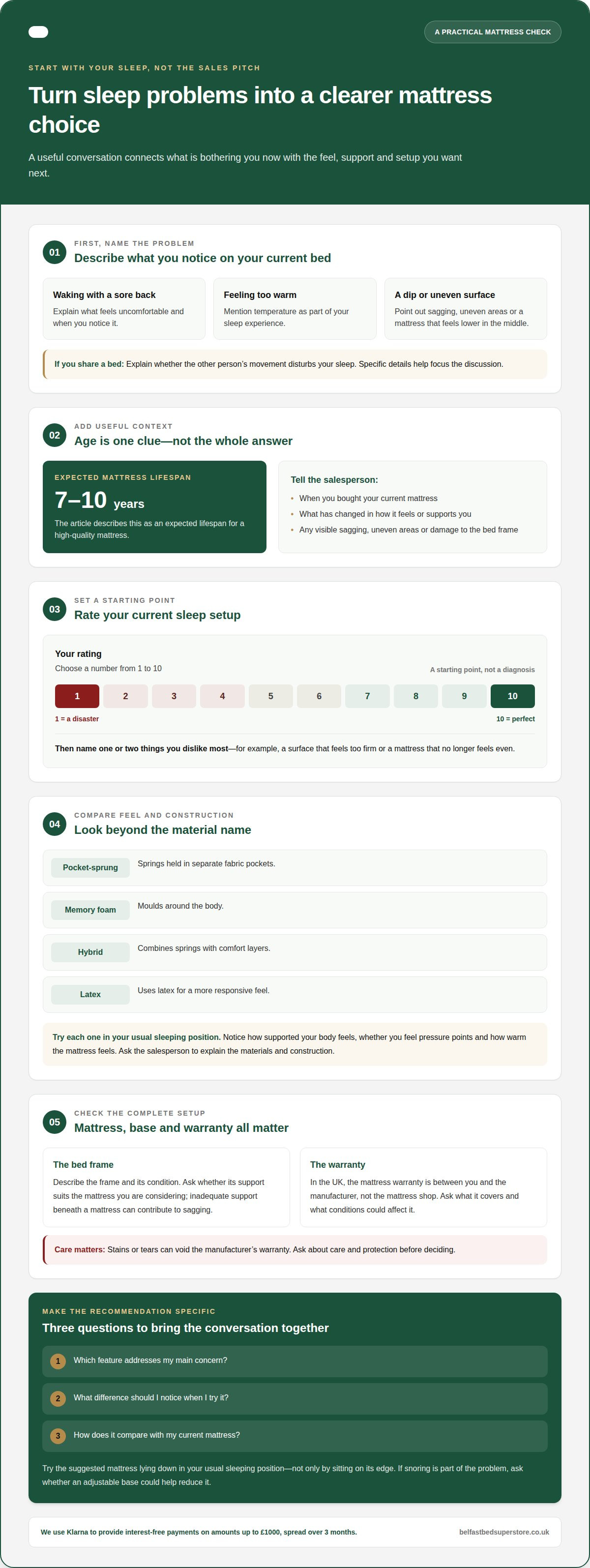
A useful conversation starts with what’s happening on your current mattress. Describe the problem clearly, such as waking with a sore back, feeling too warm or rolling towards a dip. These examples give the salesperson something specific to explore, rather than a general request for a “more comfortable” bed.
A high-quality mattress is expected to last between 7 and 10 years. Age is only one clue: visible sagging, uneven areas or a change in how supported you feel can also inform the decision. Mention when you bought the mattress and what has changed, so the salesperson can consider both its condition and your experience.
Put your current sleep experience into words before discussing alternatives. You might say, “I wake up feeling unrested,” or, “The middle of the mattress feels lower than the sides.” If you share a bed, explain whether the other person’s movement disturbs you. Specific details help distinguish between a comfort preference and a problem with the mattress or its support.
You can also rate your current sleep setup from 1, meaning a disaster, to 10, meaning perfect. The number gives you a starting point, not a diagnosis. Follow it with one or two things you dislike most, such as a surface that feels too firm or a mattress that no longer feels even. This keeps the conversation focused on what needs to change.
Ask what mattress features could address your concerns, and invite the salesperson to explain the trade-offs. If the mattress feels too firm, for example, describe whether you want a softer surface, a different level of support or both. Then try the suggested option in your usual sleeping position. A quick sit on the edge won’t tell you how it feels when lying down.
Bring up your bed frame, too. Inadequate support beneath a mattress can contribute to sagging, so describe the frame and any visible damage. Ask whether its support suits the mattress you’re considering. If the mattress has body impressions or uneven wear, ask how those conditions relate to its manufacturer’s warranty. Stains or tears can void that warranty, so ask about care and protection before deciding.
Make the next step specific: ask which feature addresses your main concern, what difference you should notice when trying it and how it compares with your current mattress. If snoring is part of the problem, ask whether an adjustable base could help reduce it. The answer should connect the option to your situation, not simply add another feature to the order.
4. Matching a mattress to sleeping needs and preferences
Pocket-sprung mattresses use springs held in separate fabric pockets; memory foam moulds around the body. Hybrid mattresses combine springs with comfort layers, while latex mattresses use latex for a more responsive feel. Ask what each construction feels like rather than choosing by material name alone.
To compare support, pressure relief and temperature, lie on each mattress in your usual sleeping position and notice how your body feels. Ask the salesperson to explain the materials and construction, then consider whether your body feels supported, pressure points feel comfortable and the surface feels too warm.
Start with who will sleep on the mattress, what size they need and why they’re replacing their bed. A mattress for one person may need different priorities from one shared by a couple. If two people are choosing together, both should try the options and describe what feels comfortable.
Your sleeping position gives the salesperson useful context. If you mainly sleep on your side, explain where you feel pressure, such as around your shoulder or hip. If you sleep on your back or front, describe how the mattress feels beneath your body. If you change positions overnight, say so rather than naming only the position you fall asleep in.
Be precise about comfort. “Soft” can mean a cushioned surface to one person and a lack of support to another. Describe the sensation you want instead, such as a gently yielding top with a stable feel beneath it. Ask the salesperson to show how a particular mattress meets that preference, then lie on it long enough to notice whether it suits you.
Compare materials by feel and construction, not by a single label. Ask whether the springs are pocketed, what comfort layers sit above them and how the mattress responds when you turn. On a hybrid, notice the interaction between spring support and cushioning. On memory foam or latex, pay attention to how quickly the surface responds as you move.
Give the conversation a practical structure. Try one option, describe the feel in a few words, then test another and identify what changed. For example, you might prefer the second mattress because its surface feels less cushioned or because turning feels easier. Those specific observations help narrow the choice without relying on selling language or brand names.
Ask the salesperson to connect the recommendation to your sleeping position and comfort priorities. If you share the bed, compare how each option feels to both sleepers. A suitable choice should make sense for the people using it, the positions they sleep in and the mattress feel they actually prefer.
5. Shopping elsewhere and comparing products
Comparing mattresses from different shops works best when you compare like with like. A familiar brand name alone doesn’t tell you whether two mattresses have similar construction, comfort layers or support. Note each model’s name and the details provided, then ask the salesperson to explain the differences. This gives you a clearer basis for choosing than relying on labels such as “medium” or “premium”.
Use the same comparison points for every mattress you try: construction, materials, firmness description, compatible base and your own comfort impression. If one option uses springs and another uses foam, ask how their construction affects the feel. Useful questions to ask a bed salesperson include how each mattress responds when you move and which features relate to your priorities.
Bring details of a mattress you tried elsewhere into the conversation. Share its model name, if you have it, and explain what appealed to you, such as a more cushioned surface or a firmer feel. Ask the salesperson to compare those features with the options available. If there’s no direct match, compare the characteristics that matter rather than expecting identical products.
Include the base in your comparison. Two mattresses can feel different because their construction varies, and the base beneath them matters too. Ask whether each mattress suits the frame you plan to use. If you’re keeping your current frame, describe it and ask how its support relates to the mattress choice. That helps you compare complete setups rather than mattress descriptions alone.
Read the warranty terms for each specific mattress. Ask who provides the warranty, what it covers and what care conditions or exclusions apply. For example, check how the terms address body impressions, stains or tears. A headline warranty period doesn’t explain every condition, so compare the written terms before deciding which option gives you the cover you expect.
Compare delivery and aftercare arrangements as well. Record what’s included, whether old-bed removal is part of the arrangement and how to raise a concern after purchase. Delivery terms may differ by postcode, so use the same address when comparing options. One of the most practical questions to ask a bed salesperson is what the full purchase arrangement covers for your specific choice.
Keep a short note for each model: its name, construction, base requirements, warranty terms and how it felt when you tried it. Add a personal observation, such as “comfortable on my side” or “too firm at the shoulder”. These notes make it easier to compare later without relying on memory. Choose the mattress that best fits your comfort priorities and the purchase terms that matter to you.
5. How do I choose the right mattress size in the UK?
Start by telling the salesperson what size you sleep on now. If you describe your current bed as full or queen, they may suggest a king. Treat that as a starting point for discussion, then consider who’ll use the bed, how much room you have and whether your existing bedding will fit.
Measure the bedroom space where the bed will sit, including room for drawers, doors and walking around the bed. Mark the intended position with removable tape to picture how much floor space the frame will occupy. A larger mattress may give sleepers more room, but it shouldn’t block a wardrobe or make the route to the door awkward.
Check the whole bed, not just the mattress label. A mattress and frame need to match in size, so ask the salesperson to confirm that the mattress fits the bedstead or divan you’re considering. If you’re keeping your current frame, use its stated size and check that the mattress sits correctly within it. Don’t assume a mattress will fit because its name sounds familiar.
Think about the people sharing the bed. If you and a partner both sleep there, describe whether either of you needs more space to move comfortably. If a child sometimes joins you, mention that too. The salesperson can use those details to discuss whether your current size suits everyday use, rather than relying only on the room’s appearance.
Room access matters as well. Before choosing a larger bed, consider the route from the entrance to the bedroom. Look at stair turns, narrow hallways and door openings, then ask how the mattress and frame will be brought into the room. A size that fits the bedroom may still be difficult to position if access is restricted.
Ask how the proposed size affects your existing bedding and bedroom furniture. For example, check whether your current sheets are made for the same mattress size and whether bedside tables will remain easy to reach. If you are planning a broader redesign, specialists like Bowkirk Kitchens & Bedrooms can help tailor fitted bedroom layouts around your new dimensions. If you’re replacing the frame as well, ask the salesperson to match the mattress and base measurements before finalising the order.
Make the decision by comparing three things: the space available, the people sleeping in the bed and the dimensions of the frame. Share those details during the conversation, then ask the salesperson to explain why the suggested size fits your room and routine. Discuss mattress size options with those practical details in mind before choosing.
Belfast Bed Superstore
Belfast Bed Superstore can help you put your mattress questions into practice when you’re ready to compare options. Bring the details that matter to you, such as your preferred feel, sleeping position, current mattress concerns and the size you need. That gives the conversation a useful starting point, whether you’re weighing up comfort, support or warranty terms.
Our range includes Hypnos, Sealy, Relyon and Dunlopillo mattresses, giving you different options to compare against your priorities. Ask us to explain how the mattresses you’re considering differ, then take time to decide which feels right for you. The best choice is the one that suits your needs, not simply the one with the most familiar name.
Contact Belfast Bed Superstore to talk through your mattress questions.
Make your next mattress conversation count
Choosing a mattress is a personal decision, and the next useful step is turning your notes into a focused conversation. Keep your priorities close: what you want to feel, what you’d like to change and which details still need a clear answer. The questions to ask a bed salesperson can help you stay centred on your needs, rather than feeling hurried by a long list of options.
At Belfast Bed Superstore, we offer mattresses from Hypnos, Sealy and Relyon. If you’d like help talking through your preferences and considering a mattress that could suit them, we’re here to make the next step feel straightforward.
Contact Belfast Bed Superstore to discuss your mattress needs. Take your time, ask what matters to you, and move towards a choice that feels right for your bedroom and your rest.
Frequently Asked Questions
What’s your warranty policy?
Warranty and guarantee terms depend on the specific mattress or bed, so there isn’t one blanket policy for every item. Before choosing, ask for the terms that apply to your selected model and request them in writing. Check how to make a claim, what proof of purchase is needed and whether the mattress must be used with a particular type of base.
Are you offering any sales right now?
Yes, the current promotion is 10% off all mattresses and divan sets. If you’re considering a particular item, ask whether it falls within the promotion and how the offer appears in your order details. You can then compare the final terms alongside the mattress features and delivery arrangements, rather than letting a discount alone decide which bed suits you.
What are your most popular mattresses?
Our mattress range includes Hypnos, Sealy, Relyon and Dunlopillo. Rather than choosing by popularity alone, tell us what feel and support you’re looking for, then compare suitable options in person at our Cambridge showroom. A model that suits one sleeper may not suit another, so consider how each mattress feels in your usual sleeping position and how it fits your bed frame.
What sleep accessories best complement my mattress?
A mattress protector and a comfortable pillow are useful accessories to consider. We offer mattress protectors, memory foam pillows and latex pillows. Think about what you want to add: a protector helps shield the mattress surface, while a pillow affects the feel beneath your head and neck. Ask how each option pairs with your mattress and choose based on your comfort preferences.
What mattress firmness is best for my sleeping position and body weight?
There’s no single firmness that’s best for everyone with the same sleeping position or body weight. Use those details as a starting point, then compare how different mattresses feel when you lie in your usual position. Tell the salesperson whether a surface feels too firm, too soft or comfortable, and discuss the support you prefer before settling on a firmness.
What is included in the bed price, such as delivery, assembly and old mattress removal?
Check the order breakdown to see which items and services are included in the quoted total. Ask for delivery, assembly and old mattress removal to be shown separately, so you can see what applies to your chosen bed and address. Also clarify whether the price covers the mattress, base and any selected extras. This makes it easier to compare complete orders.
What warranty covers the mattress and bed frame, and what exclusions apply?
The mattress and frame may have separate warranty or guarantee terms, so ask for the paperwork for both parts of the bed. Check the cover period, the claim process and whether the terms depend on the mattress being paired with a suitable base. Ask which situations are excluded, including damage or care issues, and keep the documents with your purchase record.


