

A mattress doesn’t have to end its life in landfill. What happens to recycled mattresses depends on their materials: steel springs can be made into new metal products, while foam may be processed into carpet underlay or sent for energy recovery. In landfill, a mattress can take up to 90 years to decompose.
It’s natural to wonder whether a worn mattress can really be put to use again. The answer is that recycling can give some of its materials another purpose, although covers and other low-grade fabrics can be harder to recycle.
Here, we’ll explain where recycled mattresses go, how facilities dismantle and process them, and what happens to steel springs, foam and fabric. You’ll also learn how specialist mattress recycling works and what to consider when arranging for an old mattress to be collected.
Key Takeaways
- Recycling can recover materials such as steel, foam and textiles, though the mattress’s condition and material mix affect what can be reused.
- Find out how dismantling separates mattress components and prepares them for reprocessing into new products.
- A mattress can take up to 90 years to decompose in landfill, making responsible disposal an important choice.
- Learn what happens to steel springs after removal and how specialist recycling can give mattress materials another use.
- We use Klarna to provide interest free payments on amounts up to £1000, spread over 3 months.
Where Do Mattresses Go When You Recycle Them?
Collected mattresses are taken to a recycling facility, where workers separate materials for reuse, recycling or energy recovery. The destination depends on the mattress’s construction, condition and the quality of its components.
Recovery of Mattress Materials
At a facility, workers separate steel springs, foam, textiles, fabric and any recoverable wood. Clean steel and foam blocks may have resale value, while suitable materials can be prepared for reprocessors. The key difference is whether components are clean and separable or mixed with materials that limit their next use.
A mattress in good condition may be donated to a charity that accepts mattress donations. Reuse keeps the whole item in service instead of breaking it down into separate materials.
Shredding and Incinerating Materials
Fabric and foam don’t always have a practical route into new products. Low-grade fabric can be shredded and processed into refuse-derived fuel for energy-from-waste facilities. This recovers energy, but it isn’t the same as recycling fabric into a new material.
Foam may also go to energy recovery when its condition or composition makes reuse unsuitable. Some mattress materials are recycled into usable products, while other fractions are sent for energy recovery. The exact outcome depends on the material streams a facility can separate and process.
Reusing Foam and Memory Foam
Suitable foam is separated from other mattress layers, then reprocessed for another use. Foam and memory foam can be re-crumbed into smaller pieces and made into carpet underlay or pet beds. Clean foam blocks may also be sold for reuse, depending on their condition.
This route gives foam a practical second life without turning it back into a complete mattress. Polyester wadding may also be reprocessed for manufacturing, including as filling for pet cushions.
Recycling Potential and Component Reuse
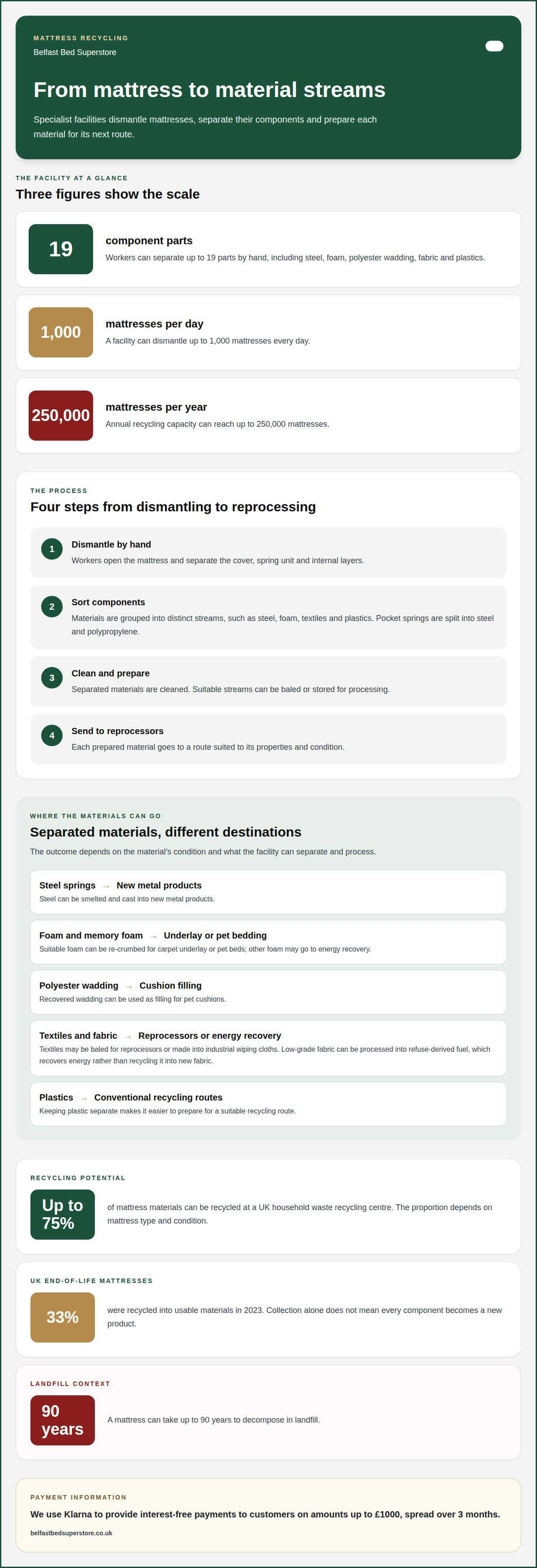
Up to 75% of mattress materials can be recycled at a UK household waste recycling centre. The proportion depends on mattress type and condition; some mattresses may be fully recyclable. In 2023, 33% of end-of-life mattresses in the UK were recycled into usable materials, showing that collection alone doesn’t mean every component becomes a new product.
Steel springs can be melted and cast into new metal products. Textiles may be baled for reprocessors, shredded into mattress components or made into industrial wiping cloths. Recovered plastics can enter conventional recycling routes, while wood may be separated if the mattress design contains recoverable wooden parts.
Additional materials can also be recovered when they are successfully separated for reuse or recycling. Foam has more than one possible destination: it may be sent to a waste-to-energy plant, or cleaned and reused to manufacture industrial carpet underlay. These routes depend on the material’s handling, with energy recovery providing an alternative to putting that fraction in landfill. At advanced facilities like those associated with Belfast Bed Superstore, a high percentage of mattress materials are diverted from landfill through careful recycling and energy recovery processes.
How mattresses are dismantled and their materials processed
At a specialist recycling facility, each mattress is dismantled so its materials can be sorted into separate streams. Workers take mattresses apart by hand, separating up to 19 component parts. This approach helps distinguish materials such as steel, foam, polyester wadding, fabric and plastics, which need different processing routes. A facility can dismantle up to 1,000 mattresses every day and recycle up to 250,000 mattresses a year.
The order of work matters. Removing the outer layers exposes internal components, which can then be separated and sorted. Pocket springs, for example, are split into steel and polypropylene. Keeping these materials apart makes it easier to prepare each type for suitable reprocessing, rather than sending a mixed assembly onwards.
- Dismantle by hand: Workers open the mattress and separate its cover, spring unit and internal layers.
- Sort components: Materials are grouped into distinct types, including steel, foam, textiles and plastics.
- Clean and prepare: Separated materials are cleaned, then suitable streams are baled or stored for processing.
- Send to reprocessors: Each prepared material goes to a route suited to its properties and condition.
Cleaning and preparation help make separated materials useful to the next processor. Steel and textiles can be baled for reprocessors, while plastics may enter conventional recycling routes. Baling compacts materials for transport and keeps each material stream together instead of mixing it with other mattress components.
After sorting, materials can become different products. Steel can be smelted into new metal products, while polyester wadding can be used as filling for pet cushions. Foam and memory foam can be re-crumbed for carpet underlay or pet bedding. Recovered materials may also be used in car upholstery, insulation and furniture padding.
Not every component becomes a new product. Mattress fabrics may be shredded into new mattress components or turned into industrial wiping cloths. Low-grade fabric can instead be processed into refuse-derived fuel for energy-from-waste facilities. That route recovers energy rather than recycling the fabric into another material.
These different routes explain why dismantling is more than simply shredding a whole mattress. Separating components first allows each stream to be assessed and prepared for its next destination. The result may include new metal products, foam-based goods and recovered textiles, alongside material sent for energy recovery. Sorting determines which route each component can take.
to energy from waste. Mattresses collected from Greater Manchester recycling centres are delivered to The Furniture Recycling Group in Bolton for dismantling. This can involve separating component materials and compacting them into bales for transport to recycling destinations. Steel, polyester, cotton and wool can be sorted, pre-treated and stored for manufacturing products including insulation, underlay and furniture padding.
Foam and memory foam can be re-crumbed and processed into carpet underlay or items such as pet beds. Recycled mattress materials can also be used to make new mattresses, pet bedding, car upholstery, carpet underlay and stab-proof vests. At the Greater Manchester mattress recycling facility, the remaining 5% of mattress materials go to energy from waste.
How long mattresses take to decompose in landfill
A mattress can take up to 90 years to decompose in landfill. That long timescale matters because a mattress is made from different materials, including steel, foam, textiles and sometimes wood. These parts don’t break down together, and some remain intact long after others have changed.
The 90-year figure is an upper estimate, not a guaranteed timetable for every mattress. Construction affects how the whole item changes: a spring mattress contains metal coils, while a foam mattress has a different material mix. Landfill conditions also influence decomposition, so there isn’t one exact date when every discarded mattress disappears.
Steel illustrates the difference between decomposition and persistence. Springs don’t break down like natural fibres, and their metal can remain in landfill. Foam and synthetic textiles also don’t readily return to natural materials. A mattress therefore takes up space while its components change at different rates.
Recycling changes the route for usable components. Instead of burying steel, foam or textiles, a facility can separate materials and send suitable fractions for processing. Recovered steel can become new metal products, while foam can be reprocessed for uses such as carpet underlay. Material recovery preserves useful resources and reduces the amount sent to landfill.
What are the environmental impacts of mattress recycling versus landfill? Recycling can recover materials for new products, while landfill leaves the mattress and its separate components to break down over time. The practical difference is whether usable steel, foam and textiles are recovered or buried.
Not every mattress component has a material-recycling route. Covers and low-grade fabrics can be difficult to recycle because contamination varies and suitable end markets are limited. In some cases, low-grade fabric is processed into refuse-derived fuel for energy-from-waste facilities. This recovers energy rather than making new fabric.
What happens to mattresses that cannot be recycled? Components unsuitable for material recycling can be sent for energy recovery, including through energy-from-waste processing. If a mattress or its remaining materials have no suitable recovery route, they can end up in landfill, where decomposition can take up to 90 years.
To understand the difference, follow each component’s route after collection. A mattress labelled for recycling might still have some materials sent for energy recovery rather than made into products. In the UK, 56% of end-of-life mattresses were sent for recycling in 2023, while 33% were recycled into usable materials. Those figures describe distinct stages, so collection for recycling doesn’t mean every part becomes a new material.
Choosing a route that recovers components helps keep useful materials in circulation. Landfill can leave a mixed mattress in place for decades, with steel, foam and fabric decomposing at different rates. Separating materials before disposal makes their destination clearer and gives suitable components another use.
Recycling steel springs
Steel springs are one of the clearest materials to recover from an old mattress. During dismantling, workers separate the metal from foam, fabric and other components. This keeps steel from being mixed with materials that follow different processing routes. Separated springs can then be prepared for reprocessors, rather than treated as part of the mattress as a whole.
The design affects how the metal is separated. A traditional open-coil mattress contains connected springs, while a pocket-spring mattress has individual springs enclosed in fabric pockets. In pocket-spring mattresses, the springs are separated into steel and polypropylene. That split matters because each material needs its own recycling route.
Once recovered, steel springs can be baled for transport or sold as a separated material. At a reprocessor, the steel can be melted and cast into new light iron products. More broadly, steel from mattress springs can be smelted into new metal products. The old spring therefore becomes source material, not a spring ready to return unchanged to another mattress.
Steel’s resale value can also support recovery. Clean, separated steel is easier to handle as a distinct stream than metal still attached to fabric or foam. Facilities dismantle mattresses and sort components before baling steel for reprocessors. Keeping the material separate helps direct it towards metal processing instead of energy recovery or landfill.
The spring assembly is only one part of the mattress. A pocket-spring unit may include polypropylene alongside steel, while surrounding upholstery can contain foam and textiles. Those materials must be separated from the metal. Foam may be re-crumbed for carpet underlay or pet beds, and textiles may be baled for reprocessors. Sorting keeps the spring’s destination distinct from the routes for other components.
Recycling steel doesn’t mean every metal part has the same destination or processing. The recovered material is melted and formed into products, while other mattress fractions are assessed separately. That distinction helps explain how one discarded mattress can feed several manufacturing streams, including new metal products, underlay and furniture padding.
For readers asking what happens to recycled mattress springs, the sequence is straightforward: separation, sorting, preparation for reprocessing, then melting and casting. The final product is a new metal item, such as a light iron product. Recovering steel gives a durable mattress component a route back into manufacturing, while the foam, fabric and plastics follow their own material pathways.
Specialist mattress recycling services
A specialist service collects mattresses for dismantling and material recovery. Unlike general disposal, this route separates usable components, such as steel, foam and textiles, before sending them to reprocessors. UK specialist mattress recycling is listed as diverting 75-90% of mattresses from landfill, though the outcome depends on the facility and materials recovered.
Council arrangements differ by area; collection may take 1-2 weeks and require the mattress to be left outside.
Before collection, the mattress needs to be dry, sanitary and hygienic. A wet or soiled mattress can be refused because its condition affects safe handling and material recovery. Keeping it dry before collection helps preserve the possibility of processing its components.
After collection, the facility separates the mattress into material streams. Steel springs can be prepared for metal reprocessing, while suitable foam can be re-crumbed for products such as carpet underlay. Textiles may be baled for reprocessors, but low-grade fabric can instead go to energy recovery.
The recycling outcome depends on more than the collection label. The mattress’s condition, construction and separability influence which materials can be recovered. Specialist recyclers may give over 85% of a mattress a second life, while UK specialist services are listed as diverting 75-90% from landfill. These figures describe different measures, so they shouldn’t be treated as interchangeable.
When considering a collection service, focus on what happens after pickup. The useful distinction is whether materials are reused, recycled into products or sent for energy recovery. Material recycling gives steel, foam and textiles a manufacturing route; energy recovery uses some unsuitable material as fuel instead.
Recycling centres offer another route when you can transport the mattress. A UK household waste recycling centre can recycle up to 75% of mattress materials. If collection is more practical, council bulky-waste services provide a local option, with arrangements and charges varying between areas.
The National Bed Federation set a target of diverting 75% of UK end-of-life mattresses from landfill by 2028. Specialist collection supports material recovery, but the destination of each component still depends on its condition and processing route. The clearest takeaway is to choose a route that separates materials for recycling wherever possible.
Belfast Bed Superstore: Hypnos Mattresses
Belfast Bed Superstore can help when you’re ready to replace an old mattress and choose a new one. Our range includes Hypnos Mattresses, alongside Sealy, Relyon and Dunlopillo mattresses.
Think about the comfort and support you want from your next mattress, then explore the brands available. Choosing a replacement is separate from arranging recycling, but considering both helps you plan the changeover and decide where your old mattress will go.
If you’re weighing up which mattress may suit your bedroom and preferred feel, contact Belfast Bed Superstore. We’re happy to help you explore the available options.
Choose your next step with confidence
Knowing what happens to recycled mattresses can help you plan a more thoughtful replacement. Decide how you’ll handle your old mattress, then focus on choosing a new one that feels comfortable and supportive for your sleep. A considered change can make the bedroom feel ready for a fresh start.
Belfast Bed Superstore offers Hypnos, Sealy and Relyon mattresses, giving you recognised options to explore as you make that choice. We also use Klarna to provide interest free payments on amounts up to £1000, spread over 3 months.
If you’re ready to discuss your next mattress, contact Belfast Bed Superstore today. We’ll be glad to help you take the next step towards a more comfortable night’s rest.
Frequently Asked Questions
What happens to a mattress at a recycling facility in the UK?
A mattress is dismantled so its parts can be directed into separate recovery streams. For example, a facility may separate the outer cover, spring unit and foam layers before preparing suitable materials for reprocessing. Components that can’t be turned into new materials may go to energy recovery. This means “recycled” can describe a collection route, even when not every part becomes a new product.
Which materials are recovered from recycled mattresses?
Commonly recovered materials include steel, foam, polyester wadding, textiles and plastics. Their next use depends on their condition and how cleanly they can be separated. For example, a pocket-spring unit contains steel springs and polypropylene, which need separate routes. Suitable foam may be processed for another use, while some low-grade fabric is directed to energy recovery instead of material recycling.
How can I recycle a mattress through my local council?
Use your council’s bulky-waste collection process or take the mattress to a household waste recycling centre that accepts them. Council arrangements vary: some collect from outside the property, while others may direct residents to a recycling centre. Keep the mattress dry and hygienic before collection, as a wet or soiled item can be refused. Follow the council’s instructions for preparing it for collection.
Do UK mattress retailers offer take-back or recycling schemes?
Yes. Four of the top five UK mattress retailers offer take-back schemes, although the arrangements differ between retailers. A take-back option can make it easier to handle an old mattress when replacing it. Before choosing that route, check whether the scheme collects the old mattress or requires you to bring it in, and what happens to the mattress after collection.


