

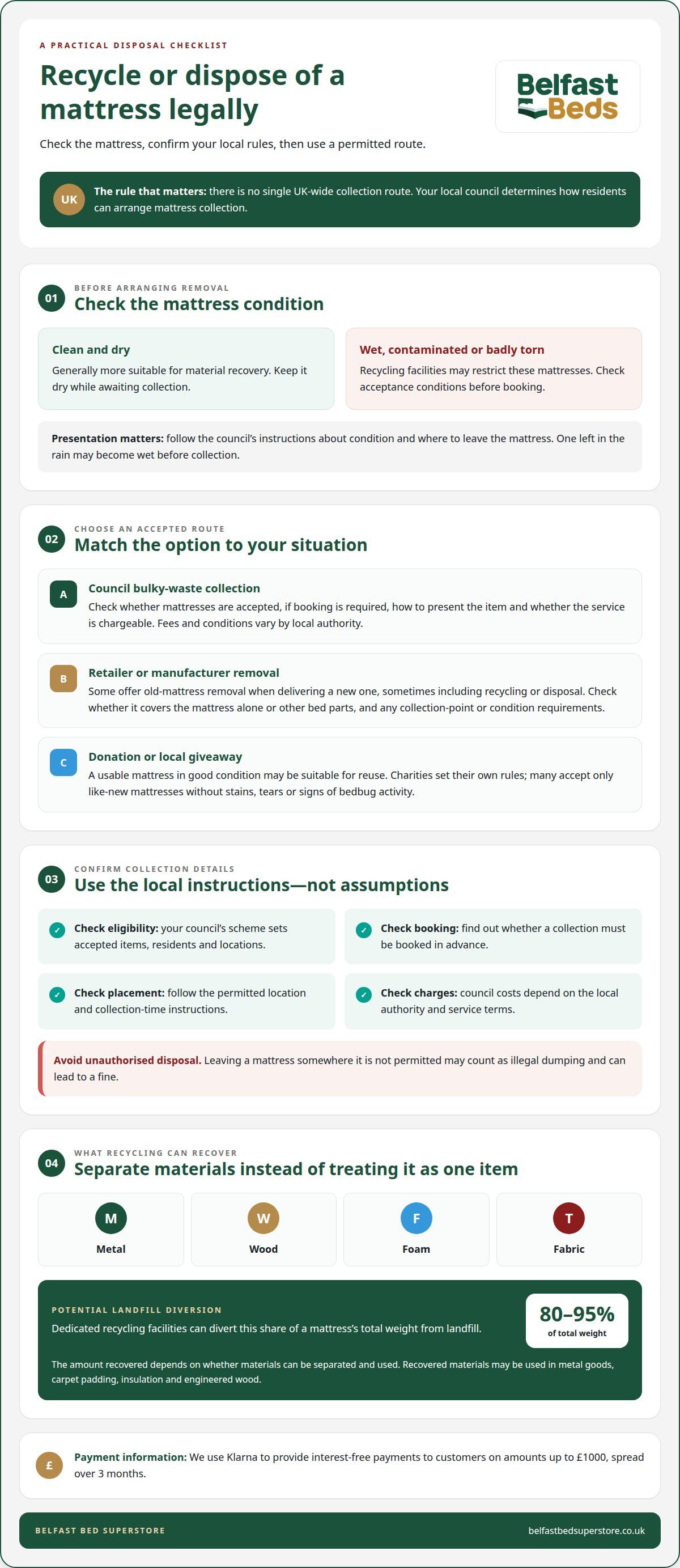
The household bin isn’t always a lawful route for an old mattress. Whether it can be collected with ordinary rubbish depends on your local council’s rules, and leaving it somewhere unauthorised may lead to a fine. Disposing of a mattress legally means using a collection or disposal route permitted in your area.
It’s understandable to want an old mattress gone quickly, especially when it’s taking up space. But putting it out without checking the rules can cause problems if it is treated as dumped waste.
This guide explains how council collections and recycling options work, what to consider before donating a mattress, and why disposal rules differ across the UK. It also covers when a retailer’s old-bed removal service can help you clear space with less guesswork.
Key Takeaways
- Putting a mattress out with ordinary rubbish isn’t automatically allowed; local council collection rules determine the permitted route.
- Check how your council handles bulky-item collections, including booking requirements and rules for leaving a mattress outside.
- A mattress in good condition may be suitable for donation, but organisations can set their own acceptance requirements.
- Leaving a mattress where it isn’t permitted can count as illegal dumping and may result in a fine.
- If you’re replacing your mattress, an old-bed removal service may offer a practical way to arrange disposal alongside the new purchase.
Municipal mattress collection and recycling
Mattresses can be recycled in the UK, with their materials separated for recovery. Recycling facilities can break them down into metal, wood, foam and fabric rather than treating the whole mattress as one waste item.
A council’s bulky-waste collection and a specialist recycling facility are different parts of the process. Collection rules determine how a mattress enters the system; the facility then assesses and separates its materials.
Mattress Damage and Recycling Restrictions
A mattress’s condition matters because recycling facilities may restrict what they accept, particularly if it is wet, contaminated or badly torn. A clean, dry mattress is generally more suitable for material recovery than one affected by moisture or contamination.
Before booking a collection, check the council’s requirements for the mattress’s condition and presentation. For example, a mattress left out in the rain may become wet before collection, making it harder to handle or process. Keep it dry and follow the collection instructions rather than assuming every damaged mattress will be recycled.
Recycling Materials and Landfill Diversion
Recycling separates materials such as metal, wood, foam and fabric so they can be considered for reuse. Recovered materials may be used in products such as metal goods, carpet padding, insulation and engineered wood.
Dedicated recycling facilities can divert 80-95% of a mattress’s total weight from landfill. The amount recovered depends on whether materials can be separated and used, which is one reason condition and sorting matter. Recycling therefore offers a route to recover useful components instead of sending the entire mattress to landfill.
Local collection schemes can connect households with recycling, but each council determines how residents access them. Some offer bulky-item collections for mattresses, with rules about eligible items and how to present them. Check the council’s collection information for booking requirements, condition rules and where to leave the mattress.
Funding and contracts shape how a collection programme operates. A grant can support a defined waste or recycling activity, while a contract sets out collection or processing work arranged by an authority. Neither determines the household’s collection rules. The practical question is whether your local scheme accepts mattresses and how collection is organised.
The phrase “mattress recycling council” may appear in information about recycling programmes, but it doesn’t refer to a UK-wide collection service. UK households follow the rules set by their local councils and authorities, not US-style state requirements. Check your local authority’s mattress instructions and use the route it provides.
Local mattress collection requirements
Local collection rules determine how residents can arrange mattress removal, whether through a council bulky-item service or a retailer. Booking, accepted condition and charges depend on the local service and the route you choose.
Local Collection Programmes
A local mattress collection programme is a council or municipal service for removing bulky household items. Some councils offer special mattress collections, with restrictions residents need to follow.
Start with your council’s bulky-waste information and look for mattress-specific instructions. Check whether you need to book, how to present the mattress and whether it must be dry or undamaged. An item left in the wrong place or outside the permitted time may not be collected, so follow the council’s arrangements.
Eligibility for a collection trailer is set by the scheme operating it, not by a UK-wide rule. If your council uses a trailer, its programme determines which residents and items qualify. Read the local conditions before arranging a drop-off or collection, particularly if the scheme limits accepted items or locations.
Collection Costs and No-Charge Options
Council mattress collection charges vary by local authority and service terms. There is no single UK-wide fee, so check your council’s bulky-waste information to find out whether collection is chargeable.
Some retailers and manufacturers offer old-mattress removal when delivering a new one, sometimes with recycling or disposal included. Whether it is free depends on the offer’s terms, so compare the removal conditions with your council’s service before choosing.
Check what the collection covers, such as a mattress alone or additional bed parts, and whether the item must be left at a particular collection point. These details affect how useful the service is. Keep the mattress accessible and meet the stated condition requirements.
Donation and Giving Away Usable Mattresses
A usable mattress in relatively good condition may be suitable for donation or a local giveaway. This can extend its use, but each charity sets its own acceptance requirements.
Many charities accept mattresses only if they are like new, without stains, tears or signs of bedbug activity. Describe the condition honestly when offering one to a charity or local community group. For a private giveaway, agree on collection arrangements directly and follow local rules for used mattress sales.
Consider the mattress’s condition before arranging collection. A clean, intact item may be suitable for reuse, while a damaged one may need a different route. Check the council’s restrictions or the retailer’s collection terms first to help avoid a failed pickup.
Federal, state and local mattress disposal rules
Businesses and landlords should arrange collection through a service that accepts mattresses from commercial or property-clearance work. Ask the relevant council’s waste-management department about its service scope, accepted items and transport arrangements.
US federal and state rules do not determine UK requirements. For a UK property, start with your local authority’s guidance and the terms of the service handling the mattress.
Who is arranging the removal?
The right disposal route may depend on whether a mattress comes from a household, rental property or business premises. A landlord clearing a furnished flat, for example, should explain that the mattress is from a property clearance. A hotel replacing guest-room mattresses should state that the items come from business premises.
This distinction matters because council household bulky-waste services may have specific eligibility rules. Don’t assume a service that accepts one resident’s mattress will also take several from a landlord or business. Ask about the source and number of items, collection location, condition requirements and permitted presentation.
Collection, waste management and transportation
Waste management covers the practical journey from removal to the mattress’s destination. Before booking, establish who will collect it, where it must be placed and whether the service accepts mattresses for recycling or disposal. A collection from a block of flats, for example, may require access details and a clear collection point.
Transport is part of the arrangement. Protect the mattress from rain and avoid leaving it in a shared access route while waiting for collection. If the service specifies a handover point, follow those instructions rather than placing the item on a public pavement or beside household bins.
Information to keep with the booking
A clear record helps a business or landlord track what happened to removed items. Keep the booking details, collection date and any receipt or transfer paperwork supplied by the service. For a rental property, note which mattress was removed and from which address. For a business, record the premises and collection arrangement.
These records can help resolve practical problems, such as a missed collection or an item refused because its condition falls outside the service terms. Describe any visible damage or contamination accurately when arranging pickup. If the service won’t accept the mattress, ask the council’s waste-management department which route applies.
The relevant rules are local, not US examples such as state recycling mandates. A UK council service may set its own booking, access and acceptance conditions, while a business collection may have separate terms. Read the applicable instructions before setting the mattress out, and make clear whether it is household, rental-property or business waste.
Illegal dumping and potential fines
Leaving a mattress somewhere it isn’t authorised can count as illegal dumping. It may harm the environment and result in a fine. For example, leaving an unwanted mattress beside shared bins doesn’t make it an accepted council pickup. What matters is whether the location and collection method are permitted, not whether the mattress is old or unusable.
There is no single UK-wide fine for every case of mattress dumping. The rules and consequences depend on the location and circumstances, so don’t rely on a figure from another country or council area. A US state’s penalty, for example, does not tell a UK resident what applies locally. Use an authorised collection or disposal route.
Consider what happens between setting out the mattress and its collection. A booked council pickup may specify a collection date and a particular place for bulky items. Putting the mattress out earlier or somewhere else can create a separate problem: it may be treated as abandoned rather than awaiting collection. Follow the instructions for your actual booking.
Keep a record of your collection arrangements to avoid confusion. Save the council booking confirmation, note the collection date and follow placement instructions. If the collection is missed, don’t move the mattress to a nearby pavement or facilities area without permission. Contact the council department responsible for the booking and follow its guidance.
Dumping a mattress rather than using an appropriate waste route can harm the environment. Recycling facilities may recover materials such as metal, wood, foam and fabric, while sending a mattress to landfill loses that opportunity. Not every mattress will be accepted for recycling, however: its condition and local collection terms may affect the route.
Landlords and businesses should record which property or premises the mattress came from and who arranged its removal. A written collection arrangement helps distinguish a booked pickup from an item left without permission. If you’re replacing one mattress at home, keep it inside until the agreed collection point and time are clear. These steps help avoid an unauthorised drop and make the disposal route easier to explain if questions arise.
Before setting out a mattress, confirm the collection route, date, accepted condition and placement instructions. If the council service doesn’t cover the item, arrange another lawful disposal route instead of leaving it beside bins or on public land. Don’t assume a mattress will be taken simply because it is visible to a collection crew.
How can I dispose of a mattress legally in the UK?
Choose a disposal route accepted by your local council or collection service. The right option depends on the mattress’s condition, whether it can be reused and the collection arrangements available where you live.
Start with your council’s bulky-waste guidance. Check the instructions for mattress bookings, accepted items, presentation and collection points. Some councils offer special bulky-item collections, but restrictions vary. Keep the mattress at home until you know the agreed pickup arrangements. Leaving it beside bins or on a pavement without an authorised collection may be treated as dumping.
If the mattress is clean and in good condition, consider reuse before disposal. Charities may accept mattresses that are like new and free from stains, tears or signs of bedbug activity. Each organisation sets its own requirements, so describe the condition honestly. If a charity declines it, a council collection may offer another permitted route.
You can also offer a usable mattress through a local community group or private giveaway. Clearly describe its condition, including any visible wear or damage, and agree on collection arrangements. Follow local rules for used mattress sales if you ask for payment. Reuse works best when the next household can make an informed decision.
If the mattress isn’t suitable for reuse, look for a local collection or recycling option. Some councils provide bulky-item collection, while recycling facilities may separate materials for recovery. Check whether the service accepts the mattress in its current condition and whether you need to book. Keep it dry and follow instructions on where and when to leave it.
Some retailers and manufacturers offer old-mattress removal when delivering a new mattress, with collection for recycling or disposal. Read the offer’s terms to understand what is collected and how to present it. This can make replacing a mattress easier, but don’t assume collection is included with every purchase.
Keep a record of the route you choose. Save a council booking confirmation or retailer collection details, and note the agreed date and handover point. If a service can’t take the mattress, arrange another accepted option instead of leaving it outside. These checks help prevent an unauthorised drop and make disposing of a mattress legally a more straightforward part of clearing your bedroom.
If a new mattress is part of your plan, explore mattress options and old-bed removal as part of arranging the replacement.
Belfast Bed Superstore: Hypnos Mattresses
Belfast Bed Superstore can help when you’re replacing an old mattress and choosing a new one. Its range includes Hypnos, Sealy, Relyon and Dunlopillo mattresses, and old-bed removal is available as an additional service.
Arranging removal alongside a replacement can make clearing your bedroom simpler. For purchases up to £1000, we use Klarna to provide interest free payments spread over 3 months.
If you’re considering a new mattress, explore the available options and plan how removal fits into your disposal arrangements. Contact Belfast Bed Superstore to discuss your next step.
Make your next bedroom change with confidence
Choosing a replacement is a chance to consider more than the mattress alone. Think about the comfort you want and how a new mattress will work with your existing bed. Planning the disposal of your old mattress at the same time can make the transition easier. If upgrading your bedroom is part of a larger property makeover, credit brokers such as I Need Cash can help homeowners explore finance options to support home improvements.
Belfast Bed Superstore offers Hypnos, Sealy and Relyon mattresses. Exploring these options can help you focus on the comfort and support you want from your next mattress.
Once you’ve chosen a replacement, arrange an authorised route for the old mattress before setting it outside. That way, disposing of a mattress legally becomes part of a considered bedroom update rather than a last-minute task.
For help with your next mattress choice, contact Belfast Bed Superstore today. A fresh start for your bedroom can begin with a simple, well-planned decision.
Frequently Asked Questions
Can I be fined for putting a mattress in regular trash?
You may face a fine if leaving a mattress with ordinary rubbish breaches local rules or is treated as illegal dumping. The outcome depends on where it is left and whether an authorised collection was arranged. A council bulky-waste booking, for example, doesn’t necessarily allow you to put the mattress out before the collection instructions say to. Use the council’s accepted route and keep your booking details.
Are Mattress Disposal Laws Federal or State?
Federal and state law are not the right framework for UK mattress disposal. Those terms describe levels of government in the United States; UK residents should follow the requirements and collection arrangements in their local area. Don’t treat advice about a US state’s mattress-recycling scheme as a UK rule. For a UK address, start with the local council’s waste and recycling information.
How do I find a mattress recycling facility near me?
Start with your council’s recycling or waste-management department and look for mattress recycling or bulky-waste information. Find out whether it lists a local facility, collection point or council-arranged route that accepts mattresses. Before travelling, check what condition the facility accepts and whether it handles household mattresses. A centre’s general recycling service, for example, doesn’t mean it accepts every bulky item.
Is it illegal to throw away a mattress in any state?
“State” refers to the United States, not the UK, so state-by-state rules do not explain what applies to a UK household. Disposal arrangements and restrictions can vary by local authority. Putting a mattress out with ordinary rubbish isn’t automatically permitted. Check your council’s rules and use a collection or disposal route it allows.
What Happens If You Dump a Mattress Illegally?
Illegal mattress dumping can harm the environment and may result in a fine. The consequences depend on the location and circumstances, so there is no single figure for the whole UK. A mattress left beside a road or communal bins without an authorised collection may be treated differently from one presented for a booked service. Keep evidence of the arrangement and follow its placement instructions.
What should I do before taking my mattress to a recycling centre?
Before travelling, check that the centre accepts mattresses and read its condition and drop-off requirements. Keep the mattress dry and describe any significant damage or contamination accurately when making enquiries. A wet mattress, for example, may not meet a facility’s acceptance conditions. Check the centre’s information for the right entrance or drop-off point, and plan transport that keeps the mattress secure.
Can my local council collect a mattress as bulky waste, and how do I book it?
Some UK councils collect mattresses as bulky waste, but each authority sets its own service terms. Find the bulky-item collection section on your council’s website or contact its waste department. Check whether mattress collection is available at your address, how to book, what condition is accepted and where to leave the item. Keep the booking confirmation as a record of the agreed arrangements.
Where can I take an old mattress to a household waste recycling centre?
Your council’s household waste recycling centre information lists local sites and accepted items. Don’t assume every centre takes mattresses or that household access rules are the same across council areas. Check the relevant centre’s guidance before travelling, including any condition or drop-off restrictions. If it won’t accept your mattress, use the council’s bulky-waste information to find another permitted route.


