
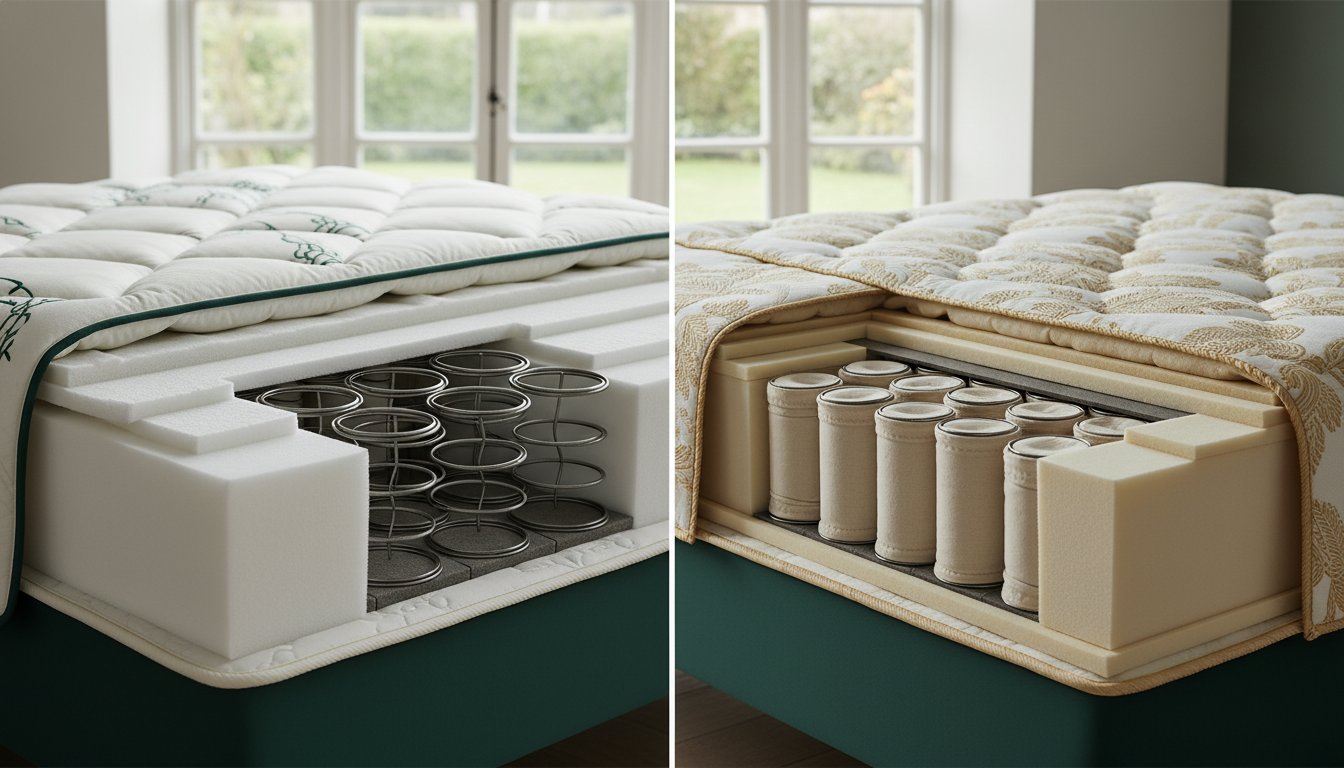
What if the reason you're waking up with a stiff lower back has nothing to do with your pillow and everything to do with a single continuous wire beneath you? It's a common frustration we hear from our neighbors. You want a bed that feels like a sanctuary, but instead, you're stuck deciphering technical jargon like wire gauge and spring counts while feeling every single move your partner makes. We understand that you just want to wake up feeling refreshed and ready for the day.
In this guide, we'll help you settle the pocket sprung vs open coil mattress debate so you can choose the right support for your unique sleep style. You'll discover the technical and comfort differences that lead to a truly pain-free morning and undisturbed sleep. We'll look at the benefits of each construction type, from the traditional bounce of coils to the bespoke alignment of pocket springs. By the end, you'll have the confidence to select a high-quality mattress from trusted names like Sealy, Hypnos, or Highgrove that will serve you well for the next decade. Let's get you back to the restful, restorative sleep you deserve.
Key Takeaways
- Understand the fundamental difference between traditional interconnected coils and individually wrapped fabric pockets to better support your body.
- Discover how to eliminate partner disturbance by choosing a system that isolates motion rather than creating a bouncy trampoline effect.
- Compare the long-term value of a pocket sprung vs open coil mattress to see why a quality investment can offer up to ten years of restorative rest.
- Learn how to match the right spring type to your specific needs, whether you're furnishing a guest room or upgrading your master suite for daily use.
- Explore why premium craftsmanship from brands like Hypnos provides the tailored spinal alignment necessary for your long-term health and comfort.
Understanding the Basics: What are Open Coil and Pocket Sprung Mattresses?
Choosing a new bed should be an exciting step toward better health, but we know it often feels like a technical exam. When you're browsing our range, you'll primarily see two types of internal support. An open coil mattress is the traditional choice, featuring a network of interconnected springs. In contrast, a pocket sprung mattress uses individual springs, each sewn into its own fabric nest. Understanding the pocket sprung vs open coil mattress differences helps you avoid buying a bed that doesn't fit your lifestyle.
The fundamental difference in the pocket sprung vs open coil mattress debate comes down to how the springs interact. In an open coil system, the springs are linked together by a wire frame; when one moves, they all move. Pocket springs act independently, reacting only to the weight placed directly on them. Both are valid choices for your home. You might find an open coil perfect for a guest room, while a pocket sprung system is often the better investment for your master bedroom where you sleep every night.
The Anatomy of an Open Coil System
Open coil systems, often called Bonnell springs, are the industry's long-standing standard for reliable support. These mattresses feature a series of hourglass-shaped springs joined together by a continuous wire. One of the biggest factors in how these feel is the "gauge" of the wire:
- 12.5 gauge: A thicker wire that provides a very firm, supportive feel.
- 13.5 gauge: A thinner wire that offers a slightly softer response.
Because the entire unit is one piece, these mattresses are often lighter than their counterparts. This makes them much easier to turn or rotate during your seasonal cleaning, which is a great benefit if you manage the household chores alone. They offer a traditional, bouncy feel that many people find familiar and comforting.
How Pocket Springs Deliver Bespoke Support
If you're looking for a bed that contours to your body, pocket springs are the answer. Each spring is housed in a small fabric pocket, allowing it to compress without pulling its neighbor down with it. This creates a tailored level of support that follows the natural curve of your spine. When researching Mattress coil construction, you'll see that these Marshall coils are designed for high-end comfort.
We usually recommend looking for a spring count between 1,000 and 2,000. It's the sweet spot where you get excellent pressure relief without the mattress feeling overly heavy. This system ensures that your hips and shoulders sink in just enough, keeping your back straight and your muscles relaxed all night long. By reacting only to the pressure applied to each specific point, it provides a truly bespoke sleeping surface that adapts as you move.
The Mechanics of Motion: How Spring Systems Affect Your Sleep
Sleep is a deeply personal experience, but it's often shared. If you sleep with a partner, you've likely experienced "motion transfer." This is the technical term for that annoying moment when your partner rolls over and you feel like you're being launched off a trampoline. When weighing up a pocket sprung vs open coil mattress, understanding how movement travels through the bed is the key to an undisturbed night. For restless sleepers who change positions frequently, the internal engineering of the springs makes all the difference between a deep sleep and a series of midnight interruptions.
Open coil systems are naturally more reactive across the entire surface because every spring is tethered to its neighbor. When weight is applied to one side, the tension pulls on the rest of the network. Pocket springs offer a dampened response. Because each spring is an island, it absorbs weight locally. High-quality Relyon mattresses are often cited as a benchmark for this kind of engineering, using precision-placed springs to ensure that movement stays exactly where it started. If you're a light sleeper, this isolation is a life-changer.
Solving the Partner Disturbance Problem
One of the biggest complaints we hear is "roll-together." This happens in interconnected spring systems where a heavier partner creates a valley in the center of the bed, causing the other person to slide toward them. It's frustrating and ruins your sleep posture. Pocket springs solve this by providing individual support zones. You can move, stretch, or get out of bed without the other person feeling a thing. If you're sharing a smaller double bed, we also recommend looking for strong edge support. This ensures the mattress remains stable right to the very perimeter, effectively giving you more usable sleeping space.
Spinal Alignment and Pressure Relief
Your spine needs to stay neutral to avoid that dreaded morning back pain. In the pocket sprung vs open coil mattress comparison, pocket springs generally win for spinal health because they prevent "hammocking." This is when the mattress sags in the middle, forcing your spine into an unnatural curve. Pocket springs push back against your lower back while letting your shoulders and hips sink in.
- Side Sleepers: Usually prefer pocket springs as they offer better pressure relief for the hips.
- Back Sleepers: Often benefit from the consistent, firmer feel of a high-gauge open coil.
- The Rod Edge: Most quality open coils use a thick wire "rod edge" to help the mattress keep its shape and prevent the sides from collapsing over time.
If you're tired of waking up every time your partner moves, you might want to explore our full range of motion-isolating mattresses to find your perfect match.
Durability and Value: Comparing Lifespans and Construction
Investing in a new bed is a commitment to your long-term well-being. While it is tempting to choose the most affordable option today, we always encourage our neighbors to consider the "cost per year" of their sleep. When comparing a pocket sprung vs open coil mattress, the difference in longevity is significant. A budget open coil typically provides reliable support for about 3 to 5 years. In contrast, a high-quality pocket sprung mattress from a trusted name like Sealy or Highgrove can easily last between 7 and 10 years. Spring fatigue is the gradual loss of resilience in interconnected wires over five years. This fatigue happens faster in open coils because the entire spring unit shares the stress of every movement, causing the metal to tire more quickly.
You might notice your mattress developing slight dips over time, which we call "settlement." This is a natural process where the comfort layers adapt to your body shape. However, the type of spring underneath determines how well the mattress recovers. Because pocket springs act independently, they maintain their structural integrity longer than interconnected coils. Choosing a pocket system often results in better financial value over a decade, as you won't need to replace a sagging bed nearly as often.
Wire Gauge and Material Quality
The strength of your mattress starts with the wire itself. In the industry, we measure this by "gauge." A lower gauge number actually indicates a thicker, firmer wire. For example, a 12.5-gauge wire is much sturdier than a 13.5-gauge wire. Premium brands often use heat-tempered steel, which is a process that strengthens the metal to prevent it from snapping or losing its "bounce" prematurely. This extra attention to material quality ensures your support remains consistent from the first night to the three-thousandth.
The Role of Fillings in Spring Longevity
What sits on top of the springs is just as vital as the metal itself. Pocket sprung models often feature natural fillings like wool or cotton. These materials are breathable and resilient, complementing the independent movement of the springs. Budget open coils frequently rely on synthetic foam or polyester layers that tend to flatten and lose their loft much faster. If you look at premium pocket sprung beds, you will also see "side-stitching." This is a traditional craft where the fillings are hand-stitched to the spring unit. It reinforces the mattress walls and prevents the "rolling off the edge" feeling that often plagues cheaper, mass-produced beds.

Choosing Your Match: Which System Suits Your Sleeping Style?
Selecting the right bed often depends on the specific job it needs to do in your home. We usually suggest a simple framework: prioritize your master bedroom for long-term health and look for economical efficiency in guest spaces. While the pocket sprung vs open coil mattress debate often focuses on the initial price, we believe the real value lies in how you feel when you wake up. Investing a bit more in a pocket sprung system for your main bed pays dividends in reduced joint pressure and better sleep quality. For those seeking targeted relief, Sealy mattresses are an excellent choice, as they often incorporate orthopaedic-level support designed to keep your body perfectly aligned.
Your body weight also plays a vital role in this decision. Heavier individuals generally find that a higher spring count in a pocket system provides the necessary resistance to prevent "bottoming out." Conversely, if you have a lighter build, you might not compress a high-tension spring enough to feel its benefits. In these cases, a softer gauge wire or a lower spring count can actually feel more comfortable and supportive.
Best for Back and Joint Pain
If you struggle with morning aches, zoned pocket springs are your best friend. These systems use different spring tensions to support different parts of your body. Your heavy hips get firmer support, while your shoulders are allowed to sink in further. There is a common myth that "firmer is always better" for a bad back. In reality, a mattress that is too hard can create gaps between your body and the surface, leaving your lower back unsupported. You should look for a "give" that allows your spine to remain straight while lying on your side. We recommend testing this by sliding a hand under the small of your back; if it slides through too easily, the bed is likely too firm.
The Best Choice for Guest Rooms and Children
An open coil system is often a smart, budget-friendly solution for rooms that aren't used every night. In a guest room, the interconnected springs provide a familiar, supportive feel that suits a wide variety of visitors. Similarly, children rarely need the complex support of 2,000 pocket springs because their smaller frames don't apply enough pressure to trigger the individual spring reactions. A quality open coil mattress is perfectly adequate for a growing child. To make these more versatile, you can always add a thick mattress protector or a topper. This gives you the "best of both worlds" by providing a luxury feel on a sensible budget.
To keep your new support system in top condition, remember that maintenance varies by type. Open coils usually require seasonal flipping to distribute wear, while many modern pocket sprung models are designed as "no-turn," meaning you only need to rotate them from head to toe. If you're ready to find the right fit for your home, view our latest mattress collections to see which support system suits your lifestyle.
Investing in Rest: Premium Brands and Final Decisions
Quality sleep is not a luxury; it's a fundamental pillar of your daily health. When you decide on a pocket sprung vs open coil mattress, you're making a choice that will affect your energy levels for the next decade. We believe in the "Sleep Investment" philosophy. This means choosing a bed that pays dividends in physical comfort and mental clarity every single morning. To help you make this choice with total peace of mind, many premium collections offer a 30-night sleep trial. This allows you to test the support in your own home, removing the risk of a hasty decision and ensuring the springs truly suit your body's needs.
If you're looking for the absolute pinnacle of comfort, Hypnos mattresses represent the height of pocket sprung craft. These beds are designed to provide a tailored sleep experience that mass-produced alternatives simply can't match. By choosing a heritage brand, you're opting for a product built with a deep understanding of spinal health and material longevity.
The Luxury of Hand-Crafted Pocket Springs
What sets a brand like Hypnos apart is the meticulous attention to detail. Skilled craftspeople use traditional techniques like hand-teasing natural fillings and genuine hand-side-stitching. These methods ensure that the mattress edges remain firm and the internal springs stay perfectly aligned for years. The Royal Warrant held by Hypnos is a powerful trust signal, proving their commitment to durability and excellence. We often find that independent retailers provide much better guidance than "bed-in-a-box" giants because we understand the intricate differences in spring tension and how they relate to your specific sleep posture.
Maintenance Tips for Your New Mattress
Modern engineering has led to the "No-Turn" revolution. Many of our high-quality pocket sprung and open coil models are now designed so you never have to flip them. Instead, you simply rotate the mattress from head to toe every few months to ensure even wear. To keep the spring housing and fillings in top condition, we recommend airing your mattress every week by stripping the sheets back for an hour. It's also vital to remember that a quality base is just as important as the springs themselves. Placing a brand-new mattress on an old, sagging base will significantly reduce its lifespan and support levels.
Before you click "buy," use this final checklist to ensure you've found your perfect match:
- Room Type: Is this for your main bedroom or a guest space?
- Partner Needs: Do you need the motion isolation of pocket springs?
- Body Weight: Does the spring count provide enough resistance for your frame?
- Longevity: Have you considered the value of a 7 to 10-year lifespan?
- The Base: Is your current bed frame or divan base still in good condition?
Taking a moment to answer these questions ensures you'll enjoy restful, pain-free nights for many years to come.
Ready to Transform Your Nightly Rest?
Choosing a new bed is one of the most important decisions you'll make for your home and your health. Whether you prefer the traditional, economical feel of an open coil or the tailored, motion-isolating support of pocket springs, the right choice will help you wake up feeling refreshed. When you weigh up the pocket sprung vs open coil mattress options, remember that your master bedroom deserves an investment that protects your spinal alignment. We've been providing expert, family-run advice since 1990, and we're here to help you navigate these technical details with ease.
You can shop with total confidence thanks to our 30-night sleep trial guarantee, which ensures your new support system is a perfect match for your body. We also offer interest-free finance options to make premium comfort from brands like Sealy and Hypnos more accessible for every budget. It's time to leave morning aches and partner disturbance behind for good. Find your perfect night’s sleep in our full mattress collection and start looking forward to bedtime again.
Frequently Asked Questions
Is a pocket sprung mattress better for back pain than an open coil?
Pocket sprung mattresses are generally superior for back pain because they provide targeted, individual support. Since each spring moves independently, the mattress contours to your body's natural curves rather than forcing your spine to adapt to a flat surface. This prevents the sagging or "hammocking" often associated with interconnected coils, which can leave the lower back unsupported.
How many pocket springs should a good mattress have for an adult?
A high-quality mattress for an adult typically features between 1,000 and 2,000 springs. This range offers the ideal balance of support and pressure relief for most body types. While some luxury models include more, you'll find that 1,000 springs provide a solid foundation, while 2,000 offer a more refined, body-molding feel.
Can you flip a pocket sprung mattress?
You should only flip your mattress if it is specifically designed as a double-sided model. Many modern pocket sprung beds are "single-sided" or "no-turn," meaning they have a dedicated top layer of comfort fillings. For these models, we recommend rotating them from head to toe every few months to ensure the springs and fillings wear evenly.
What is the average lifespan of an open coil mattress compared to pocket sprung?
An open coil mattress usually provides reliable support for about 3 to 5 years before the interconnected wires begin to fatigue. In contrast, a well-made pocket sprung mattress typically lasts between 7 and 10 years. The independent movement of the springs in a pocket sprung vs open coil mattress comparison significantly reduces the rate of structural wear.
Why are open coil mattresses so much cheaper?
Open coil mattresses are more affordable because they use a simpler, mass-produced construction method. A single continuous wire is used to create the entire support unit, which requires less labor and fewer materials than sewing individual fabric pockets. This makes them a fantastic, cost-effective solution for guest rooms or temporary sleeping arrangements.
Do pocket springs make noise over time?
Pocket springs are remarkably quiet because each coil is encased in its own fabric sleeve. This fabric barrier prevents the metal-on-metal rubbing that causes the squeaks and groans often heard in older open coil systems. If you're a light sleeper who is easily disturbed by noise, a pocket system is the much quieter choice.
Is a 1000 pocket spring mattress firm or soft?
The spring count doesn't actually determine the firmness; it tells you how many points of support you have. A 1,000-spring mattress can feel firm or soft depending on the thickness of the wire and the layers of wool, cotton, or foam on top. Always check the manufacturer's firmness rating alongside the spring count to find your match.
What does "gauge" mean when talking about mattress springs?
Gauge refers to the thickness of the steel wire used to create the springs. A lower gauge number, like 12.5, means the wire is thicker and will provide a much firmer level of support. A higher gauge, such as 13.5, indicates a thinner wire that offers a softer, more flexible response for those who prefer a gentler feel.


