
The most expensive mattress you'll ever buy might be the one you replace in four years. If you've ever woken up drenched in sweat, noticed a suspicious dip forming in the middle of your mattress, or caught that faint chemical smell when you first unwrapped a new foam bed, you already know the frustration that millions of sleepers quietly put up with every night.
You're not wrong to feel that way. Modern memory foam is heavily marketed as the pinnacle of sleep technology, and it's easy to assume that newer always means better. But when it comes to the natural fibre mattress vs foam debate, the reality is more nuanced than the advertising suggests, and the answer could genuinely change how well you sleep for the next decade.
In this guide, we'll cut through the noise and give you a clear, honest comparison across the things that matter most: temperature regulation, long-term durability, and the health considerations around materials and off-gassing. By the end, you'll know exactly which type of mattress suits your body, your budget, and your values, so you can make a choice you'll still feel good about years from now.
Key Takeaways
- The natural fibre mattress vs foam debate comes down to more than comfort — temperature regulation, lifespan, and material safety all play a significant role in which is right for your sleep.
- Hot sleepers and night sweat sufferers are likely to find natural fibres like wool and cotton far more effective than foam, thanks to the way these materials actively manage moisture and airflow.
- Foam mattresses typically need replacing within 5–7 years, while a quality natural fibre mattress can last 10–15 years or more — making the higher upfront cost a smarter long-term investment.
- New foam mattresses often release chemical odours through a process called off-gassing, whereas natural materials like wool offer inherent hypoallergenic and dust-mite resistant properties.
- Trying a mattress in a Cambridge showroom with professional guidance on spinal alignment will tell you more in ten minutes than any online trial period ever could.
Understanding the Core Differences: Natural Fibres vs. Synthetic Foam
At its simplest, a natural fibre mattress is built from materials that come directly from the natural world: wool, cotton, horsehair, and silk. These materials have been used in quality British bedmaking for centuries, and brands like Hypnos and Relyon continue to use them today precisely because they work. Synthetic foam, by contrast, is a petroleum-derived product. Whether it's standard polyurethane foam or the more widely marketed memory foam, it's essentially a manufactured chemical compound engineered to mimic the pressure-relieving qualities that natural materials provide instinctively.
That distinction matters more than most people realise. The natural fibre mattress vs foam debate isn't just about personal preference or price point. It touches directly on how your body regulates temperature during sleep, how your skin responds to the materials it spends eight hours against, and how well your spine is supported over years of use, not just the first few months.
There's also a third category worth understanding: the hybrid mattress. These combine a traditional pocket spring or open-coil base with layers of natural fillings on top, and they represent a significant portion of what quality independent retailers stock. A hybrid gives you the responsive support of a spring system alongside the breathability of natural fibres, which is why they're often recommended for people who want the best of both approaches without fully committing to either.
The Biological Advantage of Natural Materials
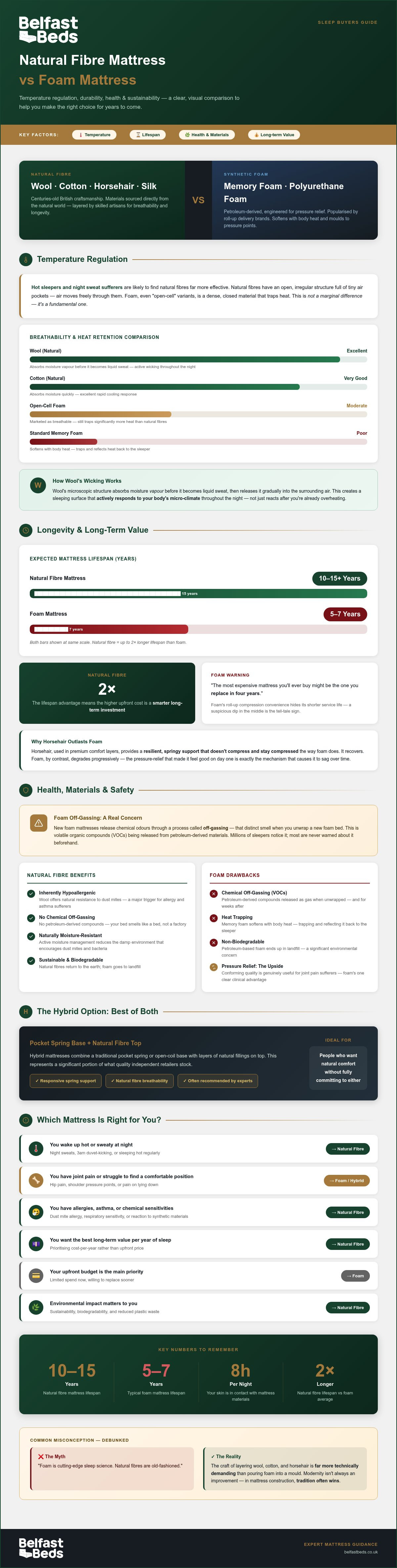
Wool is a genuinely remarkable fibre when it comes to sleep. Its microscopic structure allows it to absorb moisture vapour before it becomes liquid sweat, releasing it gradually into the surrounding air. This is wicking: the ability to move moisture away from the skin. Cotton works in a similar way, though it tends to be better at absorbing moisture quickly rather than regulating it gradually. Together, these fibres create a sleeping surface that actively responds to your body's micro-climate throughout the night.
Horsehair and silk serve a different purpose. Horsehair, used in the uppermost comfort layers of premium mattresses, provides a resilient, springy support that doesn't compress and stay compressed the way foam does. Silk adds a fine, temperature-neutral layer that sits beautifully against the skin. These aren't marketing flourishes. They're materials chosen by skilled craftspeople because they genuinely perform.
How Modern Synthetic Foams Work
Memory foam, technically called visco-elastic foam, softens in response to body heat and moulds around pressure points. That conforming quality is genuinely useful for people with joint pain or who struggle to find a comfortable position. It's also why foam became the dominant material for bed-in-a-box brands: it compresses easily for roll-up delivery, which dramatically reduces shipping costs.
The common misconception is that foam represents the cutting edge of sleep science while natural fibres are somehow old-fashioned. The reality is the opposite. The craft of layering wool, cotton, and horsehair to create a balanced, breathable, supportive sleep surface is far more technically demanding than pouring foam into a mould. Modernity isn't always an improvement, and in mattress construction, tradition often wins.
Temperature Regulation: Why Hot Sleepers Should Choose Natural Fibres
If you regularly wake at 3am kicking off the duvet, your mattress is probably making the problem worse. Temperature regulation is one of the most significant practical differences in the natural fibre mattress vs foam debate, and it's where natural materials have a clear, structural advantage that no amount of foam engineering has fully managed to replicate.
The reason comes down to how these materials are physically constructed. Natural fibres like wool and cotton have an open, irregular structure full of tiny air pockets. Air moves through them. Foam, by contrast, is a dense, closed material. Even open-cell foam variants, which are marketed as more breathable than standard polyurethane, still trap significantly more heat than a wool or cotton comfort layer does. It's not a marginal difference. It's a fundamental one.
The 'Breathability' Factor in Wool and Cotton
Think of natural fibres as a passive ventilation system built directly into your mattress. Wool, in particular, is hygroscopic, meaning it actively absorbs moisture vapour from the air around it before that moisture ever reaches your skin. A single kilogram of wool can absorb a significant amount of moisture without ever feeling damp to the touch. The result is a sleeping surface that stays dry and comfortable even during warmer nights, without any active cooling technology required.
Cotton works alongside wool beautifully. Where wool manages moisture gradually, cotton absorbs it quickly, wicking sweat away from the skin before the familiar clammy sensation sets in. Together, they create a microclimate between you and your mattress that adjusts naturally to your body temperature. Warm in winter, cooler in summer. No settings to change. No technology to fail.
It's worth knowing that this breathability benefit extends beyond comfort. Night sweats that aren't managed by your mattress materials accumulate over time, creating a damp environment that encourages dust mites and bacteria. Natural fibres, particularly wool, resist this naturally. If you're interested in a natural material that also offers some of the contouring benefits associated with foam, our Dunlopillo latex guide explores how natural latex sits in a useful middle ground between the two.
Heat Retention Issues in Memory Foam
Memory foam needs your body heat to work. That's not a flaw in the design; it's the mechanism. The foam softens as it warms up, allowing it to contour around pressure points. But that same process means the foam is constantly absorbing and holding the heat your body generates. You're essentially sleeping on a material that's designed to trap warmth close to you all night.
The 'cooling gel' trend in foam mattresses attempts to address this. Gel beads or layers are infused into the foam to draw heat away from the surface. In practice, these gel layers absorb heat initially but become saturated relatively quickly, often within the first hour or two of sleep. After that, they offer little ongoing benefit. It's a partial solution to a problem that natural fibres simply don't have in the first place.
If you already own a foam mattress and want to sleep cooler, a few practical steps can help:
- Use a natural fibre mattress topper in wool or cotton to add a breathable layer between you and the foam
- Switch to linen or bamboo bedding, which breathes more freely than synthetic or cotton-polyester blends
- Keep the room cooler before sleep, as foam takes time to warm and soften, so a cooler room slows that process
- Avoid memory foam pillows if heat is an issue, as the same insulation effect applies around your head and neck
These are workarounds, though. If overheating is a persistent problem, the most effective solution is a mattress built from materials that manage temperature naturally from the start. Visiting our Cambridge showroom lets you feel the difference between a natural fibre mattress and a foam equivalent side by side, which is genuinely the quickest way to understand what your body actually responds to.
Longevity and Value: Comparing the Lifespan of Your Investment
A foam mattress that costs less upfront can easily cost you more over time. The average foam mattress needs replacing every five to seven years. A quality natural fibre mattress, properly maintained, will typically last ten to fifteen years, and in some cases considerably longer. That gap isn't marginal. Over two decades of sleeping, you could buy three or four foam mattresses for every one natural fibre equivalent you'd need.
The maths become clearer when you think in terms of price per night. Spread a higher initial investment across fifteen years of use, and the nightly cost often works out lower than the cheaper foam option you'd be replacing halfway through. It's the same logic that applies to a well-made coat versus a fast-fashion alternative. The thing that feels expensive upfront frequently turns out to be the better value in the long run.
Resistance to Dipping and Sagging
Foam loses its rebound because its cellular structure breaks down under repeated compression. The cells that give foam its initial springiness gradually collapse, and once they do, they don't recover. That's the origin of the body-shaped dip you'll find in the centre of an older foam mattress. Natural fibres behave differently. Wool and cotton maintain their loft through a combination of fibre resilience and the way they're layered during construction. They compress under weight and spring back when that weight is removed, much like the fibres themselves do in nature.
Pocket springs play a significant supporting role here. In a well-constructed hybrid or sprung natural fibre mattress, each spring works independently, distributing weight without transferring it across the whole surface. This prevents the localised compression that causes sagging. Hand-stitched side panels, used by craftspeople at brands like Relyon, reinforce the mattress edge so the usable sleep surface extends right to the border. Without that stitching, edges collapse inward over time, effectively shrinking the mattress you paid for.
Maintenance: Turning vs. Rotating
Most foam mattresses are single-sided. The foam comfort layer sits on top of a denser base, and flipping the mattress would put you sleeping on the base. So you can only rotate them head to foot, which distributes wear in one direction only. Natural fibre mattresses are frequently double-sided, meaning you can both rotate and flip them. That doubles the usable surface and distributes compression evenly across all layers over time.
For Cambridge residents, a few simple habits will extend any mattress's life noticeably:
- Rotate every three months for the first year, then every six months after that
- Flip double-sided mattresses at the same intervals to ensure even wear across both surfaces
- Air the mattress regularly by pulling back the bedding for thirty minutes each morning, particularly useful during Cambridge's damper autumn and winter months
- Use a quality mattress protector to guard against moisture and keep the fillings clean without affecting breathability
In the natural fibre mattress vs foam comparison, this maintenance difference is genuinely underappreciated. The ability to flip a mattress isn't a minor convenience. It's a structural feature that directly extends the lifespan of your investment and keeps the sleep surface performing as it should, year after year.
Health and Sustainability: Beyond the Surface Comfort
Comfort is what most people focus on when choosing a mattress. But what your mattress is made from has implications that go well beyond how it feels on the first night. In the natural fibre mattress vs foam debate, the health and environmental dimensions are where the differences become genuinely hard to ignore, particularly for allergy sufferers, families with young children, or anyone who cares about what they're bringing into their home.
Hypoallergenic Properties and VOCs
New foam mattresses frequently arrive with a distinctive chemical smell. That odour has a name: off-gassing. It's the release of Volatile Organic Compounds, or VOCs, from the petroleum-based materials used in foam manufacturing. These compounds, which can include toluene and benzene derivatives depending on the product, dissipate over time, typically within a few days to a few weeks. For most people, the smell is an inconvenience. For asthma sufferers, those with chemical sensitivities, or anyone sleeping in a poorly ventilated room, it can be a genuine problem.
Natural fibres simply don't do this. Wool, cotton, and horsehair are inert materials. They don't release chemical compounds as they warm up or age. Wool goes further still: its natural lanolin content makes it inherently resistant to dust mites, mould, and bacteria, all without any chemical treatment. That's a meaningful distinction if you or someone in your household suffers from asthma or allergic rhinitis, conditions that are frequently aggravated by dust mite populations in bedding.
The peace of mind that comes with sleeping on genuinely chemical-free materials isn't a luxury. For many people, it's a health consideration that should sit alongside firmness and price when making a decision.
Brands like Hypnos hold a Royal Warrant, a designation that reflects consistent standards of quality and craftsmanship assessed over time. That kind of credential matters when you're evaluating what's actually inside a mattress, not just what's printed on the label. It signals accountability, which is something no amount of marketing copy can replicate.
Eco-Friendly Disposal in Cambridgeshire
End-of-life disposal is one of the least discussed aspects of mattress ownership, and it's where foam has a significant environmental problem. Synthetic foam is a complex composite material. Separating its components for recycling is technically difficult and rarely cost-effective, which means the vast majority of foam mattresses end up in landfill. A single mattress can take decades to break down.
Natural fibre mattresses are genuinely different in this respect. The individual components, wool, cotton, spring steel, can be separated and processed through established recycling streams. The organic materials are biodegradable. The springs are recyclable metal. It's not a perfect system, but it's substantially better than a block of polyurethane foam sitting in the ground.
For Cambridgeshire residents, this isn't just an abstract concern. We offer an old bed removal service when delivering your new mattress, handling the logistics so you don't have to arrange disposal yourself. It's a practical step that removes one of the real friction points in replacing a mattress responsibly. If you'd like to find out more about how we handle collection and what options are available, get in touch with our Cambridge team before your delivery is booked.
Finding Your Perfect Match: Expert Guidance in Cambridgeshire
All the research in the world won't tell you what ten minutes on the right mattress will. Reading about the natural fibre mattress vs foam debate is useful context, but your body is the only instrument that matters when it comes to making the final call. That's why visiting a physical showroom in Cambridge isn't just a nice option. For a purchase that will affect your sleep for the next decade, it's the most practical thing you can do.
Why Testing in a Cambridge Showroom is Essential
Online mattress brands offer 30-night or even 100-night trial periods as a substitute for the showroom experience. The logic sounds reasonable until you consider what's actually involved in returning a mattress you've slept on. These beds arrive compressed in a box, expand to full size in your bedroom, and returning them typically means coordinating a collection, waiting for a refund, and sleeping on the floor in the meantime. It's a significant inconvenience dressed up as customer-friendly flexibility.
Spending ten minutes in our Cambridge showroom sidesteps all of that. You can feel the genuine difference between soft, medium, and firm tension levels across multiple mattresses, not just read about them. Lying down in your actual sleeping position, whether that's on your side, back, or front, tells you immediately whether your hips are sinking too far into a soft foam surface or whether a firmer natural fibre mattress is holding your spine in the neutral alignment it needs. Our team can guide that assessment, pointing out what to look for in terms of shoulder support, lumbar positioning, and pressure relief at the hips and knees.
That kind of professional input is genuinely difficult to replicate online. Spinal alignment isn't something you can judge from a product description or a star rating.
Local Support and White-Glove Delivery
Belfast Bed Superstore has been an independent, family-run business since 1990. That history matters in a practical sense. When you buy from us, there's a real team of people in Cambridge who know the products they're selling and stand behind them. You're not navigating a chatbot or waiting days for an email response from a warehouse somewhere.
Our delivery and assembly service removes the physical burden that puts many people off upgrading their bed. A quality divan base or bedstead isn't something most people want to wrestle up a staircase alone, and improper assembly can compromise the structural integrity of the frame or base from day one. Having it done properly by people who know the product means your new bed performs as it should from the very first night.
We also collect and remove your old bed as part of the delivery process, which handles one of the genuine logistical headaches of mattress replacement for Cambridge and Cambridgeshire residents.
Whether you're drawn to a natural fibre mattress after reading this guide or you want to explore how a Sealy or Hypnos mattress feels in person, the showroom is where that decision becomes easy. Pair the right mattress with quality bedroom furniture and you're not just replacing a mattress. You're building a sleep environment that works properly, built around you, by people who genuinely care how well you rest.
Come in and see us. The right bed is closer than you think.
Make the Right Choice for the Next Decade of Sleep
The natural fibre mattress vs foam debate doesn't have a single right answer, but it does have a right answer for you. If you run hot at night, want a mattress that lasts well over a decade, or care about what materials you're sleeping on, natural fibres have a genuine structural advantage that foam simply can't match. If pressure relief for joint pain is your priority, foam still has its place.
What matters most is making an informed decision rather than a convenient one. A mattress isn't something you should gamble on with a returns process.
We make it straightforward. Our 30-night sleep trial gives you real confidence in your choice. We'll remove and recycle your old bed as part of the delivery. And if budget is a consideration, 0% finance options are available so the right mattress doesn't have to wait.
The best next step is simple: come and feel the difference for yourself. Book a sleep consultation at our Cambridge showroom and let us help you find the mattress that'll still be working hard for you in 2036.
Frequently Asked Questions: Natural Fibre Mattress vs Foam
Is a natural fibre mattress better for back pain than memory foam?
It depends on the cause of your back pain and your sleeping position. Memory foam contours closely around pressure points, which some people find helpful for joint discomfort. A well-constructed natural fibre mattress with pocket springs, however, offers responsive, zoned support that holds your spine in neutral alignment without the sinkage that can misalign hips over time. Side sleepers with hip or shoulder pain often do well with foam; back and front sleepers frequently find sprung natural fibre mattresses more supportive.
The most reliable way to assess this is to lie down in your actual sleeping position on both types in our Cambridge showroom. Spinal alignment is visible and assessable in person in a way that no product description can replicate.
Why do natural fibre mattresses cost more upfront?
The higher price reflects the materials and the labour involved. Layering wool, cotton, and horsehair by hand, then hand-stitching the side panels to reinforce the mattress edge, is a skilled, time-intensive process. Foam manufacturing is largely automated, which keeps production costs low. You're also paying for longevity: a quality natural fibre mattress typically lasts ten to fifteen years, which changes the cost-per-night calculation considerably compared to a foam mattress replaced every five to seven years.
Can I use a natural fibre mattress on a slatted bed base?
Yes, but the slat spacing matters. Slats should ideally be no more than 7cm apart to provide adequate support across the mattress surface. Gaps wider than this can allow the mattress to bow between slats over time, reducing comfort and potentially voiding the manufacturer's guarantee. A solid divan base or a platform top divan offers the most consistent support for a natural fibre mattress, particularly for heavier fillings like horsehair. If you're unsure about your existing base, our team can advise before you buy.
How often should I flip or rotate a natural fibre mattress?
For the first year, rotate and flip a double-sided natural fibre mattress every three months. After that, every six months is sufficient. This distributes compression evenly across all filling layers and prevents any one area from bearing disproportionate wear. Single-sided mattresses can only be rotated head to foot, so check your specific model. Consistent turning is one of the simplest things you can do to extend the lifespan of your mattress significantly.
Do natural fibre mattresses smell when they are new?
A very mild, natural lanolin scent from wool is common and harmless, typically fading within a few days of airing. This is completely different from the chemical off-gassing associated with new foam mattresses. Natural fibres don't contain the volatile organic compounds found in petroleum-based foam, so there's no chemical odour to wait out. Airing your new mattress in a well-ventilated room for a day or two is good practice regardless, and the natural fibre mattress vs foam difference here is genuinely noticeable from day one.
Are natural fibre mattresses suitable for people with wool allergies?
True wool allergies are relatively uncommon; most reactions attributed to wool are actually sensitivities to lanolin or to the coarse texture of lower-grade fibres. If you have a confirmed wool allergy, a natural fibre mattress filled primarily with cotton is a practical alternative that still delivers the breathability and moisture-wicking benefits of natural materials. A mattress protector also creates a barrier between the filling and your skin. It's worth discussing your specific sensitivity with our team before choosing, as filling compositions vary between models.
What is the best natural fibre for hot sleepers?
Wool is the most effective natural fibre for temperature regulation. Its hygroscopic structure absorbs moisture vapour before it reaches your skin, releasing it gradually into the air rather than letting it accumulate as sweat. Cotton absorbs moisture quickly and wicks it away from the surface, making it an excellent complement to wool in a layered comfort system. Together, they create a sleeping environment that adjusts passively to your body's temperature throughout the night, without any technology involved.
How long does a Hypnos or Relyon mattress typically last?
A quality Hypnos or Relyon mattress, properly maintained with regular rotation and flipping, will typically perform well for ten to fifteen years. Both brands use hand-crafted construction methods, pocket spring systems, and natural fibre fillings that resist the premature compression seen in foam alternatives. Hypnos, which holds a Royal Warrant, is built to standards that reflect consistent, assessed quality over time. Lifespan does vary depending on usage, body weight, and how well the mattress is maintained, so following the care guidance from our team will help you get the most from your investment.


