

That "extra firm" mattress you bought to fix your aching back might actually be the reason you're waking up with morning stiffness and tingling limbs. It's a common mistake to assume that firmer always means better support, but the truth is that the right tension is entirely personal to your body. Understanding how to choose mattress firmness isn't just about pushing down on a display model in a shop; it's about finding the sweet spot where your spine stays neutral and your pressure points feel weightless.
We know how frustrating it is to spend a small fortune on a bed only to find yourself tossing and turning or feeling every move your partner makes. We're here to help you master the mattress firmness scale by aligning your sleeping position and BMI with the perfect tension. This guide explains how to identify the right feel for your frame and why our Cambridge experts recommend specific tensions from premium brands like Sealy or Relyon. By the end, you'll know exactly how to secure a mattress that provides blissful, pain-free mornings for the next decade.
Key Takeaways
- Understand why the 1-10 firmness scale is subjective and how the initial surface feel differs from the deep support your spine needs.
- Learn how to choose mattress firmness by matching your specific BMI and preferred sleeping position to the correct internal spring tension.
- Discover why the "orthopaedic" label isn't a medical standard and how a softer surface can still provide world-class spinal alignment.
- Explore bespoke solutions like dual-tension and zip-and-link systems that ensure both you and your partner get a perfect night's rest.
- Master our expert techniques for testing mattresses in our Cambridge showroom to guarantee your new bed remains comfortable for over ten years.
Understanding the Mattress Firmness Scale: From 1 to 10
When you visit our Cambridge showroom, the first thing you'll notice isn't the technical spring count; it's how the bed feels the moment you sit down. This initial sensation is what we call firmness. While many people use the terms interchangeably, firmness is the subjective level of comfort provided by the mattress's top layers, distinct from its core support. If you are wondering how to choose mattress firmness for a better night's sleep, you'll need to look at how these layers interact with your body weight. Understanding the nuances of mattress construction helps clarify why two beds with the same spring unit can feel completely different based on their upholstery.
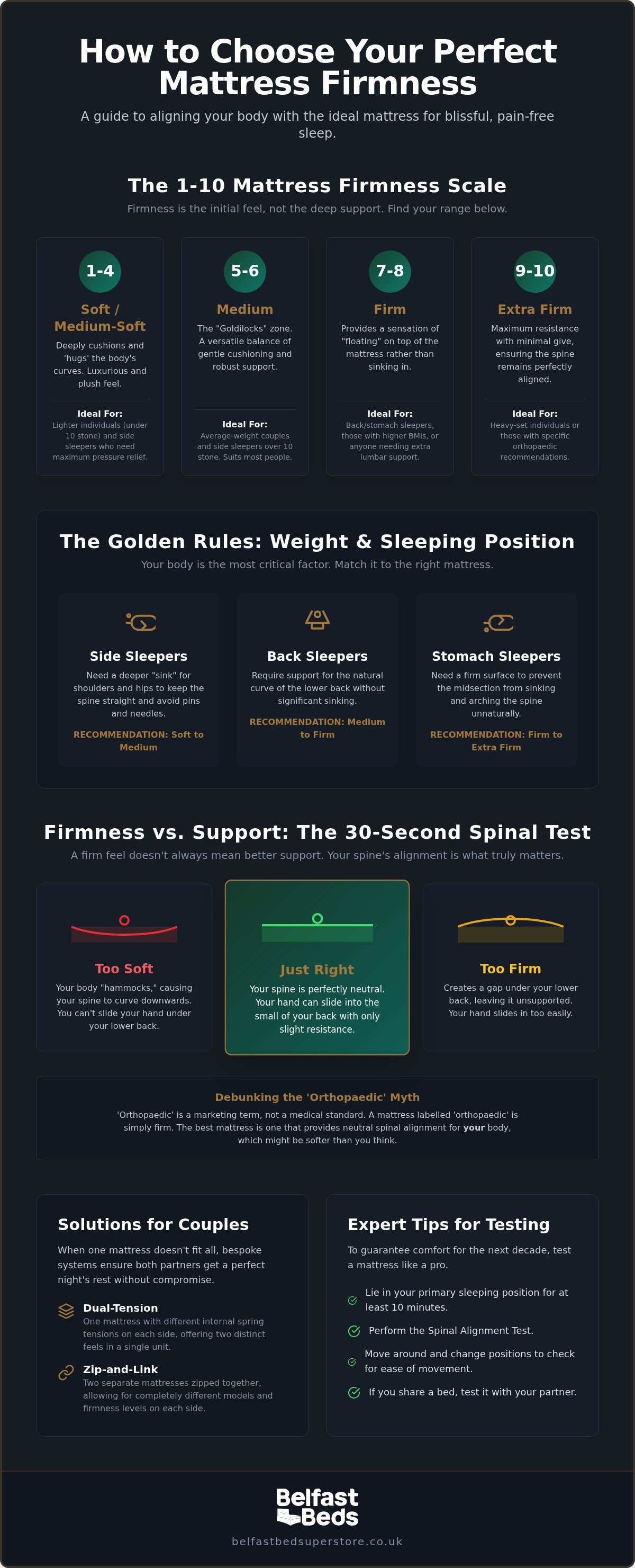
To make things easier, the industry uses a universal 1-10 scale to categorise these feelings. A rating of 1 represents a cloud-soft surface that you sink deeply into, while a 10 is comparable to sleeping on a carpeted floor. Most sleepers find their perfect match in the "Medium" (5-6) or "Medium-Firm" (7-8) categories. These middle-ground options provide a versatile balance that suits a wide range of body types and preferences. Learning how to choose mattress firmness involves looking past these numbers to see how the materials react to your specific shape.
Soft to Medium-Soft (1-4): Who is it for?
These plush mattresses are designed to "hug" the body's natural curves, providing deep cushioning for the hips and shoulders. They are typically ideal for lighter individuals, generally those under 10 stone, who don't apply enough pressure to compress firmer materials. Brands like Relyon or Hypnos often use generous layers of natural fillings like wool or cotton to achieve this luxurious feel. However, there are drawbacks to consider. If you're a heavier sleeper or prefer lying on your stomach, a soft mattress might cause your midsection to sink too far, leading to an uncomfortable arch in your lower back.
Medium to Firm (5-10): The Support Standards
Medium mattresses (5-6) are often called the "Goldilocks" zone. They're a brilliant choice for couples with different needs because they offer enough give for side sleepers but enough resistance for back sleepers. If you move into the Firm (7-8) range, you'll find the traditional choice for those with higher BMIs or anyone who prefers "floating" on top of the bed. Many Sealy models excel here, offering robust tension that stands the test of time. These categories are often broken down as follows:
- Medium (5-6): Best for side sleepers over 10 stone and average-weight couples.
- Firm (7-8): Ideal for back sleepers, stomach sleepers, and those who need extra lumbar support.
- Extra Firm (9-10): Specifically designed for orthopaedic needs and heavy-set individuals.
Extra Firm options provide maximum resistance to ensure the spine remains perfectly aligned throughout the night. This prevents that "stuck" feeling some people experience with softer beds, making it easier to turn over during the night. Our team in Cambridge can help you determine if this level of tension is truly necessary for your comfort or if a supportive Medium-Firm would be a better fit.
The Golden Rules: Weight and Sleeping Position
Your body weight is the most critical variable when deciding how to choose mattress firmness. It's a matter of simple physics. A sleeper weighing 8 stone won't compress the comfort layers of a firm mattress enough to trigger pressure relief. Conversely, a 16-stone sleeper will sink right through a soft mattress, losing all spinal support. We always remind our Cambridge customers that a mattress doesn't have a fixed feel; it has a reactive feel based on your BMI. If you're on the heavier side, you'll likely need a firmer tension to keep your spine neutral, while lighter individuals will find better comfort on something more forgiving.
You can perform a "Spinal Alignment Test" in just 30 seconds to see if a bed is right for you. Lie in your usual position and try to slide your hand into the gap between the mattress and the small of your back. If your hand slides in too easily, the bed is likely too firm. If you can't get your hand in at all, the mattress is too soft, and you're likely "hammocking." A perfect fit allows your hand to slide in with just a little resistance, indicating your spine is properly supported.
Side Sleepers: Finding the Pressure Relief Zone
Side sleepers require a deeper "sink" for their shoulders and hips to maintain a straight spine. Without this, you'll likely wake up with pins and needles or a dull ache in your joints. A "Medium" tension is often the sweet spot for the average UK side sleeper, as it cushions these heavy pressure points while filling the gap at the waist. For those who need even more precision, the Sealy Posturepedic guide explains how targeted hip support can transform your sleep quality by preventing the pelvis from tilting.
Back and Stomach Sleepers: Preventing the 'Hammock' Effect
If you sleep on your stomach, you need a firmer surface to prevent your hips from sinking and arching your back into an unnatural curve. Back sleepers also benefit from a "Medium-Firm" feel that supports the lumbar region while gently cushioning the buttocks. The danger of a mattress that is too soft is the "hammock" effect, which is a leading cause of chronic lower back pain. To ensure you're making the right choice for your posture, you might want to speak with our friendly local experts who can guide you through our range of Hypnos and Relyon models.
Don't forget that your pillow loft must change depending on the firmness of your mattress. If you choose a firm mattress, your shoulders won't sink in very far, meaning you'll need a loftier pillow to keep your neck aligned. If you opt for a softer surface, your body sinks deeper, and a thinner pillow will be necessary to prevent your head from being pushed upwards. It's these small adjustments that lead to a truly restorative night's rest.
Firmness vs. Support: Debunking the 'Orthopaedic' Myth
One of the biggest hurdles when learning how to choose mattress firmness is separating "feel" from "support." We often meet customers in our Cambridge showroom who ask for an orthopaedic mattress because they believe it's a medical requirement for back pain. In reality, "orthopaedic" is largely a marketing term used to describe a very firm feel. It isn't a regulated medical standard or a clinical certification. Genuine support is simply the mattress's ability to keep your spine in a neutral, healthy position, regardless of whether the top layers feel like a cloud or a board.
You can have a mattress that feels incredibly soft but remains highly supportive if it has a quality pocket spring core. Deep support is provided by the spring unit, such as Hypnos's ReActive springs which adjust to your every move, while the level of firmness is determined by the comfort fillings layered on top. This distinction is vital because it means you don't have to sacrifice a cosy, plush feel just to look after your back.
The Role of Pocket Springs in Support
Pocket springs act as the engine of your bed. Unlike older open-coil systems where the springs are wired together, these individual springs are housed in their own fabric pockets. This allows them to react to your body weight independently. It's this independent movement that ensures your heavy hips and shoulders sink in just enough while the springs beneath your waist stay firm to support your lumbar. While many people focus on high spring counts, a higher number doesn't always mean better support; the quality and tension of the wire are what truly matter. For those who want to use every inch of their bed, Relyon's hand-stitched borders are essential. This traditional craftsmanship provides robust edge-to-edge support, preventing that "rolling off" feeling when you're near the side.
Natural Fillings and Their Impact on Feel
The layers of wool, cotton, and silk found in premium mattresses do more than just provide a soft-to-medium feel. These natural materials breathe significantly better than synthetic foams, which helps you stay cool and comfortable throughout the night. It's helpful to remember that every new mattress has a "settling" period. Because these natural fibres are so lofty, your bed might feel slightly firmer in the first 14 days as the materials begin to contour to your body. To maintain the consistent level of firmness you've chosen, regular rotation is key. This ensures the fillings settle evenly across the entire surface, keeping your mattress supportive and comfortable for the next decade.
Bespoke Solutions: Split Tensions and Zip and Link Systems
Finding the perfect bed is often a solo journey, but for couples, the challenge doubles. We frequently see partners who are at a stalemate because one prefers a soft, "sinking-in" feeling while the other needs a firm, supportive surface. If you're trying to figure out how to choose mattress firmness as a duo, you don't actually have to compromise. Modern manufacturing allows for bespoke solutions that cater to both individuals without anyone having to sacrifice their sleep quality.
The two primary ways to achieve this are dual-tension mattresses and zip and link systems. A dual-tension mattress is a single unit that contains two different spring tensions side-by-side. It looks like a standard mattress from the outside, but the internal "engine" is split down the middle. This is a fantastic option if you want the seamless look of one large bed but have different BMI requirements. It solves the "Partner Compromise" by ensuring both spines are perfectly aligned based on individual weights.
The 'Partner Compromise' Solved
Forcing yourself to sleep on a tension that doesn't suit your frame can lead to long-term health issues, including chronic neck pain and hip bursitis. We're proud to offer brands like Hypnos and Relyon, as they specialise in these bespoke split-tension configurations. For light sleepers, we often recommend the zip and link approach. Because these are essentially two separate mattresses zipped together, they offer superior motion isolation. When your partner turns over or gets up in the night, the movement doesn't travel across the zip, leaving you undisturbed.
Access and Logistics in East Anglian Homes
In a city like Cambridge, architectural constraints are a very real part of the buying process. Many of our local customers live in beautiful Victorian terraces or narrow townhouses where a standard Super King mattress simply won't fit around the tight turns of a staircase. This is where zip and link systems truly shine. By delivering two smaller mattresses that are then joined in your bedroom, we can navigate the most challenging "narrow staircase" problems without any risk of damaging your new bed or your walls.
To make the process even smoother, our team provides a professional assembly service to ensure your complex zip and link setup is perfectly aligned and secure. If you're tired of compromising on your rest, visit our Cambridge experts today to find a bespoke tension that works for both of you.
The Expert Selection Process: Testing in Cambridge
While digital guides provide a solid foundation for understanding how to choose mattress firmness, nothing replaces the physical experience of lying on a bed. Buying a mattress blind online is a gamble with your sleep health that often leads to the frustration of returns and restless nights. We invite you to our Cambridge showroom to experience the difference for yourself. To get the most out of your visit, we suggest wearing comfortable, loose clothing and spending at least 10 minutes on any model that catches your eye. Lying in your natural sleeping position for an extended period is the only way to feel how the materials settle under your weight.
Our friendly local experts are always on hand to help you navigate the heritage brands we stock. We understand the specific nuances of each manufacturer, from the responsive feel of a Sealy to the traditional luxury of a pocket-sprung Relyon. This professional guidance ensures you aren't just guessing based on a number on a scale but making an informed decision based on how your body actually reacts to the tension. It's about finding that perfect alignment that makes you feel weightless the moment you lie down.
What to Look for in the Showroom
When you're testing a bed, perform the "Hand Gap" test we discussed. If there's a large hollow at your lower back, the mattress is likely too firm; if you're struggling to slide your hand in at all, it's too soft. Don't forget to evaluate the edge support by sitting on the side of the mattress as if you're getting ready in the morning. A quality bed should feel stable and supportive right to the very edge, preventing that sloping sensation. Comparing different brands side-by-side is also vital. You might find that a "Medium" from Hypnos feels significantly different than a "Medium" from another brand due to the specific natural fillings used in their construction.
The 30-Night Sleep Trial Guarantee
We know that even with a thorough testing process, it can take a few weeks for your body to fully adjust to a new sleeping surface. That's why we offer a 30-night sleep trial guarantee for our Cambridge and East Anglian customers. This acts as the ultimate safety net for anyone worried about how to choose mattress firmness. If you discover after a few weeks of use that the tension isn't quite right for your body, you have the peace of mind knowing you can swap it for a different feel. We value your long-term comfort over a quick transaction, and this trial ensures you end up with a bed that provides restorative rest for years to come.
Visit our Cambridge showroom or browse our Hypnos collection today to start your journey toward a better night's sleep.
Ready for Your Best Night's Sleep?
Achieving the perfect rest is a balance of science and personal comfort. We've explored how your weight and sleeping position dictate the tension you need, and why high-quality support doesn't always have to feel like a hard board. Whether you're navigating the narrow staircases of a Cambridge terrace with a zip and link system or seeking a dual-tension solution for you and your partner, the right choice is within reach. Mastering how to choose mattress firmness is the first step toward waking up without that stubborn lower back stiffness.
As a family-run business helping our neighbours since 1990, we take pride in demystifying the buying process. You don't have to worry about making the wrong choice thanks to our 30-night sleep trial guarantee. Plus, our team handles the heavy lifting with professional assembly and old bed removal across Cambridgeshire. Visit our Cambridge Showroom to test the 2026 Hypnos & Relyon ranges and feel the difference for yourself. We're looking forward to helping you find a bed that brings comfort and joy to your home for years to come.
Frequently Asked Questions
Is a firm mattress always better for back pain?
No, a firm mattress isn't a universal cure for back pain. If a bed is too rigid, it won't allow your shoulders and hips to sink in, which can actually worsen pain by forcing your spine out of its natural alignment. The goal is to find a tension that supports your specific weight while providing enough "give" to cushion your joints and maintain a neutral posture.
How do I know if my mattress is too soft?
You'll know a mattress is too soft if you feel like you're "hammocking," where your hips sink significantly lower than your shoulders and feet. If you find it difficult to roll over during the night or wake up with a dull, heavy ache in your lower back every morning, these are clear signs that the core support isn't sufficient for your body weight.
Can I change the firmness of my current mattress with a topper?
A topper can effectively make a firm mattress feel softer by adding a plush comfort layer, but it can't fix a mattress that is too soft or sagging. Because toppers only sit on the surface, they don't provide the structural support needed to firm up a bed that has lost its internal tension. If your mattress is dipping, it's usually time for a replacement.
What mattress firmness is best for side sleepers with hip pain?
Side sleepers with hip pain generally benefit from a Medium or Medium-Soft tension. This level of firmness allows the heavier parts of your body to sink in just enough to keep your spine straight, which relieves the pressure that causes hip discomfort. Understanding how to choose mattress firmness for your specific sleeping style is the best way to ensure you wake up feeling refreshed and pain-free.
What is a 'Dual Tension' mattress and do I need one?
A Dual Tension mattress features two different internal spring tensions within a single mattress cover. You might need one if you and your partner have a significant weight difference or different comfort preferences. It allows each side of the bed to be tailored to your individual BMIs, ensuring both of you get the correct support without the need for two separate mattresses.
Does mattress firmness change over time as it's broken in?
Yes, it's perfectly normal for a new mattress to "settle" during the first few weeks of use. As the natural wool or cotton fillings compress and contour to your body shape, the mattress will begin to feel slightly softer than it did in the showroom. We recommend regular rotation during this initial period to ensure the fillings settle evenly across the entire sleeping surface.
What firmness should I choose if I am a heavy person?
If you're a heavier person, typically over 16 stone, you'll likely need a Firm or Extra Firm tension to maintain proper alignment. This provides the necessary resistance to prevent you from sinking too far through the comfort layers and hitting the spring unit. Learning how to choose mattress firmness based on your BMI is essential for ensuring your bed remains comfortable for years to come.
Do zip and link beds feel different in the middle because of the join?
Modern zip and link beds are crafted so that you won't feel the join in the middle while you sleep. Quality brands like Hypnos use recessed zips and generous edge-to-edge upholstery, which means the two mattresses feel like a single, unified surface. It's a brilliant solution for Cambridge homes with tight access that still require a large, luxurious sleeping area.


