
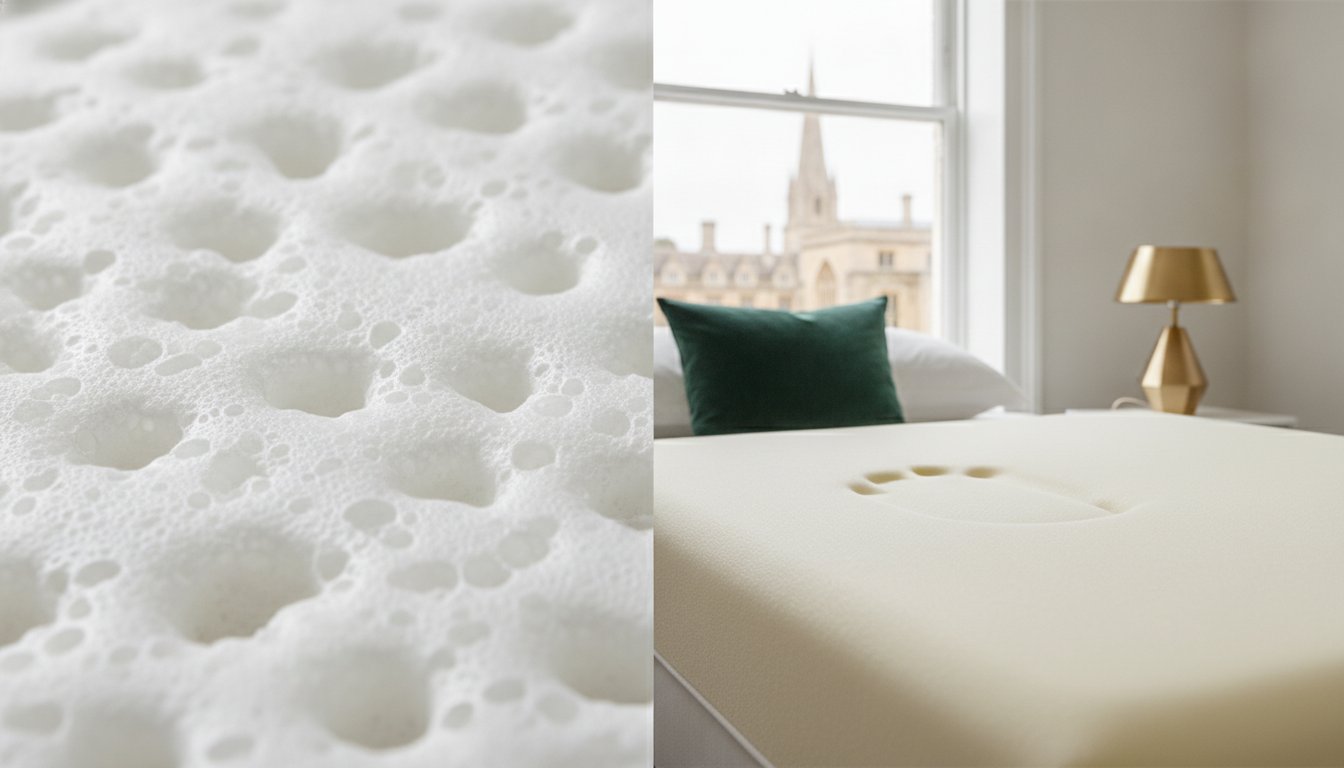
What if the reason you're waking up with stiff joints and aching shoulders isn't your age, but the fact that your mattress is fighting your body instead of supporting it? It's a common frustration we hear from our Cambridge neighbors who feel stuck between a mattress that feels like quicksand and one that's simply too firm. If you've been searching for a Dunlopillo vs Tempur latex mattress, the first thing to clear up is that while Dunlopillo is pure, buoyant latex, Tempur is actually a specialized memory foam designed for deep pressure relief.
We understand that choosing a premium bed is a big decision for your home and your health. You want a surface that stays cool throughout the night and lasts for over a decade without sagging. In this 2026 guide, we'll help you decide whether the instant "bounce-back" of Dunlopillo's natural Talalay latex or the weightless, contouring sensation of Tempur's SmartCool technology is right for your sleep style. We'll compare everything from spinal alignment to breathability, ensuring you find the comfort you deserve for a truly restful night.
Key Takeaways
- Understand the fundamental material differences between Dunlopillo’s natural Talalay latex and Tempur’s advanced memory foam to find your perfect match.
- Identify whether your joints need the "weightless" pressure relief of a contoured foam or the "buoyant" lift of a responsive latex surface.
- Discover how to stay cool all night by comparing natural open-cell ventilation with modern SmartCool fabric technology.
- Consult our Dunlopillo vs Tempur latex mattress comparison to choose a premium investment that offers superior spinal alignment for 10+ years.
- Learn why these high-quality designs are a smarter choice for your Cambridge home, offering maintenance-free comfort without the need for flipping.
Understanding the Core Technologies: Latex vs. Memory Foam
We often find that our Cambridge neighbors feel a bit puzzled when starting their search for a new bed. Many people come to us asking for a Dunlopillo vs Tempur latex mattress comparison, often assuming both brands use the same materials. It's a natural mistake to make because both names are synonymous with premium luxury. However, they offer polar opposite experiences: one is designed to lift you up, while the other is engineered to draw you in.
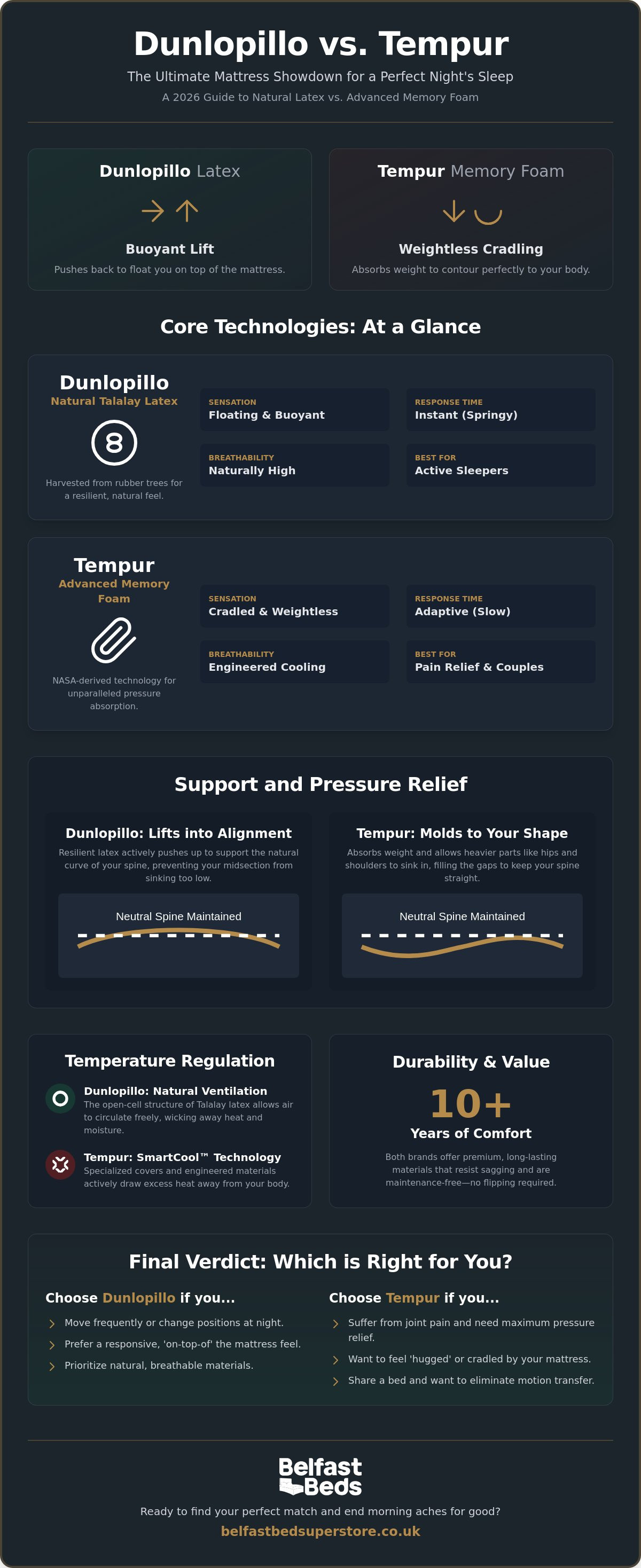
The confusion usually stems from the fact that both materials are "foam" in a broad sense, but their origins couldn't be more different. Dunlopillo is the original pioneer of natural latex, a material harvested from rubber trees. Tempur, conversely, is the world leader in visco-elastic foam. To help you visualize the difference before you even lie down, we've put together this quick-reference guide to their core properties.
| Feature | Dunlopillo (Latex) | Tempur (Memory Foam) |
|---|---|---|
| Primary Sensation | Floating / Buoyant | Cradled / Weightless |
| Response Time | Instant (Springy) | Adaptive (Slow) |
| Breathability | Naturally High | Engineered Cooling |
| Material Origin | Natural Rubber Sap | NASA-derived Synthetic |
The Dunlopillo Latex Advantage
Latex is essentially the "floating" mattress. Because it's a natural product, it has a signature resilience that pushes back against your body weight. This instant response is a huge benefit if you tend to move around a lot during the night. You won't ever feel "stuck" in a groove. For those concerned about East Anglian summers, the open-cell structure of Dunlopillo's Talalay latex acts like a natural ventilation system. It's incredibly breathable and keeps the air moving so you stay dry and comfortable. Plus, latex is famously durable, often outlasting traditional pocket-sprung options by several years.
The Tempur Visco-Elastic Experience
On the other hand, Tempur provides a "sinking" or "hugged" sensation. To understand what memory foam is and why it feels so unique, you have to look at its history. This technology was originally developed by NASA to cushion astronauts during the intense G-force of lift-off. It doesn't push back like latex; instead, it absorbs your weight and redistributes it across the entire surface. This creates a feeling of weightlessness that can be life-changing for those with chronic pain. It's also the gold standard for couples. If your partner is a restless sleeper, Tempur's motion absorption ensures you won't feel a single toss or turn on your side of the bed.
Support and Pressure Relief: Solving the Morning Aches
Waking up with a "crick" in your neck or a dull ache in your lower back is often your body's way of saying your current mattress has failed. When we look at the Dunlopillo vs Tempur latex mattress debate, we're really looking at two different philosophies of body support. One aims to lift you into alignment, while the other is designed to mould to your unique shape. Understanding the difference between memory foam and latex is the first step toward ending those restless nights in your Cambridge home.
Spinal alignment isn't simply about how hard or soft a mattress feels. It's about keeping your spine in a neutral, straight line from your neck to your tailbone. Tempur achieves this by letting your heavier parts, like shoulders and hips, sink into the material until the foam meets your waist. Dunlopillo does the opposite; its resilient core "lifts" your midsection to prevent that painful hammocking effect. If you find you still prefer the traditional feel of steel coils over these solid-core options, a Hypnos mattress offers a natural, spring-based alternative that provides a similar level of luxury with a more familiar bounce.
Best for Side Sleepers: Dunlopillo or Tempur?
Side sleepers often struggle with "pins and needles" in their arms because of pressure buildup. Tempur is exceptional here. It absorbs pressure points completely, which helps maintain steady blood flow throughout the night. However, Dunlopillo's latex provides a responsive "push back" that supports the curve of your waist while still cushioning your joints. It's a similar philosophy to Sealy mattresses, which use specialized support zones to keep your body level. Choosing between them usually depends on whether you prefer to feel "hugged" by your bed or "buoyant" on top of it.
Back Pain and Spinal Alignment
There's a common myth that a "firm" mattress is the only cure for a bad back. In reality, a surface that's too hard can leave gaps under your lower back, forcing your muscles to work all night long. Latex maintains a very consistent surface tension, which is excellent for long-term spinal health. For those who need even more flexibility, pairing these premium materials with an adjustable base allows you to find the perfect angle for your specific needs. If you're still weighing up your options, you can browse our full range of supportive beds to see how different tensions compare.
Temperature Regulation and the "Hot Sleeper" Debate
One of the most frequent concerns we hear from our customers is the fear of overheating during the night. It's a valid worry, especially when you're comparing a Dunlopillo vs Tempur latex mattress. Traditional synthetic foams have earned a reputation for trapping body heat because they often rely on your warmth to soften and contour to your shape. However, a 2016 study on mattress materials suggests that latex typically performs better at maintaining a neutral temperature due to its natural, open-cell composition. Dunlopillo takes this further with a "pin-core" construction, featuring tiny ventilation holes that allow air to circulate freely every time you move.
Tempur has worked hard to solve the heat issue by developing advanced cooling covers like their SmartCool and CoolTouch ranges. These fabrics are designed to feel instantly cool and help draw excess heat away from your skin throughout the night. While these engineered solutions are very effective, they work differently than the passive, natural breathability found in a 100% latex core. If you're particularly sensitive to temperature shifts, you might find our guide on Natural Fibre Mattress vs Foam: Myth-Busting Your Sleep in 2026 helpful for understanding how different layers interact with your body heat.
Why Breathability Matters in Cambridgeshire Homes
Living in East Anglia means preparing your home for everything from humid summer nights to damp, chilly winters. In older Cambridge terraced houses, where insulation can be a bit hit-and-miss, a mattress that regulates itself is a massive advantage. Latex helps keep you warm in the winter and cool in the summer by preventing moisture buildup. When deciding on a Dunlopillo vs Tempur latex mattress, it's also helpful to consider the specific environment of your bedroom. For those who want the ultimate breathable setup, pairing your bed with a natural Relyon mattress topper can add an extra layer of ventilation that synthetic materials often struggle to match.
Eco-Friendly Credentials of Latex
Sustainability is a priority for many of our neighbors when they're choosing new furniture. Dunlopillo mattresses are made from rubber sap harvested from managed plantations, making them a renewable and biodegradable choice for your home. This natural origin also contributes to their impressive longevity; a well-cared-for latex bed can often last significantly longer than standard synthetic foam alternatives. If you're looking to reduce your environmental footprint, you can explore our deep dive into The Best Eco-Friendly Mattresses in the UK. You'll see how latex compares to other sustainable materials in terms of both long-term comfort and planet-friendly manufacturing processes.
Durability and Value: Is a Premium Mattress Worth It?
Investing in a premium mattress is a serious commitment for your home and your budget. While online "bed-in-a-box" brands are popular, they often lose their support within three to five years. In contrast, choosing between a Dunlopillo vs Tempur latex mattress means you're investing in a product designed to last well over a decade. We often tell our neighbors that the true value of a mattress is measured by how you feel on year seven, eight, and ten. These brands use high-density materials that don't degrade like cheaper synthetic alternatives. To give you total peace of mind, we offer a local 30-night sleep trial so you can be certain your choice is right for your specific needs.
Longevity: Latex vs. Memory Foam
Latex is famously tough. It's a natural material that maintains its shape and springiness for years without dipping in the middle. When looking at a Dunlopillo vs Tempur latex mattress for longevity, both offer exceptional warranties that far exceed industry standards. Tempur foam is also incredibly durable, though it does have a "settling" period. During the first month, the cells open up and adapt to your body weight. This is a normal part of the process. Because these mattresses are significantly heavier than standard ones, they need a solid foundation. Pairing your new mattress with a sturdy frame from Birlea Furniture ensures the core remains supported and helps extend its lifespan.
The Investment: 0% Finance and Local Service
We know that a luxury bed is a big purchase. That's why we offer 0% finance options to help you spread the cost into manageable monthly payments. Being a local specialist means we can provide a level of service that national websites simply can't match. Our "white glove" delivery team will bring your new bed directly into your Cambridge bedroom, assemble it for you, and even take away your old mattress. This removes the heavy lifting and the stress of disposal.
Maintenance is another area where these premium options shine. Dunlopillo latex mattresses are designed to be single-sided. You never have to flip them. You simply rotate them occasionally to ensure even wear. Here are a few ways we make your investment easier:
- White-glove delivery: We handle the heavy lifting into your room of choice.
- Assembly service: Our team ensures your new bed is set up perfectly.
- Mattress recycling: We'll take away your old bed so you don't have to.
If you're ready to see how these materials feel in person, you can view our latest mattress collections and chat with us about which option fits your lifestyle.
Final Verdict: Which Should You Choose in 2026?
Selecting the winner in the Dunlopillo vs Tempur latex mattress comparison ultimately comes down to how you want your body to feel at 2:00 AM. There isn't a single "better" mattress here; there's only the one that aligns with your specific sleep needs. We've spent years helping our Cambridge neighbors navigate these choices, and we've found that sleepers usually fall into one of two distinct camps based on their personal comfort preferences.
You should choose Dunlopillo if you value a natural, breathable surface and enjoy a bit of "spring" when you move. It's the ideal choice for those who want to feel like they're sleeping on top of the mattress rather than inside it. Conversely, Tempur is the right pick if you suffer from chronic joint pain or have a partner who tosses and turns. Its ability to isolate motion and cradle your pressure points is unmatched. It provides that unique, weightless sensation that simply can't be replicated by other materials.
Summary Checklist for Buyers
To help you narrow it down, consider these three factors before you make your final decision:
- Your Sleeping Position: Side sleepers often prefer the deep contouring of Tempur to protect their shoulders, while back and stomach sleepers frequently benefit from the firmer, "lifting" support of latex.
- Temperature Control: If you're a naturally hot sleeper, the passive, open-cell breathability of a Dunlopillo vs Tempur latex mattress comparison usually tips in favor of the natural latex.
- Partner Disturbance: If you're easily woken by a restless partner, Tempur's motion absorption is the gold standard for an undisturbed night.
Visit Our Cambridge Showroom
No amount of reading can replace the "Cambridge Test." We invite you to visit our showroom to experience these sensations for yourself. It's the only way to truly understand the difference between the buoyant lift of latex and the adaptive hug of memory foam. While you're here, you can also explore how these premium cores feel compared to a traditional Hypnos mattress, which many of our customers find offers a lovely middle ground of natural comfort.
Our expert team is here to guide you through the process without any high-pressure tactics. We'll help you find the perfect pairing for your home, whether that's a new Dunlopillo core or a stylish frame from Flintshire Furniture to complete your bedroom's look. We pride ourselves on being your local sleep experts, and we're dedicated to ensuring you wake up feeling refreshed for years to come. If you're ready to start your journey to better sleep, you can browse our full Dunlopillo range today or pop in to see us this week.
Ready to Transform Your Sleep Quality?
Your journey to waking up refreshed starts with choosing a surface that truly understands your body's needs. Whether you're drawn to the natural, cooling lift of a Dunlopillo or the weightless, medical-grade pressure relief of a Tempur, you're making an investment that will transform your sleep for years. We've been helping families across East Anglia find their perfect match since 1990; we know that the right Dunlopillo vs Tempur latex mattress decision is best made with a little bit of expert guidance and a lot of personal testing.
We want you to feel completely confident in your purchase. That's why we offer a 30-night sleep trial guarantee and 0% finance options to make luxury rest accessible. Our professional Cambridge delivery and assembly team will even handle the heavy lifting for you, ensuring your new bed is set up perfectly in your home. It's all part of our long-term commitment to your domestic comfort and physical well-being. We value your satisfaction over a quick transaction.
Explore our Dunlopillo and Tempur Collections in Cambridge and take the first step toward the restful night you deserve. We look forward to helping you find your dream bed very soon.
Frequently Asked Questions
Is a Dunlopillo latex mattress better for back pain than Tempur?
The best choice for back pain depends on whether you need reactive support or deep pressure relief. Dunlopillo is often better if you require a buoyant surface that keeps your spine level and prevents you from sinking. Tempur is excellent if your pain is caused by specific pressure points, as the foam contours to your exact shape. Both are high-quality options for our Cambridge customers, but the right one depends on your individual support needs.
Does Tempur make a 100% natural latex mattress?
No, Tempur doesn't manufacture a 100% natural latex mattress. Their products are made from a proprietary visco-elastic material originally developed for NASA. While many shoppers look for a Dunlopillo vs Tempur latex mattress comparison, it's important to remember that Tempur is a high-tech synthetic foam. If you're specifically looking for a natural, plant-based material for your home, Dunlopillo’s Talalay latex is the original and leading choice.
How long does a Dunlopillo latex mattress last compared to memory foam?
A Dunlopillo latex mattress typically has a longer lifespan, often reaching 15 years or more due to the natural resilience of rubber. Tempur mattresses are also incredibly durable and come with a 10-year manufacturer's quality guarantee. Both brands represent a far better investment for your Cambridge bedroom than cheaper alternatives. They use high-density materials that maintain their supportive shape long after budget "bed-in-a-box" models have started to sag.
Will a Tempur mattress make me feel too hot at night?
Modern Tempur models feature SmartCool and CoolTouch technology specifically designed to stop you from feeling too hot. While older memory foams had a reputation for trapping heat, these advanced covers help regulate your temperature throughout the night. If you're a naturally very hot sleeper, we recommend testing a Dunlopillo vs Tempur latex mattress side-by-side. The open-cell structure of natural latex provides a different type of passive ventilation that some find more breathable.
Can I use a latex mattress on a slatted bed frame?
You can certainly use a latex mattress on a slatted frame, provided the gaps between the slats aren't too wide. For a Dunlopillo, we recommend that the spacing is no more than 7cm. This prevents the heavy latex core from bulging through the gaps, which could damage the mattress over time. A sturdy foundation ensures you get the full benefit of the buoyant support and helps your investment last for its full lifespan.
What is the main difference between Dunlopillo and Tempur for side sleepers?
The main difference is how the materials handle your shoulders and hips. Tempur "absorbs" these heavy pressure points to prevent pins and needles and maintain blood flow. Dunlopillo provides an instant "push-back" that supports your waist while still cushioning your joints. Both options are excellent for side sleepers in East Anglia, but your choice will depend on whether you prefer a "hugged" sensation or a more responsive, springy feel.
Do I need to flip my Dunlopillo or Tempur mattress?
No, you don't need to flip either a Dunlopillo or a Tempur mattress. Both are designed as "no-turn" products, which is a real benefit considering how heavy these premium materials are. We simply suggest rotating your mattress from head to toe once a month for the first six months of use. After that, a rotation every few months is enough to ensure even wear and keep your sleep surface in peak condition.
Is latex more eco-friendly than memory foam?
Latex is generally the more eco-friendly choice because it's a natural, renewable resource harvested from rubber trees. These trees can produce sap for up to 30 years and actively help absorb carbon dioxide from the atmosphere. Tempur material is a synthetic, petroleum-based foam. While Tempur has made significant strides in sustainable manufacturing, Dunlopillo’s natural Talalay latex remains the preferred option for our environmentally conscious neighbors in the Cambridge area.


