

Could a mattress certification tell you less than you think? To understand what CertiPUR-certified foam means, start with what the label covers: CertiPUR-US® certifies flexible polyurethane foam, not the entire mattress or the company that makes it.
That distinction matters when you’re choosing somewhere comfortable to sleep. The certification indicates that the foam meets programme requirements for specified substances and emissions, but it doesn’t promise that a mattress will feel right for you or guarantee its overall quality. It also doesn’t mean the foam is organic, natural or chemical-free.
We’ll explain which substances and VOC emissions the programme limits, and how its testing works. The CertiPUR™ programme says its logo may appear on a mattress or furniture product only when it was produced exclusively with certified foam. This makes it easier to understand what the certification does and doesn’t tell you before choosing a mattress.
Key Takeaways
- Understand that the certification applies to flexible polyurethane foam, not automatically to an entire mattress.
- Learn which specified substances are restricted and how VOC emission limits relate to indoor air quality.
- Look for wording or a label that identifies certified foam, and understand what it can tell you about the product.
- Keep certification in perspective: it addresses materials and emissions, not whether a mattress will feel comfortable or suit your needs.
- We use Klarna to provide interest free payments to customers for amounts up to £1000, spread over 3 months.
CertiPUR limits on harmful substances and VOC emissions
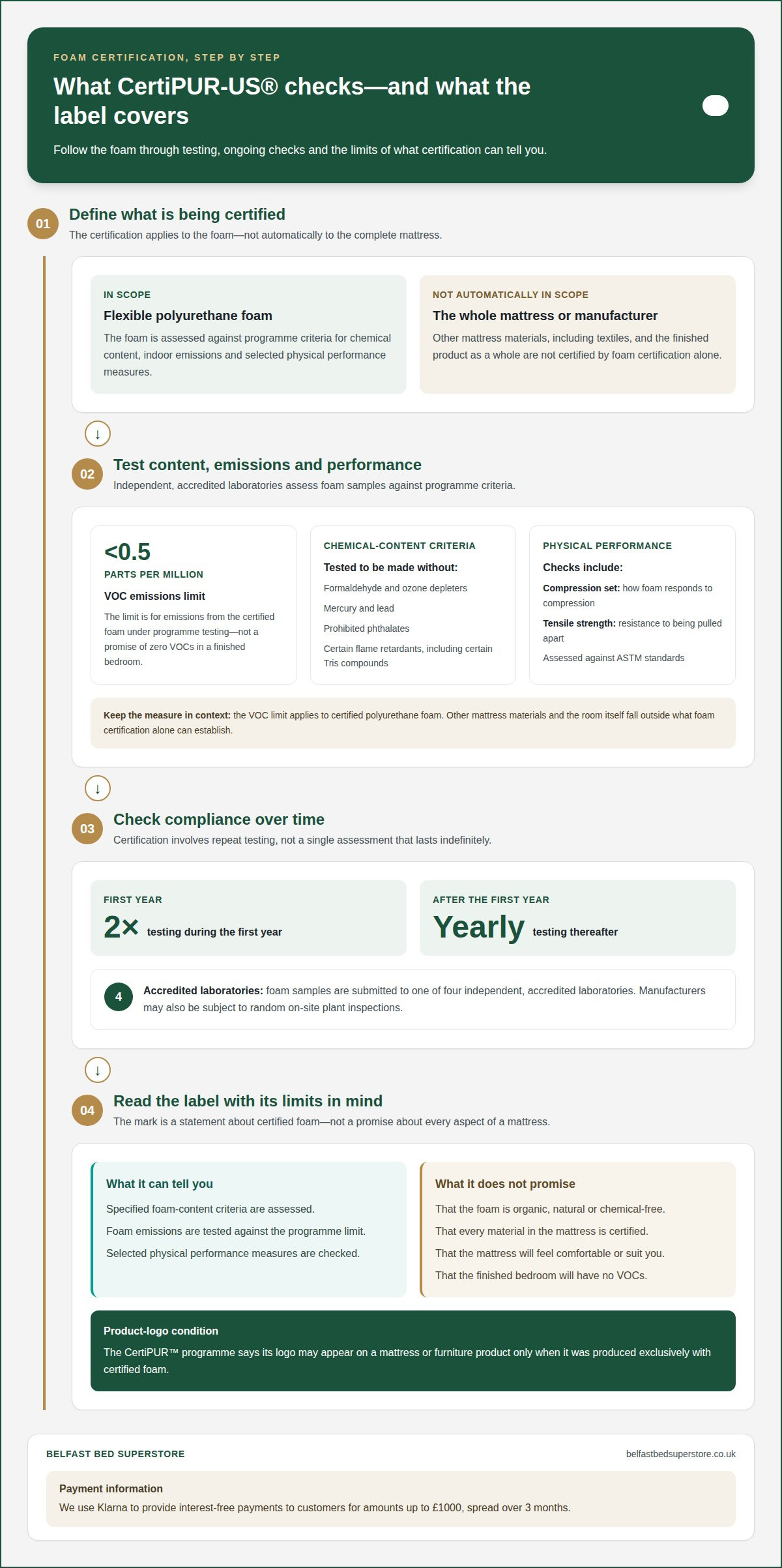
CertiPUR-US® tests flexible polyurethane foam for specified chemical content, emissions and physical performance. It does not certify a whole mattress. The programme sets limits for certain harmful substances and volatile organic compound emissions, or VOCs. Certified foam must have VOC emissions below 0.5 parts per million for indoor air quality.
That threshold gives you a concrete measure of emissions, but it isn’t a promise of zero VOCs. Volatile organic compounds can be released into the air from materials, including new foam. CertiPUR-US® addresses this through emissions testing against its programme criteria. The certification also doesn’t mean foam is organic, natural or entirely chemical-free. It means the foam meets specified standards.
Substance testing covers exclusions as well as maximum limits for certain components. CertiPUR-US® certified foam is tested to be made without formaldehyde, ozone depleters, mercury, lead, prohibited phthalates and certain flame retardants, including certain Tris compounds. These criteria focus on the foam’s chemical content, not every material used in a finished mattress.
Testing also looks beyond chemical composition. Independent, accredited laboratories assess certified foam against criteria for content and indoor emissions. The programme also tests physical performance, including compression set and tensile strength against ASTM standards. Compression set relates to how foam responds to compression, while tensile strength measures its resistance to being pulled apart. These checks cover durability measures, but don’t predict whether a mattress will feel comfortable to you.
For indoor air quality, the below-0.5-parts-per-million VOC emissions limit is the key figure to understand. It refers to emissions from the certified polyurethane foam under the programme’s testing criteria, not a guarantee that a finished bedroom will have no VOCs. Other mattress materials and the room itself fall outside what foam certification alone can establish.
In short, which substances and emissions does CertiPUR test for? It assesses specified harmful substances, including formaldehyde, lead and prohibited phthalates, and measures VOC emissions against its indoor-air-quality limit. It also tests physical properties such as compression set and tensile strength, so the certification covers foam content, emissions and selected performance measures.
What does it mean when a foam is CertiPUR-US® certified?
CertiPUR-US® certification applies to flexible polyurethane foam, not automatically to a mattress, furniture range or manufacturer. The foam in a product is assessed against programme criteria for chemical content, indoor emissions and selected physical performance measures. This distinction separates a claim about foam from broader claims about the finished product.
Independent, accredited laboratories carry out the testing. Foam samples are submitted to one of four such laboratories, where testing assesses whether the foam meets programme requirements. Physical checks include compression set and tensile strength against ASTM standards. These measures relate to how foam responds to compression and pulling forces, not whether its feel or comfort will suit a particular sleeper.
Certification involves repeat testing, rather than a single assessment that lasts indefinitely. CertiPUR-US® certified foams must pass testing twice during their first year and annually thereafter. Independent laboratories test the foam to check ongoing compliance with programme specifications. Manufacturers may also be subject to random on-site plant inspections to examine whether production continues to meet requirements.
For readers asking how CertiPUR-US differs from CertiPUR in the UK and Europe, the names refer to programme terminology. CertiPUR™ is a voluntary testing, analysis and certification programme for polyurethane foam used in bedding and upholstered furniture, while CertiPUR-US® is the certification programme name used in the United States. While consumers encounter these labels in bedding, manufacturers sourcing commercial cushioning and packaging foam through suppliers like oemmaterials.com also track material specifications closely. Both relate to polyurethane foam, but read each certification label and its requirements as stated rather than assuming they apply to every material in a finished product.
OEKO-TEX® Standard 100 has a different focus. According to OEKO-TEX Association, it tests finished textile products for over 100 harmful substances. The scheme covers textiles, while CertiPUR-US® assesses flexible polyurethane foam. A mattress may contain both foam and textile parts, so the two certifications address different components rather than competing for the same purpose.
That distinction answers how CertiPUR-certified foam compares with OEKO-TEX-certified foam: CertiPUR-US® relates to foam content, emissions and physical measures; OEKO-TEX® Standard 100 relates to finished textiles and harmful substances. Neither label alone establishes a mattress’s comfort or certifies every material it contains. A metal bedstead is a separate bed-frame choice, so you can explore metal bedsteads while assessing mattress materials independently.
Importance of certification when choosing a mattress
Mattress certifications can help you understand specific materials or safety aspects, but each has a defined scope. For a useful comparison, separate foam certification from checks covering textiles, fire safety or cot-mattress construction.
Certification Scope Across a Mattress
CertiPUR-US® certification applies to flexible polyurethane foam, not automatically to every part of a mattress. A mattress may contain foam, textiles and other materials, so foam certification doesn’t describe all its components.
This distinction matters when reading a product label or description. A certification mark on a mattress or furniture product should not be taken to mean that every material or component is certified. The mark therefore relates to the foam used throughout that product, not to a general certification of its textiles, frame or overall construction.
Limits of Mattress Certifications
A certification addresses the criteria of its particular scheme; it doesn’t guarantee mattress comfort or overall quality. CertiPUR-US® certification also doesn’t establish that foam is chemical-free, eco-friendly or hypoallergenic.
That boundary helps set realistic expectations. A foam test can’t tell you whether a mattress’s firmness will feel comfortable, while a textile certification addresses different materials. A certification also doesn’t replace considering support, construction or suitability for the person sleeping on the mattress.
Checking Mattress Certification
Check the product description or label for the certification name and identify exactly which material it covers. For a CertiPUR™ logo on a mattress, the stated condition is that the product was made exclusively with certified foam.
Then distinguish a specific foam claim from a claim about the whole mattress. The CertiPUR-US directory is updated weekly and lets readers look for participating foam producers. A directory entry concerns the foam producer, so it shouldn’t be treated as proof that every material in a particular mattress is certified.
For a cot mattress in the UK, BS EN 16890 is identified as a mandatory standard covering firmness, flatness and structural safety. This addresses cot-mattress characteristics, rather than polyurethane foam chemistry. For adult mattresses sold in the UK, BS 7177 is identified as a mandatory fire safety standard. These standards and voluntary material certifications serve different purposes.
For a baby’s mattress, keep those purposes distinct: BS EN 16890 concerns cot-mattress firmness, flatness and structural safety, while CertiPUR-US® relates to polyurethane foam. A certification can inform one part of your decision, but it doesn’t determine comfort or establish that every material is covered. Look for the named scheme and the component it applies to before drawing conclusions about what the mattress contains.
Restrictions on substances in polyurethane foam
CertiPUR-US® sets substance criteria for polyurethane foam, including prohibited chemicals and maximum limits for some components. These restrictions apply to the foam, not automatically to every material in a mattress.
Restricted Substances in Foam
The certification programme defines which substances certified polyurethane foam must exclude and which components have maximum limits. This distinction matters: a restriction on a specified chemical doesn’t mean the foam contains no chemicals at all.
When comparing mattress descriptions, ask whether the claim names the foam and the certification. A foam-content standard concerns the material assessed, while fabric and other mattress components have separate material scopes.
Substances Excluded from Certified Foam
CertiPUR-US® certified foam is tested to be made without formaldehyde, ozone depleters, mercury, lead, prohibited phthalates and certain flame retardants. The programme also excludes certain Tris flame retardants, including TCEP, TDBPP, TDCP and TEPA.
These names identify specific chemical restrictions, not a general promise about every substance used across a finished mattress. Keeping the scope clear helps you interpret what a foam certification actually says.
Flame retardants are a category, not a single chemical. The programme’s restriction concerns certain compounds within it, including the named Tris examples. It would be inaccurate to interpret this as a statement that every flame retardant is excluded from every mattress material.
Phthalates also require precise wording. Certain phthalates are classified as harmful to human health and are prohibited in consumer products in the UK and EU. CertiPUR-US® certified foam is tested to be made without prohibited phthalates, but the certification doesn’t assess every material in the product.
Ozone depleters and volatile organic compound emissions are distinct parts of the wider chemical picture. The programme prohibits ozone-depleting substances in foam production and separately sets criteria for foam emissions. One restriction shouldn’t be mistaken for a blanket statement that all chemicals or emissions are absent.
A practical way to read the claim is to separate three things: the polyurethane foam, the restricted substances and the rest of the mattress. For example, mattress fabric or a barrier layer isn’t polyurethane foam, so foam certification alone doesn’t establish its chemical composition.
That boundary is useful when product descriptions mention both foam and fabric. CertiPUR-US® addresses specified content in polyurethane foam, including restrictions on named substances and limits for some components. It doesn’t turn a material-specific certification into a chemical-free claim for the entire mattress.
Checking whether a product uses certified foam
To check whether a mattress uses certified foam, match the claim to the product and material it covers. If you’re asking, “What does CertiPUR certified foam mean for this mattress?”, look for clear wording about the foam inside that specific product.
Start with the product description, packaging or label. Look for “CertiPUR-US®” alongside a direct statement that the mattress uses certified polyurethane foam. A general mention of certification elsewhere on a brand page doesn’t establish which mattress or component the claim refers to. For example, a claim about a foam pillow shouldn’t be read as certification of a mattress.
Next, read how the logo is used. Under the programme’s stated condition, the CertiPUR™ logo may appear on a mattress or furniture product only when it was made exclusively with certified foam. That’s different from saying one foam layer is certified while other foam layers are not. If the product wording describes only one layer, keep the claim limited to that layer.
- Identify the product: match the certification wording to the exact mattress model, not just its manufacturer.
- Identify the material: confirm the statement refers to polyurethane foam, rather than fabric or another component.
- Read the scope: distinguish a claim about certified foam from a claim about the whole mattress.
- Check the programme: the CertiPUR-US directory is updated weekly and lists foam producers participating in the programme.
The directory can help verify a producer’s programme status, but it isn’t a product-by-product list of every mattress using that producer’s foam. A directory entry alone doesn’t show which model contains the certified material. The product description and label still need to connect that mattress with its foam clearly.
Manufacturers may use certification language alongside other material claims. Keep them separate: CertiPUR-US® concerns flexible polyurethane foam, while a textile label such as OEKO-TEX® Standard 100 concerns finished textile products. A fabric claim cannot substitute for a foam claim, even when both appear in one product description.
If you’re concerned about indoor emissions, check that the stated certification is specifically CertiPUR-US®, rather than relying on broad wording such as “tested” or “low emissions”. The programme tests foam against criteria for content and indoor emissions; vague wording doesn’t identify the test or material assessed.
For a specific model, ask yourself, “What does CertiPUR certified foam mean here?” Match the product name to the foam claim, then consider what the certification covers. For help choosing a mattress, explore mattress options suited to your needs.
Belfast Bed Superstore: Memory Foam Pillows
Belfast Bed Superstore offers memory foam pillows and mattresses from Hypnos, Sealy and Relyon for shoppers comparing comfort, materials and product details. If you’re weighing up options after learning what foam certification covers, use that information to understand specific material claims, while choosing a mattress or pillow that feels right for you.
We also use Klarna to provide interest free payments to customers for amounts up to £1000, spread over 3 months. This payment option is separate from mattress certification, so consider each choice on its own merits.
Belfast Bed Superstore can help you explore its pillow and mattress options in Cambridge and Cambridgeshire. Visit the showroom to compare products and discuss your bedding needs.
Choose the details that matter for your sleep
Understanding what CertiPUR-certified foam means gives you a clearer starting point, but your next choice is personal: consider how you like a mattress to feel and the support you want from it. Certification can inform your decision without choosing your ideal comfort level for you.
If you’re ready to compare options, Belfast Bed Superstore offers Hypnos, Sealy and Relyon mattresses. Consider your preferred feel and how you sleep, then explore which mattress could suit your bedroom and routine. Taking time over those details can make the decision simpler and more considered.
A new mattress can help make your bedroom a more comfortable place to unwind. Keep material information in perspective, trust your own comfort preferences and take the next step when you’re ready.
Explore mattresses at Belfast Bed Superstore, and find an option that feels right for you.
Frequently Asked Questions
Is CertiPUR-US® the same as organic?
No. CertiPUR-US® certification doesn’t mean polyurethane foam is organic or natural; it addresses specified chemical-content and emissions standards. If a mattress description uses both terms, treat them as separate claims and identify the material each refers to. For example, an organic claim about a textile component doesn’t establish that the foam is organic, and CertiPUR-US® alone doesn’t establish organic sourcing.
How often is the foam retested?
CertiPUR-US® certified foam must pass testing twice during its first year and annually thereafter. This recurring testing checks whether foam continues to meet programme specifications, rather than relying only on its initial assessment. Manufacturers may also be subject to random on-site plant inspections. When comparing products, distinguish this ongoing foam compliance process from testing of a finished mattress model.
What are CertiPUR-US certified 25% biobased foams?
These are certified foams that meet the programme’s criteria and are additionally analysed for biobased content. The stated 25% figure describes the biobased-content category, not a claim that the entire mattress is 25% biobased. Testing uses ASTM D6866-22 Method B, with analysis by an independent ISO 17025-accredited laboratory. The label therefore relates to the foam’s tested biobased content.
What does CertiPUR certification mean for foam?
It means flexible polyurethane foam has been tested against programme criteria covering content, indoor emissions and selected physical performance measures. In practical terms, the certification distinguishes assessed foam from an unqualified claim about a mattress. It doesn’t identify the foam’s firmness or tell you how it will feel during sleep, so consider material information alongside your own comfort preferences.
What are the current CertiPUR-US limits for VOC emissions and harmful substances?
CertiPUR-US® certified foam must have VOC emissions below 0.5 parts per million for indoor air quality. It is also tested to be made without formaldehyde, ozone depleters, mercury, lead, prohibited phthalates and certain flame retardants. These criteria apply to certified polyurethane foam. They don’t mean that every material in a finished mattress has the same certification or substance limits.
Does CertiPUR certification apply to the finished mattress or only its foam?
CertiPUR-US® certifies flexible polyurethane foam, not an entire mattress. A mattress may combine foam with fabric, other materials and construction components, each outside the foam certification’s scope. For example, a CertiPUR-US® statement doesn’t establish that a mattress cover has been tested under the same programme. Read the product wording to identify the exact component covered by each claim.
How can I check whether foam is genuinely CertiPUR certified?
Look for CertiPUR-US® wording tied to the exact product and its polyurethane foam, rather than a general claim about a manufacturer. The programme’s directory of foam producers is updated weekly and can help you check producer participation. A directory entry alone doesn’t identify every mattress using that producer’s foam, so check that the product information links the certification to the specific mattress model.
What does CertiPUR certification not guarantee about a mattress?
It doesn’t guarantee that a mattress will feel comfortable, suit your preferred firmness or meet your expectations for overall quality. Nor does it establish that the foam is chemical-free, hypoallergenic or eco-friendly. Treat the certification as information about assessed foam, then consider the mattress’s feel and construction separately. Certification can inform your choice, but it can’t make the comfort decision for you.


