

A mattress can still need a fire label even when it doesn’t need the familiar display label. From 30 October 2025, the fire safety regulations for UK mattresses no longer require manufacturers to attach a display label to new products, but permanent-label obligations remain.
It’s understandable to find the rules confusing: the label is only part of the picture, and the mattress filling and intended use matter too. This guide explains when a permanent label is required, how rules apply to foam and composite fillings, and what cigarette, match and Crib 5 tests involve.
You’ll also see how the tests differ for domestic and higher-hazard settings, so the terminology is easier to follow when choosing a mattress. If you’re buying as you read, we use Klarna to provide interest free payments on amounts up to £1000, spread over 3 months.
Key Takeaways
- New mattresses no longer need a display label from 30 October 2025, but permanent-label obligations remain.
- Learn how mattress hazard classifications relate to the level of fire testing required for different settings.
- Foam and composite fillings have distinct requirements, so the materials inside a mattress matter as well as its outer cover.
- Understand how cigarette, match and Crib 5 tests differ, and why a Crib 5 rating is relevant to some contract settings.
- When buying a mattress, we use Klarna to provide interest free payments on amounts up to £1000, spread over 3 months.
Do mattresses need a fire label in the UK?
Yes. UK mattresses must carry a permanent fire-safety label, even though the rules for display labels changed in 2025. The fire safety regulations for UK mattresses also connect the label with the product’s hazard classification and manufacturing details.
Mattress Labels and Hazard Classifications
A mattress label gives fire-safety information, including its BS 7177 hazard classification. BS 7177 groups mattress use into four categories: Low, Medium, High and Very High.
The category indicates the level of fire testing associated with a mattress’s intended setting. A domestic mattress and one designed for a higher-hazard environment may have different classifications. Check the label to identify the applicable category, rather than judging by appearance or filling alone. This distinction matters when selecting a mattress for a home bedroom or a contract setting.
Permanent and Display Labels
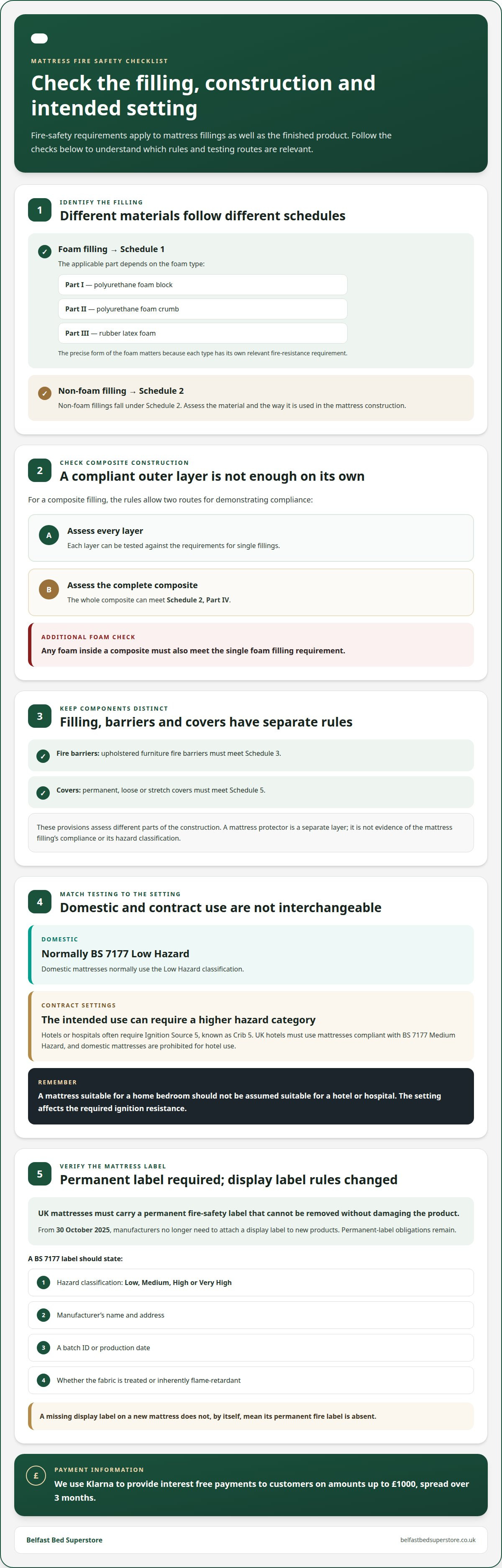
A permanent label remains attached to the mattress, while a display label provides information at the point of sale. UK mattress products must carry a permanent label that cannot be removed without damaging the product.
A BS 7177 label should state the hazard classification, manufacturer’s name and address, and a batch ID or production date. It should also indicate whether the fabric is treated or inherently flame-retardant. Under regulation 11, permanent-label requirements are set out in Schedule 7. These details help identify the product and its relevant fire-safety information after purchase.
Fire Labels and the Amendment
The Furniture and Furnishings (Fire) (Safety) (Amendment) Regulations 2025 came into force in the United Kingdom on 30 October 2025. The amendment removed the requirement for manufacturers to attach a display label to new products, but permanent-label obligations remain.
A missing display label on a new mattress does not, by itself, mean its permanent fire label is absent. The change concerns display labelling, not the requirement for permanent mattress labelling. Understanding the fire safety regulations for UK mattresses means distinguishing the point-of-sale label from the label attached to the product.
For second-hand furniture, suppliers should follow regulation 14 of the amended Furniture and Furnishings (Fire) (Safety) Regulations 1988 for permanent labelling. Upholstered headboards, footboards and side rails must carry both display and permanent labels, so their rules differ from mattress labelling.
When looking at a mattress, distinguish its attached permanent label from any display label. The permanent label’s BS 7177 classification helps explain the hazard category, while the listed manufacturer and production details identify the product. The label is one useful part of understanding the applicable fire-safety requirements; filling rules and testing also matter.
Fire safety requirements for single and composite fillings
Fire rules apply to mattress fillings as well as the finished product. The relevant requirements depend on whether the filling is foam, non-foam or a combination.
Requirements for Filling Types
A single filling is assessed according to its material, while composite fillings must meet requirements for their layers or as a complete construction. Foam fillings fall under Schedule 1 of the Furniture and Furnishings (Fire) (Safety) Regulations 1988; non-foam fillings fall under Schedule 2.
For composite fillings, every layer can be tested against the rules for single fillings, or the whole composite can meet Schedule 2 Part IV. Any foam inside that composite must also meet the single foam filling requirement. This distinction matters because a compliant outer layer alone doesn’t establish compliance for the filling beneath it.
Fire Resistance of Fillings and Covers
Schedule 1 separates foam by type: polyurethane foam block is covered by Part I, polyurethane foam crumb by Part II, and rubber latex foam by Part III. Each material has its own relevant fire-resistance requirement, so the filling’s precise form matters.
For upholstered furniture, fire barriers must meet Schedule 3, while permanent, loose or stretch covers must meet Schedule 5. Those provisions distinguish the barrier, filling and fabric cover rather than treating them as one material. The required assessment therefore follows the component and its place in the construction.
Domestic and Contract Requirements
Domestic mattresses normally use the BS 7177 Low Hazard classification. Contract use can call for a higher hazard category: mattresses for hotels or hospitals often require Ignition Source 5, known as Crib 5.
UK hotels must use mattresses compliant with BS 7177 Medium Hazard, and domestic mattresses are prohibited for hotel use. The setting therefore affects the required ignition resistance. A mattress suitable for a bedroom at home shouldn’t be assumed suitable for a hotel or hospital.
BS 7177 sets mattress testing levels, while filling rules apply alongside it. Foam and latex components must be fire-tested individually under Schedule 1, Parts 1 and 3, for domestic or commercial mattresses. For a composite, the separate-layer route and the whole-composite route address different ways of demonstrating that its construction meets the applicable requirements.
Some products removed from the furniture regulations’ scope still have general product-safety requirements. In Great Britain, those products must meet the General Product Safety Regulations 2005. In Northern Ireland, they must meet EU Regulation 2023/988 on General Product Safety. The applicable rules therefore depend on where the product is supplied.
A mattress protector is a separate layer, not evidence of the mattress’s filling compliance or hazard classification. For a bedding layer, browse our mattress protectors, while keeping the mattress’s own fire-safety requirements in view.
What is a Crib 5 mattress?
A Crib 5 mattress meets the BS 7177 Medium Hazard category, also called Ignition Source 5. UK hotels must use mattresses compliant with this category, so the intended setting matters when you’re assessing a mattress.
Manufacturers and importers must ensure products meet applicable fire-safety requirements, including those for fillings and intended use. Retailers should supply compliant products and accurate information, including details of applicable fire labels. Clear, traceable product information matters throughout the supply chain.
For a purchase, start with the intended setting: a domestic bedroom, hotel or hospital. Then identify the mattress’s stated BS 7177 hazard category. A domestic classification does not establish suitability for hotel use, where Medium Hazard compliance is required. Matching the category to the setting is more useful than relying on a general claim that a mattress is “fire resistant”.
Check that the fire-safety information relates to the mattress itself. A BS 5852 certificate for upholstered seating cannot substitute for a mattress certificate. This matters when a bed includes an upholstered bed frame or headboard: those are separate items, and their compliance doesn’t establish the mattress’s classification. Keep the mattress and bed components distinct when considering product information.
Crib 5 is not the same as Crib 7. BS 7177 High Hazard mattresses require low-hazard tests plus Ignition Source 7; Very High Hazard mattresses use the High tests and extra requirements set by the specifier. Some high-risk environments, including prisons, offshore facilities and some healthcare settings, require Crib 7 testing. The right rating depends on the setting, not simply the mattress’s build.
A common misconception is that a mattress complies simply because its cover or one filling layer resists ignition. Composite fillings have separate compliance requirements, and a covering material alone does not show that the complete mattress meets its relevant standard. Product information must match the mattress and its construction.
Non-compliance can carry serious consequences. The stated penalties include fines of up to £5,000 per non-compliant item and imprisonment for up to 6 months. For domestic upholstered furniture, the first supplier must keep compliance records for five years. Clear records help establish product traceability and support checks on the mattress’s intended use and applicable hazard category.
These checks help buyers distinguish a genuine Crib 5 mattress from a general fire-resistance claim. The category, setting and product-specific compliance information should align before the mattress is used in a contract environment.
UK furniture fire safety regulations
The Furniture and Furnishings (Fire) (Safety) Regulations 1988 apply flammability requirements to domestic upholstered furniture supplied anywhere in the United Kingdom, according to the UK legislation register. The core requirements therefore apply across England, Scotland, Wales and Northern Ireland.
British Standards for Mattresses and Furniture
British Standards describe ways to assess fire performance: BS 7177 covers mattresses, while BS 7176 covers upholstered furniture such as bed frames and headboards. These standards matter because a mattress and an upholstered bedstead are distinct products, with separate assessments. A BS 5852 certificate for seating, for example, cannot replace a mattress certificate.
The regulations use test methods based on BS 5852: Part 1, BS 5852: Part 2 and BS 6807 for materials in upholstered furniture. For mattresses, BS 7177 sets testing methods and performance levels. Identifying the item first helps distinguish which standard relates to its construction and use.
Regional Differences in Fire Safety Rules
For domestic upholstered furniture supplied anywhere in the UK, the 1988 Regulations provide the common flammability framework. That means the core furniture fire-safety requirements do not change simply because a mattress is sold in England rather than Scotland, Wales or Northern Ireland.
There is a separate distinction for some products removed from the regulations’ scope from 30 October 2025. In Great Britain, these products must meet the General Product Safety Regulations 2005; in Northern Ireland, they must meet EU Regulation 2023/988 on General Product Safety. The applicable general product-safety rules therefore depend on the UK nation.
The Furniture and Furnishings (Fire) (Safety) Regulations 1988 cover domestic upholstered furniture supplied for private use, including furniture in rented homes and guest accommodations. Ensuring safety and comfort is equally critical across the hospitality sector, where professional short-term letting specialists like Home Vacay focus on maintaining high accommodation standards for business and leisure guests. The regulations also apply to foam-containing mattresses, divans and bed bases sold in the UK. Furniture manufactured before 1950 or intended for export is outside the regulations’ stated scope.
Different parts address different components. Foam fillings fall under Schedule 1, non-foam fillings under Schedule 2, fire barriers under Schedule 3, upholstery composites under Schedule 4, and permanent, loose or stretch covers under Schedule 5. For example, a mattress with foam and a fabric cover involves separate component requirements, not a single test for the whole bed.
Under regulation 5, upholstery must pass a cigarette test; mattresses, bed bases, pillows and cushions are excluded from that specific requirement. Regulation 8 requires permanent covers to pass a match test, but mattresses, bed bases, pillows and cushions are again excluded. Those exclusions do not remove the separate mattress and filling requirements.
Commercial settings can call for higher hazard performance. UK hotels must use mattresses meeting the BS 7177 Medium Hazard category, while domestic mattresses are prohibited for hotel use. Some high-risk environments, including prisons, offshore facilities and certain healthcare settings, may require Crib 7. The setting and specification determine which hazard level is relevant, so domestic and contract requirements should not be treated as interchangeable.
Cigarette, match and Crib 5 mattress tests
BS 7177 Low Hazard mattress testing includes cigarette and match-equivalent tests. Medium Hazard adds the Crib 5 test.
Cigarette Tests
The cigarette test assesses whether a smouldering cigarette ignites a mattress sample. For domestic mattresses, BS EN 597-1 provides the cigarette test within BS 7177 Low Hazard testing.
This test matters because smouldering ignition differs from a brief flame. The test examines the mattress’s response to a standard ignition source, rather than assuming its fabric or filling will resist ignition. BS 7177 also covers mattress pads, divans and bed bases, so the product type matters when interpreting test information.
Match Tests
The match test uses a flame to represent a small flaming ignition source. BS EN 597-2 is the match-equivalent test used for mattresses under the low-hazard assessment.
In the described test, a butane flame is applied to a mattress sample for 20 seconds. After removing the ignition source, flames must extinguish within 120 seconds. These conditions give the test a defined exposure and pass criterion. The match test complements the smouldering cigarette test, as each checks a different ignition scenario.
Crib 5 Tests
Crib 5 is the BS 6807 Source 5 test used for the BS 7177 Medium Hazard category. It adds a more demanding ignition source to the cigarette and match tests required for the lower hazard level.
The test uses a wooden crib as its ignition source. The test uses mattress samples measuring 50x50 cm. For BS 6807 Crib 5 testing, flaming combustion must cease within 10 minutes of ignition. Passing this test alongside the cigarette and match tests meets BS 7177 Medium Hazard.
The three tests are not interchangeable. A cigarette test measures resistance to smouldering, while the match test and Crib 5 test assess flaming ignition sources of different intensities. Together, these results help distinguish a Low Hazard mattress from one tested to Medium Hazard requirements.
BS 7177 classification depends on the intended use. Domestic mattresses are normally tested to Low Hazard; Medium Hazard includes Crib 5 in addition to the low-hazard tests. For contract use, the required classification can depend on the setting and its specified hazard level. A test result for one mattress should not be assumed to cover a different product or bed base.
These test names make product information easier to interpret: BS EN 597-1 identifies the cigarette test, BS EN 597-2 the match-equivalent test, and BS 6807 Source 5 the Crib 5 test. To explore mattress options with these distinctions in mind, browse mattress choices.
Belfast Bed Superstore: Mattress Protectors
Belfast Bed Superstore offers mattress protectors alongside Hypnos, Sealy and Relyon mattresses for customers in Cambridge, Cambridgeshire and East Anglia. A protector adds a bedding layer; it does not replace the mattress’s own fire-safety requirements or change its hazard classification.
When choosing a mattress, consider its intended setting and applicable fire-safety category. For everyday bedding protection, explore our mattress protectors, and choose a mattress that suits your needs and how you will use it.
Contact Belfast Bed Superstore if you’d like help exploring mattress and protector options.
Choose a Mattress That Fits Your Next Step
Choosing a mattress means considering both its intended use and the comfort you want. The fire safety regulations for UK mattresses are part of that decision, alongside practical preferences such as support and feel. Keeping these factors in mind can help you choose an option suited to your home or setting, rather than relying on appearance alone.
Belfast Bed Superstore offers Hypnos, Sealy and Relyon mattresses. Comparing these options is a practical starting point when considering different mattress choices. Suitability for a particular setting depends on the mattress’s own fire-safety information, so keep your intended use central as you decide.
If you’re ready to discuss your mattress options, contact Belfast Bed Superstore. We’re here to help you take the next step towards a more comfortable night’s rest.
Frequently Asked Questions
What Are the Legal Fire Safety Requirements?
Mattresses supplied in the UK must meet the fire-safety requirements that apply to their materials and intended use. The Furniture and Furnishings (Fire) (Safety) Regulations 1988 cover relevant fillings, while BS 7177 sets mattress ignition-resistance performance levels. For a domestic mattress, BS 7177 Low Hazard is the usual benchmark. Contract settings, such as hotels, can require a higher classification. A permanent label also provides important product and hazard information.
What are the products covered by the regulations?
The regulations cover domestic upholstered furniture, including mattresses, bed bases, pillows and mattress pads, often called toppers. They also apply to furniture supplied for private use in rented homes. A bedstead or headboard with upholstery is treated as furniture, distinct from the mattress resting on it. Furniture made before 1950 or intended for export is outside the regulations’ stated scope, so product type and intended supply both matter.
What does Crib 5 mean?
Crib 5 means a mattress meets the BS 7177 Medium Hazard classification, also described as Ignition Source 5. It is relevant to contract settings where the specification calls for that hazard level, including UK hotels. The name refers to the ignition source used in testing, not a mattress size or construction style. A domestic classification alone does not establish that a mattress is suitable for hotel use.
What is the Crib 5 test?
The Crib 5 test assesses a mattress sample using a five-tier wooden crib made from 20 sticks. Under BS 6807 Source 5 testing, the sample is exposed to this ignition source, and flaming combustion must cease within 10 minutes of ignition. The result forms part of a wider Medium Hazard assessment, alongside the cigarette and match-equivalent tests. Passing only one of those tests does not establish the full classification.
Why is Crib 5 testing important?
Crib 5 testing helps determine whether a mattress meets the Medium Hazard level required for certain contract uses. This matters particularly in hotels, where domestic mattresses are prohibited and mattresses must meet BS 7177 Medium Hazard. The test provides information about performance against a defined ignition source. It is not a universal requirement for every home mattress, so intended use is central to choosing the right classification.
What UK fire safety regulations apply to mattresses sold to consumers?
The main furniture-specific rules are the Furniture and Furnishings (Fire) (Safety) Regulations 1988, alongside mattress testing under BS 7177. The regulations address mattress and bed-base fillings, while BS 7177 gives hazard classifications and associated performance levels. Consumers can use the permanent label to identify a mattress’s classification and manufacturing details. Some products excluded from the furniture regulations have separate general product-safety requirements, which differ between Great Britain and Northern Ireland.
What are the Furniture and Furnishings (Fire) (Safety) Regulations 1988 requirements for mattresses?
The 1988 Regulations set fire-resistance requirements for mattress fillings according to material type. Foam fillings are covered by Schedule 1, and non-foam fillings by Schedule 2. For a composite filling, each layer can meet its single-filling requirements, or the complete composite can meet Schedule 2 Part IV. Any foam within a composite must still meet the single foam filling requirement. Covers and barriers have separate provisions.
What fire-resistance tests and standards must UK mattresses pass?
BS 7177 sets the mattress hazard categories and testing levels. Low Hazard testing normally includes a smouldering cigarette test under BS EN 597-1 and a match-equivalent test under BS EN 597-2. Medium Hazard adds the BS 6807 Source 5 Crib 5 test. High Hazard uses the low-hazard tests plus Ignition Source 7, while Very High Hazard adds requirements set by the specifier. The required level depends on intended use.


