

A familiar mattress may work on an adjustable bed. Can you use a normal mattress on an adjustable base? Yes, if its construction can bend and move with the base. Whether you can keep your current mattress depends on its type, materials and build, not simply on whether it’s labelled “special”.
It’s sensible to be cautious: a mattress that feels comfortable on a flat bed may not suit a base that changes position. You may not need to replace yours, though. Compatibility depends on the mattress type, materials and construction.
Here, you’ll learn which foam, latex, hybrid and spring constructions are more likely to work, how thickness can affect movement, and what to look for in the mattress’s edges and layers. We’ll also explain why some traditional designs may be less suitable, so you can make a more confident choice for comfortable, supported rest.
Key Takeaways
- A regular mattress may work on an adjustable base if its construction can flex with the base’s movement.
- Foam, latex and flexible hybrid designs are among the types commonly suited to adjustable beds.
- Use mattress thickness as one compatibility factor, alongside how easily the mattress bends and fits the base.
- Traditional spring designs can be less suitable, especially when rigid parts restrict movement.
- Material, layer construction and edge support can all affect how well a mattress performs as the bed changes position.
Do you need a special mattress for an adjustable bed?
No, a mattress doesn’t have to be labelled “special” to work on an adjustable bed. What matters is whether its construction can flex with the base without restricting movement.
Regular Mattress Compatibility
A regular mattress can work on an adjustable base if it bends as the bed changes position. The label alone won’t tell you whether your current mattress is suitable. A flexible memory foam mattress, for example, may move with the base, while a rigid construction may resist bending.
Consider how the mattress responds along its length. When the base raises the head or foot, the mattress needs to follow rather than stay flat or lift away from the support. If it doesn’t move with the base, it may feel uncomfortable or restrict adjustment.
Coil construction matters, too. Traditional innerspring mattresses with rigid border wires are often unsuitable because the wires can resist movement. Some innerspring designs use coils that flex, while pocketed coils are generally a better option than conventional innerspring coils. The construction, not simply the word “spring”, is key.
Manufacturer Compatibility Guidance
The mattress maker’s compatibility guidance can tell you whether a specific mattress is designed for an adjustable base. Look for the maker’s recommendations instead of relying only on broad descriptions such as “foam” or “hybrid”. Mattresses in the same category can have different layers and support systems.
Use the maker’s guidance to identify any conditions for adjustable-base use. One flexible hybrid may be compatible, while another with a rigid frame may not bend as intended. If you have a custom mattress, its construction and the maker’s instructions are especially relevant.
Warranty terms matter as well. In the UK, coverage for use on an adjustable base depends on the mattress manufacturer’s wording. Check whether adjustable-base use is permitted and whether conditions apply. Don’t assume the warranty covers every base just because the mattress fits.
A headboard, footboard or mattress protector can be part of an adjustable-bed setup, but each must accommodate the base’s movement. A fixed footboard may obstruct the mattress and interfere with adjustment. A protector should stay in place without restricting flex.
Risks of an Incompatible Mattress
Yes, repeated bending may damage an incompatible mattress. Rigid border wires, stiff edges or layers that don’t move together can strain as the base changes position. This may cause deformation or reduce comfort, particularly if the mattress repeatedly resists movement.
An unsuitable mattress can also interfere with the adjustable base. If it won’t flex as the platform rises, it may pull away from its support or place extra strain on moving components. A rigid innerspring mattress, for example, may not follow the raised sections smoothly.
Check the mattress maker’s guidance and the base instructions before pairing them. Compare the mattress’s stated compatibility with the base’s movement, paying particular attention to rigid borders and coil construction. A mattress that follows the base smoothly is a better match than one that resists each adjustment.
Mattress thickness and compatibility
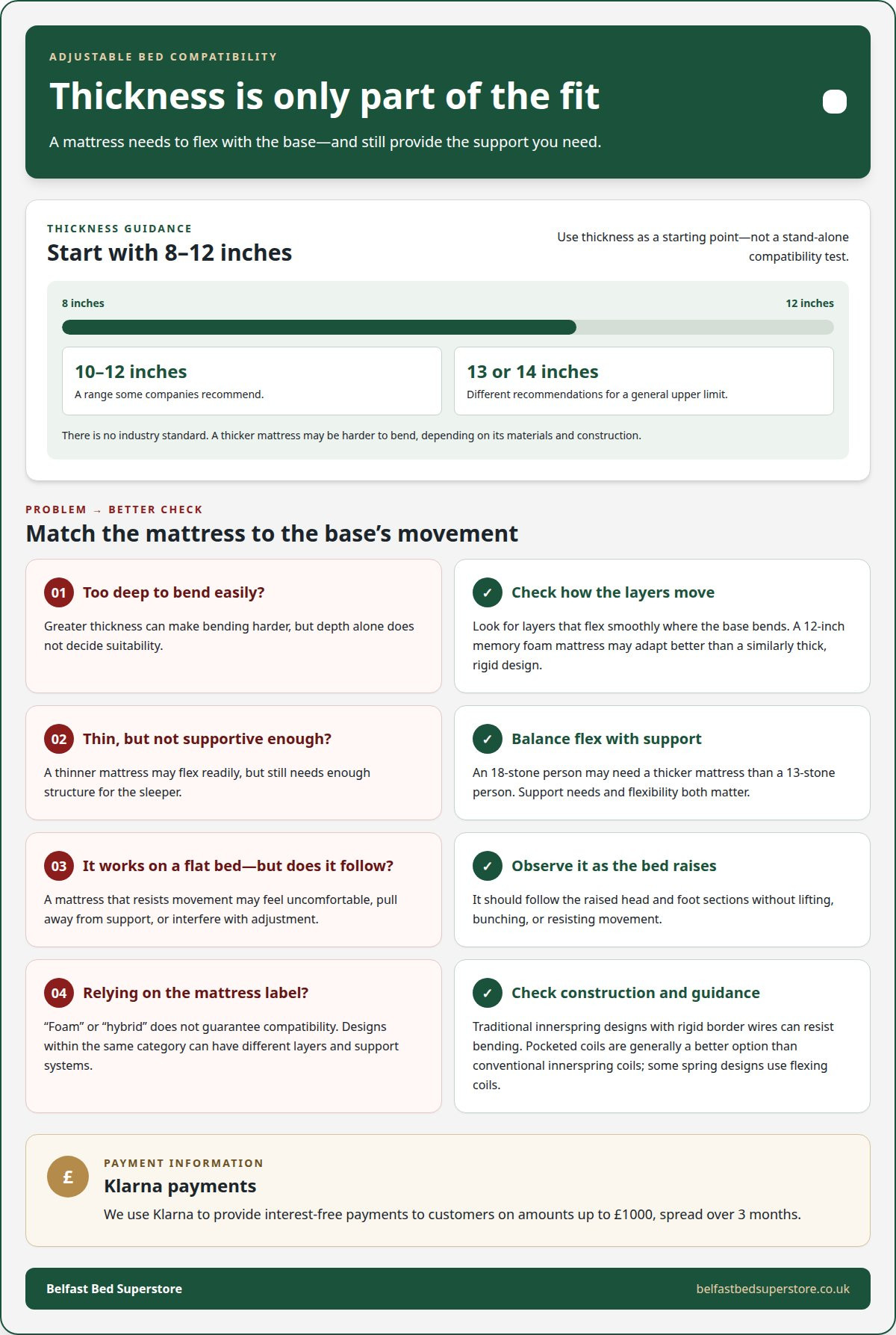
Mattress thickness affects how easily it bends as an adjustable base moves. A useful starting point is 8 to 12 inches, but flexibility and support matter alongside the measurement.
Mattress Thickness and User Weight
Mattress thickness and user weight work together to influence support and comfort. A thinner mattress may flex readily, but still needs enough structure to support the person using it. For example, an 18-stone person may need a thicker mattress than a 13-stone person. The right balance depends on both the sleeper’s support needs and the mattress’s ability to move.
Thickness alone doesn’t determine suitability. A deeper mattress may have layers that bend well, while a thinner design may feel firm and resist movement. Memory foam can contour to an adjustable base, but construction and feel still affect comfort. Consider how the mattress supports you when the bed is flat and raised.
Thickness and Flexibility Choices
Choosing a mattress thickness means combining the base’s movement with the mattress’s flexibility and support. An 8 to 12-inch mattress is a practical range to consider, while some companies recommend 10 to 12 inches. There’s no industry standard, so those ranges are guidance rather than a universal rule.
Guidance also differs on the upper limit: some recommendations say an adjustable-base mattress should generally be no thicker than 13 inches, while others say no thicker than 14 inches. A thicker mattress can be harder to bend, depending on its materials and construction. Match the mattress to the base’s instructions and the maker’s compatibility guidance.
Flexibility matters most where the base bends. The mattress should follow the raised sections without lifting, bunching or resisting movement. A thinner latex design may be more suitable because latex mattresses can be more rigid. For a thicker mattress, check that its layers flex smoothly rather than assuming its depth makes it unsuitable.
Use the measurements as a starting point, then consider how the mattress feels and moves. For example, a 12-inch memory foam mattress may be more adaptable than a similarly thick mattress with a rigid structure. A lighter sleeper may prioritise a comfortable, supportive feel, while a heavier sleeper may need more depth for support. In either case, a mattress that bends with the base is essential.
Mattress types that can be used with adjustable bases
Materials and construction determine how well a mattress follows an adjustable base. All-foam, latex and flexible hybrid designs are common options, while waterbeds and many inflatable mattresses are generally unsuitable.
Memory foam: Memory foam mattresses can adapt to a moving base. Their layers compress and flex as the head or foot section rises, helping the mattress follow the platform. Still, check that the specific mattress is suitable for adjustable use, as construction varies between models.
All-foam and bed-in-a-box: All-foam mattresses are often flexible enough to work with adjustable bases. Bed-in-a-box mattresses are usually made from foam, so they may also be suitable. The packed format doesn’t establish compatibility; the foam construction and mattress maker’s recommendations matter more.
Latex: All-latex mattresses can work on an adjustable base, and latex mattresses are durable enough for regular movement. However, latex can be more rigid than foam, so the mattress needs to bend with the base instead of bridging over raised sections. A thinner latex design may suit this movement better.
Hybrid mattresses: A hybrid combines foam or other comfort layers with a coil support system. It can work if its construction is designed to flex. Pocketed coils are generally preferable to traditional innerspring coils for adjustable use because they can move independently. The full construction still determines whether the mattress bends smoothly.
Innerspring mattresses: Some modern innerspring mattresses use coils that can flex on an adjustable base. Traditional designs with rigid border wires are often unsuitable because fixed edges may resist movement and become damaged. Check the full construction rather than assuming every spring mattress behaves the same way.
Airbeds and waterbeds: Some modern airbeds are designed for adjustable bases, but that doesn’t make every inflatable mattress compatible. Waterbeds and inflatable mattresses are generally considered unsuitable. Their structure may not follow the base’s movement like flexible foam or an airbed designed for this use.
For example, a flexible hybrid may bend with the raised platform, while a rigid traditional spring mattress may stay flatter and resist movement. That difference affects both function and durability. Choose based on construction and compatibility guidance, not category name alone. Even mattresses made from similar materials can behave differently on an adjustable base.
Mattress materials and construction
Materials explain how a mattress bends, while construction determines whether its layers move together. On an adjustable base, that flexibility helps the surface follow the platform and support you during sleeping. Two mattresses made from similar materials can behave differently if one has a rigid perimeter or tightly fixed layers.
Memory foam responds to pressure and can adapt to an adjustable bed’s contours. Its flexibility helps it follow raised sections, though the overall build still matters. A foam mattress with layers that move together, for example, may bend more smoothly than one with a stiff outer structure. Material is a useful clue, not the only factor.
Latex has a springier, firmer feel and can be more rigid than memory foam. That makes its thickness and construction relevant to movement. A thinner latex design may bend more readily than a deeper, firmer one. Its durability can suit regular movement, provided it flexes with the base instead of resisting each adjustment.
Hybrid construction combines comfort layers with a coil support system. Check how these parts work together: flexible upper layers can’t compensate for a rigid support unit that prevents bending. Individually wrapped coils may allow more movement than a connected coil system, while rigid border wires can restrict the edges. The complete structure determines flexibility.
Edge support deserves attention, too. Reinforced sides can help a mattress retain its shape and reduce sagging or deformation over time. However, a very rigid edge may resist the base’s movement. Look for enough structure to provide support while allowing the sides and central layers to follow the platform as it rises.
Heat and comfort are material considerations, too. Gel-infused memory foam may be an option for sleepers concerned about heat retention. That feature alone doesn’t establish compatibility with an adjustable base. The mattress still needs to bend with the base, and comfort depends on how its materials feel when the bed is flat and raised.
Assess the mattress as a whole, including its comfort layers, support core, edges and any firm border components. A flexible foam mattress with supportive edges, for example, may combine movement with shape retention. A mattress that bends in the centre but has rigid sides may behave differently. The manufacturer’s guidance can clarify how its specific construction is intended to perform on an adjustable base.
Whether adjustable beds need a special mattress
An adjustable bed doesn’t always require a mattress made specifically for adjustable use. A regular mattress may work if its construction bends with the base and the manufacturer’s guidance allows it. What matters is how the mattress behaves as the platform changes position, not whether its label says “adjustable bed mattress”.
That distinction matters because adjustable bases can move through many positions. A flexible mattress can follow the raised sections, while a rigid design may resist movement. An all-foam mattress, for example, may bend with the platform, while an innerspring model with rigid border wires may stay flatter. The mattress type offers a clue, but construction determines how it responds.
Consider three things together: the mattress, the adjustable base and their manufacturers’ guidance. The mattress must flex as the base moves, and the base must support the combined weight of the mattress, occupants, bedding and accessories. A mattress that fits when the platform is flat may still be unsuitable if it obstructs movement when raised.
Durability is another reason to match the mattress to the base. Regular bending puts movement demands on the mattress’s layers and edges. A flexible hybrid, for instance, needs a support system designed to move with its comfort layers. If these parts work against one another, repeated adjustment may strain the construction or affect its shape.
Use the mattress maker’s recommendations to determine whether the specific model is suitable. Then check the base maker’s instructions for any restrictions on construction or combined weight. Warranty coverage for adjustable-base use also depends on the mattress’s terms. This gives you a clearer answer than relying on broad descriptions such as “foam” or “spring”.
The takeaway is straightforward: a special label isn’t essential, but compatibility is. Keep a regular mattress if its construction flexes with the base and both manufacturers’ guidance supports the pairing. If you’re choosing a new setup, compare the mattress’s flexibility with the positions you plan to use, such as raising the head to read or lifting the foot section for rest.
To explore options for a mattress-and-base pairing, browse suitable mattress options.
Belfast Bed Superstore: Adjustable Beds
Belfast Bed Superstore offers adjustable beds alongside mattresses, including Hypnos and Sealy options, so you can consider the base and mattress together. When choosing a new setup, weigh mattress flexibility against the base’s movement. Mattress protectors are also available to help protect your sleeping surface.
We use Klarna to provide interest free payments to customers for amounts up to £1000, spread over 3 months.
For help exploring adjustable beds and mattress options, contact Belfast Bed Superstore.
Choose a setup that suits your next chapter of rest
Think about how you want your bed to support your routine. Perhaps you’d value an adjustable position for reading, or prefer a level surface for sleeping. Considering how you’ll use the bed can help you decide whether to keep your current mattress or choose a new pairing.
If you’re deciding whether you can use a normal mattress on an adjustable base, consider how well your mattress suits the way you’ll use the bed. This question is also a useful starting point when comparing a new mattress and base. Belfast Bed Superstore offers Hypnos Mattresses, Sealy Mattresses and Relyon Mattresses to consider alongside an adjustable bed.
A comfortable setup starts with a choice that fits your needs, not simply a label on the mattress. Contact Belfast Bed Superstore to discuss your next step and find a bed arrangement that feels right for your home.
Frequently Asked Questions
Are there specific materials that perform best on adjustable bases?
Memory foam and latex commonly suit adjustable bases because they can follow changes in position. A hybrid may work when its coil system and comfort layers are designed to move together. If heat retention affects your sleep, gel-infused memory foam is another material to consider. The mattress’s full construction still matters, so material alone doesn’t establish compatibility.
Can you use a standard mattress on an adjustable bed base?
Yes, a standard mattress can work if it’s compatible with the base and moves with it. “Standard” describes a conventional mattress, not how it behaves when raised. A flexible foam mattress, for example, may follow an adjustable platform, while a rigid spring design may resist movement. The mattress maker’s compatibility guidance is the best place to start.
Which mattress types work best with an adjustable base?
Memory foam, latex and flexible hybrid mattresses are common suitable choices. Some modern airbeds are also designed for adjustable bases. A bed-in-a-box mattress is often foam-based, but its packaging style doesn’t guarantee compatibility. Compare how each mattress’s support core responds when the base changes position instead of choosing by category name alone.
Can memory foam mattresses be used on adjustable beds?
Yes, a memory foam mattress can be used on an adjustable bed if its construction is compatible. Foam can adapt to the platform’s changing contours as the head or foot section rises. Consider whether the mattress follows both sections smoothly. The model’s own compatibility recommendations matter more than the words “memory foam” on its label.
Can innerspring or pocket-sprung mattresses bend on an adjustable base?
Some can, but coil construction makes a difference. Pocketed coils are generally preferred for adjustable use because they can move more independently than traditional connected coils. A conventional innerspring mattress with rigid border wires may resist bending. A spring mattress can still be unsuitable if its edges or internal construction stop it following the base.
Can a hybrid mattress be used on an adjustable bed?
Yes, if the hybrid is designed to flex with the base. A hybrid combines comfort materials with a coil support system, so both parts need to work together as the base moves. Flexible upper layers alone won’t make a rigid support unit suitable. Check the maker’s guidance for the specific model, since hybrid construction varies.
How can you tell if a mattress is compatible with an adjustable base?
Start with the mattress manufacturer’s compatibility recommendations, then compare them with the base instructions. Look for guidance on adjustable use, construction restrictions and any conditions. Observe whether the mattress follows the base without lifting or bunching. Also account for the total load, including the mattress, occupants, bedding and accessories, and compare it with the base’s weight capacity.
Can you use a standard UK king-size mattress on an adjustable base?
Yes, if the mattress and adjustable base are both designed for the same UK king-size dimensions and the mattress is compatible with adjustable movement. Check the size information for both items rather than assuming similar labels mean an exact fit. A mattress that overhangs the platform or sits improperly may interfere with movement, even if its construction can flex.


