

A mattress can feel supportive without feeling hard. A Kayflex mattress review should compare foam, gel-infused memory foam and latex-material constructions by how their cushioning and support match your preferred sleep feel. Latex is described as antimicrobial and able to repel dust mites, fungi and bacteria, but those properties alone don’t determine whether a mattress will suit you.
It’s understandable to want a mattress that eases pressure without feeling too warm or too soft. This Kayflex mattress review explains how foam, cooling gels and latex relate to cushioning, support and hypoallergenic claims, helping you compare materials before choosing a mattress in Cambridgeshire or East Anglia.
We’ll look at what each material can contribute, how to weigh comfort against support, and why a material’s properties are only part of the decision. You’ll have a clearer way to assess mattress descriptions against your comfort preferences and sleep position.
Key Takeaways
- Compare foam and gel-infused constructions by the feel and cushioning you want, rather than assuming a cooling feature guarantees a cooler night.
- Latex is described as antimicrobial and able to repel dust mites, fungi and bacteria, but material properties are only one part of choosing a comfortable mattress.
- Judge support and pressure relief together: consider how the mattress feels beneath your body and whether its comfort suits your sleeping needs.
- Read the delivery, trial, returns and warranty terms alongside safety information so you understand the practical details before deciding.
Foam technology and cooling gels
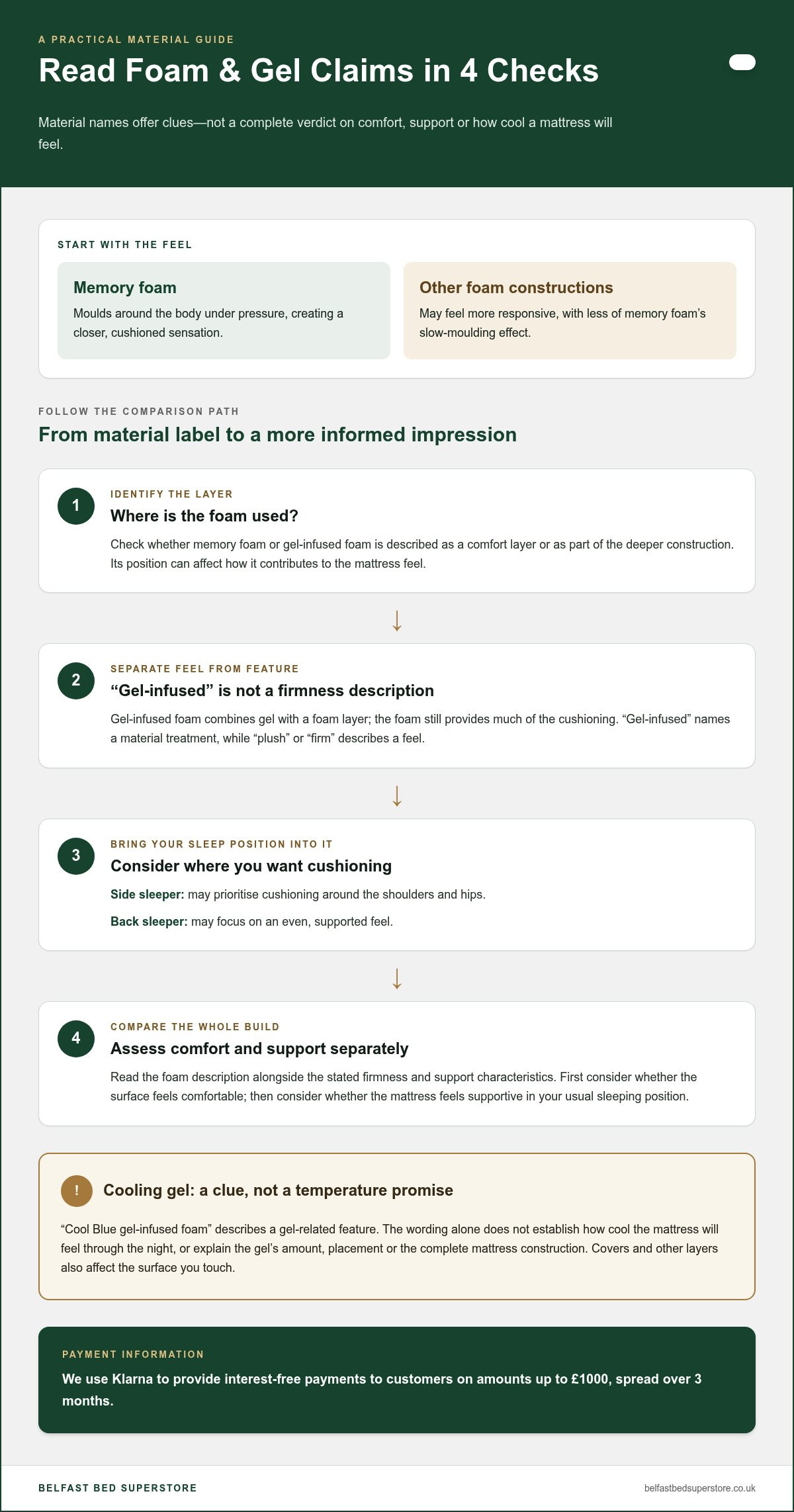
Foam mattresses can feel quite different, even when both use memory foam. The feel depends on how the foam responds to pressure, the depth of its comfort layers and the support beneath them. Memory foam moulds around the body under pressure, creating a closer, cushioned sensation. Other foam constructions may feel more responsive, with less of that slow-moulding effect. These descriptions help you compare materials, but they can’t tell you exactly how a mattress will feel to you.
Cooling gel is another feature to interpret carefully. Gel-infused foam combines gel with a foam layer, while the foam still provides much of the cushioning. “Cool Blue gel-infused foam” describes a gel-related feature, but the wording alone doesn’t establish how cool the mattress will feel through the night. It also doesn’t explain the gel’s amount or placement, or the construction of the complete mattress. Treat the label as a starting point for understanding the material, not a temperature measurement or a promise of a particular result.
Consider the complete construction, not just the gel name. Gel-infused foam in a comfort layer may feel different from foam deeper in a mattress, where it supports the layers above. Covers and other materials also affect the surface you touch. Two mattresses with gel-infused foam can still differ in firmness and cushioning if their layers are arranged differently. A feature name alone can’t explain those differences.
Use these practical steps to compare foam descriptions:
- Identify the layer. Check whether memory foam or gel-infused foam is described as a comfort layer or part of the mattress’s deeper construction.
- Separate feel from feature. “Gel-infused” names a material treatment; “plush” or “firm” describes a feel. Neither term replaces the other.
- Consider your sleep position. A side sleeper may prioritise cushioning around the shoulders and hips, while a back sleeper may focus on an even, supported feel.
- Compare the whole build. Read the foam description alongside the mattress’s stated firmness and support characteristics, rather than judging by one phrase.
In a Kayflex mattress review, gel and foam are useful clues, not a complete verdict. The overall construction and your comfort preferences shape how a mattress feels, including its cushioning and support. Consider those separately: first assess whether the surface feels comfortable, then whether the mattress feels supportive in your usual sleeping position. This helps put terms such as “Cool Blue” in context without treating them as proof of a guaranteed sleeping temperature.
Latex and hypoallergenic properties
Latex has a different feel from memory foam. It can offer a springier response, while memory foam is known for closer contouring. The actual feel depends on how latex is used in the mattress and on the surrounding layers. A description such as “latex material” identifies a component, but doesn’t say how much latex is present or whether it is natural or synthetic. Consider the full construction before drawing conclusions from one material name.
The term “natural latex” is a material description, but product details can vary. A rubber tree can produce latex for up to 30 years. Latex is described as antimicrobial and able to repel dust mites, fungi and bacteria. These properties may appeal to people considering bedroom materials and household allergens. However, “hypoallergenic” shouldn’t be read as “allergy-proof”. It describes a potential material characteristic, not a promise that every sleeper will have the same experience or that every allergen is excluded.
For a practical comparison, separate three questions:
- What is the material? Check whether the description says latex, latex material, natural latex or a blend. These terms don’t all describe the same composition.
- Where is it used? A latex layer near the surface may affect the first impression of comfort, while other mattress layers also shape support and overall feel.
- What does “hypoallergenic” mean here? Consider the stated properties, such as resistance to dust mites, fungi and bacteria, without treating the label as a guarantee against every sensitivity.
These distinctions matter when comparing a mattress with latex pillows. A pillow places its filling close to the face, while a mattress supports the body across a much larger surface. The same material name doesn’t mean the products will feel alike or serve the same purpose. Assess each item’s construction and comfort separately.
If latex is your priority, use the product description to understand its role rather than relying on the word alone. Note whether it is described as natural or blended, where it sits, and how the mattress is said to feel. Then compare those details with your comfort preferences. A hypoallergenic label alone doesn’t answer the Kayflex mattress review question: the material, complete construction and feel all matter. If you’re considering latex for both your bed and pillow, assess the comfort needs of each separately. Belfast Bed Superstore also offers latex pillows.
Mattress support and pressure relief
Support and pressure relief describe different parts of mattress comfort. Assess how the mattress holds your body and cushions contact points such as your shoulders and hips.
Mattress Support
Support is about how evenly a mattress holds your body, not simply whether it feels firm. Notice whether your hips and shoulders feel comfortable and whether your back feels settled in your usual sleeping position. A back sleeper, for example, can consider whether the middle of the body feels supported without the surface seeming rigid.
Compare the stated firmness with the mattress construction, then consider your body shape and sleeping position. A “firm” label alone doesn’t show how the mattress will feel beneath you. Look for balance: the surface should cushion you, while the mattress beneath feels steady rather than sagging or uneven.
Pressure Relief
Pressure relief refers to how a mattress cushions the areas of your body that press against it. Side sleepers can pay particular attention to their shoulders and hips, while back sleepers may notice pressure around the lower back. The surface should cushion these contact points without making you feel trapped or unsupported.
Foam can contour around the body, while other constructions may feel more responsive. Neither description proves that the mattress will provide suitable pressure relief for every sleeper. Notice whether you can settle into a comfortable position and turn easily. The balance between cushioning and movement matters as much as softness.
Use these checks to compare support with pressure relief:
- Start with your sleep position. Note where your body meets the mattress, such as the shoulder and hip when lying on your side.
- Assess the whole body. A soft surface can cushion one area yet feel inadequate elsewhere, so consider both comfort and steadiness.
- Compare descriptions carefully. Firmness, foam type and support describe different qualities. Don’t treat one label as a complete guide.
- Consider how you move. If you change position often, notice whether the surface feels easy to move across.
Consider a side sleeper who wants cushioning at the shoulders but dislikes sinking deeply. They can weigh the surface’s give against the steadiness underneath, rather than choosing by “soft” or “firm” alone. Keep your preferred sleeping position and comfort priorities in mind as you compare mattress descriptions. Support and pressure relief work together, but one doesn’t guarantee the other.
What are Kayflex mattress delivery, trial, returns, and warranty terms in the UK?
Delivery, trial, returns and warranty are separate parts of a Kayflex mattress purchase. Read each term as its own commitment: delivery covers arrival, a trial concerns trying the mattress, returns explain how an unwanted purchase is handled, and a warranty describes cover for specified faults. Those labels alone don’t establish the exact conditions that apply.
Delivery
For delivery, look for the method, stated timescale, whether delivery is to a room of your choice and what happens if access is difficult. A rolled mattress, for example, may arrive packaged differently from a full-size mattress, so plan where it can be received and unwrapped. Belfast Bed Superstore provides free delivery within Cambridgeshire, with two-person delivery to the room of choice. Check the product details for delivery arrangements to your address.
Trial and returns
A trial period and a returns policy aren’t interchangeable. A trial gives you time to experience the mattress under its stated conditions; a returns policy explains how a return is arranged and what requirements apply. Check when the trial starts, how long it lasts, the required mattress condition and any collection or return costs. Sleeping on a mattress, for example, differs from inspecting it immediately after delivery.
Read the return steps before purchase, not only after deciding the mattress feels wrong. Note how to start a return, the required mattress condition and whether the original packaging matters. Keep your order details and delivery records together. These practical steps make it easier to follow the stated process if the mattress doesn’t suit your comfort preferences.
Warranty
A warranty is different from a comfort trial. It describes the faults or issues covered and the process for making a claim, rather than offering a way to change your mind. Read the duration, coverage, exclusions and care requirements for the specific Kayflex mattress. A warranty may distinguish a manufacturing fault from a change in preferred firmness.
Keep proof of purchase and follow the mattress care instructions. Read the product description and warranty terms together, since care requirements can affect how cover applies. Don’t assume that a trial, return option and warranty share the same duration or conditions.
Before ordering, use this short checklist:
- Delivery: note the method, timescale and any access requirements.
- Trial: identify when it begins and the conditions for using it.
- Returns: understand the process, mattress condition and any stated costs.
- Warranty: record the coverage, exclusions and care instructions.
This approach keeps the practical details distinct when comparing Kayflex mattresses. A clear delivery arrangement helps you plan for arrival, while trial and return conditions explain your options if the comfort isn’t right. Warranty terms address a different concern: specified product faults. Review all four before deciding, and keep the relevant purchase information accessible after delivery.
Do Kayflex mattresses have UK safety certifications or comply with fire regulations?
A brand name alone doesn’t establish the safety status of every mattress model. For a Kayflex mattress, assess the exact product’s safety information and any named certification or testing evidence. Compliance and certification are related but not interchangeable: certification refers to a particular assessment, while a compliance claim concerns applicable requirements. Look for documentation specific to the product rather than relying on a general description.
Start with the mattress product page and accompanying documents. Check that they identify the model clearly and explain the safety claim. A logo without a named standard or explanation gives less useful detail than documentation linking the exact mattress to a specific assessment. Information for one Kayflex model doesn’t automatically apply to another with different materials or construction.
Use this checklist when reviewing the product information:
- Match the model. Ensure the document names the same Kayflex mattress you’re considering, not simply the brand.
- Identify the claim. Separate fire-safety compliance statements from wider claims about product quality or certification.
- Look for evidence. Note any named standard, testing organisation or certificate details included in the documentation.
- Read the scope. Check which mattress components or product version the evidence covers.
A fire-safety statement should make clear what it refers to. “Tested” isn’t the same as an explanation of the test, and a certification mark is most useful when its scope is described. For example, evidence about a mattress’s materials may not cover every element of the finished product. Keep this distinction in mind when comparing product pages or paperwork.
Safety documentation serves a different purpose from comfort features. Foam type, latex content, cooling gel and firmness describe materials or feel; on their own, they don’t demonstrate fire-safety compliance. Likewise, a warranty concerns specified product faults, not proof of safety certification. Consider each claim separately and connect it to the exact Kayflex model.
In your Kayflex mattress review, record the model name and the wording of each safety claim. Note whether the product information names a certification, standard or testing body, and what the evidence covers. This gives you a practical basis for comparing mattresses without treating a brand label or material description as a safety certificate. Keep the product details with your purchase records so you can refer to the same model information later.
Describe a Kayflex mattress as certified or compliant only when evidence for that specific model supports the claim; status may differ between models.
Belfast Bed Superstore: Hypnos Mattresses
Belfast Bed Superstore offers Hypnos mattresses for readers considering alternatives after comparing Kayflex materials and comfort. If your priorities are support, pressure relief or a different mattress feel, comparing options across brands can help you identify what matters most.
Alongside Hypnos, Belfast Bed Superstore offers Sealy, Relyon and Dunlopillo mattresses. Focus on the features that shape your decision: preferred firmness, cushioning and mattress construction. This keeps the comparison centred on your comfort, not brand names alone.
For a friendly next step, contact Belfast Bed Superstore to discuss its mattress range.
Choose the mattress feel that suits you
A Kayflex mattress review can help you understand materials and features, but the next step is deciding which comfort qualities matter in everyday use. Think about the feel you want each night and which details are essential. That gives you a clearer basis for comparing options.
If you’d like to broaden your comparison, Belfast Bed Superstore offers Hypnos, Sealy and Relyon Mattresses. We use Klarna to provide interest free payments on amounts up to £1000, spread over 3 months. Consider your preferred payment option alongside the mattress qualities that matter to you.
Contact Belfast Bed Superstore for advice and take your next step towards a mattress that feels right for you.
Frequently Asked Questions
What are Kayflex mattress firmness ratings and materials?
Kayflex mattresses may use foam, gel-infused foam or latex material. Their feel depends on the complete construction and cushioning. Compare stated firmness and support characteristics with your preferred sleeping position.
Are Kayflex mattresses suitable for back pain, side sleepers, or different body weights?
Side sleepers can prioritise cushioning at the shoulders and hips; back sleepers can assess whether the mattress feels evenly supportive and comfortable around the lower back. Consider whether it cushions contact points without leaving the body unsupported.
What is a Kayflex mattress and who makes it?
Kayflex mattresses are described as using foam, gel-infused memory foam or latex material.


