

To move a heavy mattress through your home, clear the route, protect it with a suitable cover and get help to carry it. Measure the mattress and narrow spots first, then lift with your legs, keep the load close and move slowly without twisting. Knowing how to move a heavy mattress safely starts with planning its route, not wrestling it around corners.
Moving a bed between rooms or floors can feel awkward, especially where doorways, stairs and landings leave little room to manoeuvre. A steady plan makes the job easier and helps protect both the mattress and your home.
This guide explains how to wrap, lift, turn and transport a heavy mattress, with practical steps for checking measurements and choosing a suitable vehicle. You’ll also learn when to pause and rethink the route instead of forcing the mattress through a tight space. From clearing the path to placing the mattress, each step helps you move carefully and keep it in good condition.
Key Takeaways
- Clear the route and protect the mattress before moving it to help prevent snags, dirt and damage.
- Get help for a heavy or awkward lift, and agree on how you’ll move before picking it up.
- Use a steady, controlled technique through doorways and stairs; pause and reassess if the mattress gets stuck.
- Measure the mattress and the tightest parts of the route before choosing how to transport it.
- Keep the mattress supported in the vehicle, with nothing stacked on top, and drive smoothly to reduce shifting.
How Do You Wrap a Mattress for Moving?
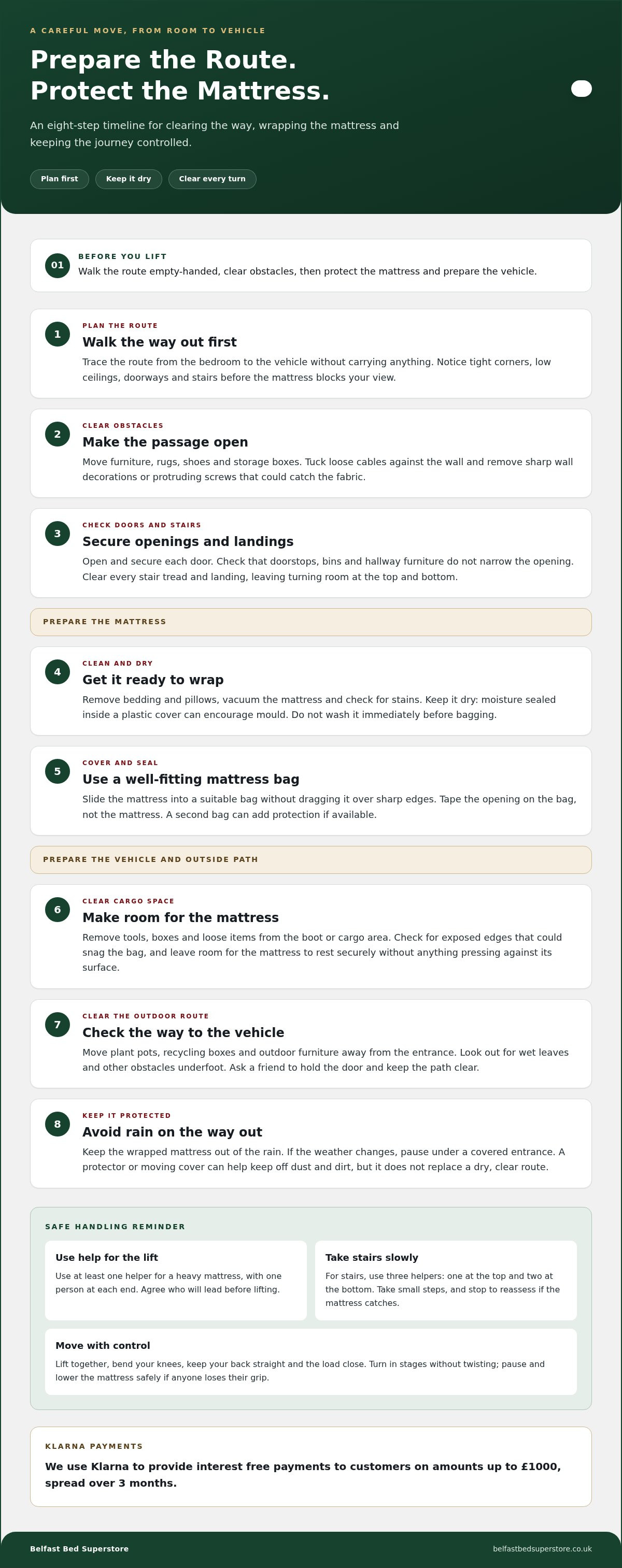
- Start by choosing a route from the bedroom to the vehicle. Walk it without carrying anything, from the mattress’s current position to the exit. Note tight corners, low ceilings, doorways and stairs. This walkthrough helps you spot obstacles before the mattress blocks your view or limits your movement.
- Clear furniture, rugs, shoes and storage boxes from the route. Move bedside tables away from doorways and tuck loose cables against the wall. Remove wall decorations, sharp picture hangings and protruding screws along the path. They can catch the mattress fabric or make a narrow passage harder to navigate.
- Open each door along the route and secure it so it won’t swing shut. Check that doorstops, bins and hallway furniture aren’t narrowing the opening. If you’ll use stairs, clear every tread and landing. Leave room at the top and bottom, where you may need to turn the mattress.
- Prepare the bedroom before wrapping the mattress. Remove bedding and pillows, vacuum the mattress and check for stains. Keep it dry: moisture trapped inside a plastic cover can encourage mould. Don’t wash the mattress immediately before bagging it. A clean, dry surface can be wrapped without sealing in dampness.
- Choose a mattress bag that fits, then slide the mattress in without dragging its fabric over sharp edges. Seal the opening with tape, keeping the tape on the bag rather than the mattress. Plastic can tear during handling, so add a second mattress bag for extra protection if you have one.
- Clear the vehicle’s loading space before bringing the mattress outside. Remove tools, boxes and loose items from the boot or cargo area, then check for exposed edges that could snag the bag. Make room for the mattress to rest securely, with nothing pressing against its surface during the journey.
- Keep the path between your home and vehicle clear before lifting. Move plant pots, recycling boxes and outdoor furniture away from the entrance. Check for wet leaves or other obstacles underfoot. Ask a friend to hold the door and keep the route clear while you carry the mattress.
- Keep the wrapped mattress out of the rain while moving it between your home and vehicle. If the weather changes, pause under a covered entrance rather than leaving the bag exposed. A mattress protector or moving cover can help keep off dust and dirt, but it doesn’t replace a dry, clear route.
Getting help to lift and manoeuvre a mattress
Use at least one helper to carry a heavy mattress, with one person at each end. For stairs, use three helpers, one at the top and two at the bottom, and move slowly with small steps.
-
Arrange Help for Lifting and Carrying
Ask a friend to help before you lift, then agree who will lead and which way you’ll turn. Each person should take an end and grip a firm edge, not loose fabric or a handle that may not support the weight. Make sure both people can hold their positions comfortably. Lift together only when you’re both ready.
-
Move the Mattress Between Floors
For stairs, position three helpers, one above and two below the mattress. Keep it under control, take small steps and pause on a landing if anyone needs to reset their grip. Don’t carry a large mattress downstairs alone. If it catches, stop and reassess the angle instead of forcing it.
- Agree on simple instructions before lifting. The person with the clearest view can call “stop”, “turn” or “lower” as needed. Signal before changing direction, especially at a hallway corner where the mattress may block someone’s view. Clear communication helps everyone adjust together instead of pulling against one another.
- Lift as a team, holding opposite ends and keeping the mattress close enough to control. Bend your knees, keep your back straight and rise slowly rather than jerking the load upwards. If the mattress shifts, lower it onto a clear surface before changing your grip. Don’t use straps unless everyone understands how they affect the hold and movement.
- Take small, steady steps through narrow hallways and keep the mattress balanced between helpers. Turn in stages: pause before a corner, check the space, then move the end nearest the turn while the other person guides it. Avoid twisting your back while carrying the load. A short pause is safer than rushing through a doorway.
- Before lifting again, check that every helper has secure footing and a clear view of the route ahead. On stairs, keep the pace slow and coordinated. The person at the top can guide the direction while the helpers below support the mattress. If anyone loses their grip, stop and lower it safely before continuing.
What Is the Easiest Way To Move a Mattress Without Damaging It?
Protect the mattress by checking its condition, planning each turn and choosing a safe way to move it. If you’re working alone, don’t attempt a lift you can’t control.
- Inspect the mattress before packing it. Vacuum the surface and note existing marks, loose seams or damaged fabric, so you can distinguish them from damage caused during the move. Don’t wash it just before putting it in a bag. A damp mattress sealed in plastic can develop mould, so let any moisture dry before wrapping.
-
Measure the Mattress and Plan the Path
Measure the mattress and compare its width and length with doorways, landings and tight corners. Walk the route and plan where you’ll turn, rather than discovering a pinch point mid-move. Check ceiling height and stair clearance too. Some super king mattresses can weigh up to 80 kg, so plan a route that avoids awkward lifts.
-
Gather Moving Supplies and Protective Bags
Gather a mattress bag, strong tape and a clean sheet or cardboard for sliding it across carpet. Specialist packaging providers such as Phoenix Supplies UK offer heavy-duty covers designed to shield beds and upholstery during transit. A second bag can reinforce the first if the plastic tears. Keep the mattress dry before wrapping, and seal the opening without sticking tape directly to the fabric. Keep sharp tools away from the mattress when removing packaging.
-
Move the Mattress Alone Without Damage
Ask someone to help lift a heavy mattress, especially on stairs or through a narrow hallway. If you’re moving a manageable mattress alone across one room, reduce lifting by placing cardboard beneath it and sliding it gently. Keep both hands on the mattress and move in short stages. Don’t attempt to carry a large mattress downstairs alone.
- Place furniture sliders under the corners to shift a mattress across a smooth floor with less lifting. On carpet, a large, flat piece of cardboard can help it slide. Push gradually, keeping the mattress supported and watching its edges. Stop if the cover catches, the mattress tips or your grip becomes hard to maintain.
- Keep the mattress in its natural shape as you manoeuvre it. Don’t fold it in half. Before bending or rolling it, check the manufacturer’s instructions, as the wrong movement can cause damage. This is particularly important for memory foam: don’t force it around a corner. Change the angle or route instead of pressing it against a doorway.
- Protect the mattress as you load it into the vehicle. Keep its cover intact, avoid sharp edges and place it on a suitable supporting surface. Don’t pile boxes or other belongings on top. Once it’s positioned, check that it can’t slide into loose equipment during the journey.
Transporting mattresses in trucks, vans, cars, and SUVs
Choose a vehicle that supports the mattress in the correct transport position. Secure it before driving and keep other belongings from pressing against its surface.
-
Position and Secure the Mattress
Place the mattress on a flat, supportive surface if its type requires it. Keep it clear of sharp edges, tools and other belongings that could shift against it. Use suitable straps to limit movement without crushing the mattress. Check that the straps hold it steady and that nothing rests on top. Recheck its position before setting off.
-
Transport the Mattress in a Vehicle
Choose a van, truck, car or SUV only if its available space can support the mattress securely. A memory foam or hybrid mattress should lie flat on a flat surface, with nothing placed on top. If the vehicle can’t accommodate this position, choose a more suitable vehicle instead of forcing the mattress inside or transporting it unsupported.
-
Consider Folding or Bending the Mattress
Don’t fold or bend a mattress unless the manufacturer says it’s suitable. Check the instructions before changing its shape, since bending or rolling can cause damage. If it must be compressed for transport, rolling is preferable to folding, but confirm first that the mattress can be rolled. Take its structure into account, especially with memory foam.
- Check the mattress type before deciding how to position it. An innerspring or encased coil mattress can travel flat or on its side lengthwise, with nothing stacked on top. A memory foam or hybrid mattress needs to lie flat on a flat surface. Don’t assume every mattress can travel upright just because the vehicle has room.
- Secure the mattress so it can’t slide during the journey. Keep straps snug enough to hold it in place, but don’t overtighten or pull them across delicate fabric. Leave the driver’s view and access to controls unobstructed. Before departure, check that the doors or boot close safely and no loose belongings can shift onto the mattress.
- Drive slowly, signal before turning and take wide turns. Avoid sudden stops, which can cause an unsecured mattress to shift inside a van, truck, car or SUV. If you’re transporting a mattress alone, don’t try to hold it in place while driving. Secure it before setting off, then stop somewhere safe if it needs repositioning.
- Check the load again when you reach your destination. Open the vehicle carefully, since a shifted mattress may press against the door or boot. Remove straps without dragging them across the cover, then get help lifting the mattress out if its size or weight makes it difficult to handle. Keep it supported until it reaches its final room.
Measuring the mattress and choosing transport
- Measure the mattress before choosing a vehicle. Record its length, width and thickness, then compare these with the vehicle’s usable floor space and opening. Measure the boot or cargo-door opening as well as the space inside. A mattress may fit the interior but still be too wide to load through the door.
- Use the listed mattress dimensions as a planning reference: twin is 38 x 75 inches, twin XL is 38 x 80 inches, full is 56 x 75 inches, queen is 60 x 80 inches, king is 76 x 80 inches, and California king is 72 x 84 inches. Measure your own mattress rather than assuming its label matches these figures.
- Include the mattress’s depth in your measurements. A typical mattress is between 8 and 14 inches thick, so thickness can affect whether it clears a car boot, van door or hallway turn. Measure the mattress at its fullest point, then check whether the vehicle opening leaves room to angle it safely during loading.
- Measure the route as carefully as the vehicle. Check the narrowest doorways, hallway corners, stair turns and ceiling height. Compare each tight spot with the mattress dimensions and the angle needed to pass through. For example, a mattress may fit through a bedroom door straight-on but need extra turning space on a landing.
- Choose transport based on the mattress type and the support available. A memory foam or hybrid mattress should travel flat on a flat surface, with nothing on top. An innerspring or encased coil mattress can travel flat or lengthwise on its side. Don’t choose a vehicle that requires an unsuitable position.
- Consider weight alongside size when planning how to move your mattress. The listed twin mattress weight is 40-45 lbs, while a king is 130-180 lbs. Actual mattresses vary, so check product information if available and arrange enough help for controlled loading. A bulky mattress can be difficult to manage even when its weight seems modest.
- Match the vehicle to the mattress’s measured footprint and required position. A van or truck may provide a flatter loading area, while a car or SUV may have a restricted boot opening or uneven interior. Check the usable surface, not just the vehicle’s external size, and leave space to secure the load.
- Make your decision before loading the mattress. Confirm that it can pass through the vehicle opening, sit in the correct transport position and remain clear of other belongings. If any of these conditions can’t be met, use a vehicle with more suitable space rather than bending the mattress to make it fit.
Belfast Bed Superstore: Hypnos Mattresses
If moving reveals worn fabric, sagging or other damage, it may be a good time to consider whether your mattress still meets your needs. Belfast Bed Superstore offers Hypnos Mattresses in Cambridgeshire for customers looking for a replacement.
You can also explore Sealy Mattresses, Relyon Mattresses and Dunlopillo Mattresses. We use Klarna to provide interest free payments on amounts up to £1000, spread over 3 months. Compare mattress options against the support and feel you prefer, then consider how a new mattress will fit your bed and bedroom.
If you’re ready to explore mattress options, visit belfastbedsuperstore.co.uk.
Settle Into Your Next Restful Chapter
Moving can be a useful moment to consider how your bedroom supports your sleep. Once the mattress is in place, think about whether it still feels comfortable and suits your needs. Knowing how to move a heavy mattress safely helps protect it during the transition, while the right mattress can make your new space feel more comfortable.
Belfast Bed Superstore offers Hypnos Mattresses, Sealy Mattresses and Relyon Mattresses in Cambridgeshire. If you’re considering a change, explore these options and think about the feel and support you prefer. A mattress suited to your comfort needs can help you settle into a refreshed bedroom.
For a friendly next step, contact Belfast Bed Superstore to explore your mattress options. Take your time, choose what feels right for your home, and look forward to making your bedroom a comfortable place to unwind.
Frequently Asked Questions
How Do You Move a Bed Within Your Home?
Where practical, move the mattress and bed frame separately so each is easier to control. Remove bedding, pillows and detachable frame parts, then keep screws and fittings together in a labelled bag. Cover exposed frame corners with something soft and move each component along the clearest route. For a tight turn, carry the frame upright only if it stays stable and won’t scrape the walls.
How to Move a Heavy Mattress by Hand Without a Dolly?
Carry a large mattress with another person rather than trying to balance it alone. If you’re moving it across one room, reduce lifting by sliding it on a clean, flat sheet or cardboard. Keep it supported and move in short stages, adjusting your grip when needed. Avoid dragging it across rough flooring, which can snag the cover or strain the seams.
How many people are needed to move a heavy mattress safely?
For a heavy mattress, use at least two people, with one at each end. Moving it upstairs calls for three helpers: one at the top and two at the bottom. This helps the team control the mattress as the height and direction change. If the helpers can’t maintain a steady grip or coordinated pace, stop and reposition before continuing.
What equipment helps move a heavy mattress, such as a mattress bag, straps or trolley?
A mattress bag protects against dirt and snags, while straps can help a team maintain a secure hold when used correctly. A furniture trolley may help across a level, unobstructed floor, but its platform must support the mattress and prevent it from sliding. On carpet, use a clean sheet or flat cardboard to reduce friction. Keep scissors handy to remove wrapping safely.
How to move a mattress without damaging walls, floors or the mattress?
Protect contact points before carrying: put corner guards or folded blankets over sharp frame edges, and cover floors where furniture might scrape. Keep the mattress covered and avoid pressing its corners into doorframes. During a turn, have one person guide the leading edge while the other watches the trailing end. If it catches, lower it and change the angle.
How to secure a mattress on a car roof or in a van in the UK?
A van with a suitable flat load space is generally easier to secure a mattress in than a car roof. Use a roof rack only if its instructions allow the mattress’s size and load, then secure it with suitable straps and check that it can’t shift. Don’t rely on holding the mattress through a window or door. If it blocks the driver’s view, choose another transport arrangement.
What are the risks of moving a heavy mattress alone, and how can you avoid back injury?
Moving alone can make a mattress twist, tip or block your view, increasing the risk of losing control or straining your back. Get help with stairs, large mattresses and awkward turns. For a small move across a clear room, slide rather than lift if the floor allows. Stop if you feel pain, numbness or lose your grip, and don’t force the load.


