

Convincing your partner on a mattress choice starts with comparing how you each sleep, not assuming one firmness will suit you both. If your preferences differ, a split-tension or zip-and-link mattress may offer different support on each side. If they’re similar, a medium or medium-firm feel could be a sensible middle ground.
It’s understandable to want a quick compromise, especially when a mattress feels comfortable to one person but too soft or firm to the other. A poor fit can affect more than comfort: movement, pressure points and different sleep temperatures can all make sharing a bed harder.
This guide will help you talk through what each of you needs, compare mattress options and reduce disturbance from a partner’s movements. You’ll also learn when dual-comfort designs may help and how to test a mattress together in your usual sleeping positions, so your decision feels considered and comfortable for both.
Key Takeaways
- Compare how your weight, sleeping position and preferred feel affect the support you each need.
- Look beyond firmness to consider how mattress construction may affect movement between sides.
- Choose a mattress size that gives you room to sleep comfortably while still fitting your bedroom.
- Explore dual-comfort options if a shared mattress feels like an uneasy compromise.
- Test shortlisted mattresses together in your usual sleeping positions to see how they feel in practice.
1. What If You and Your Partner Sleep Differently?
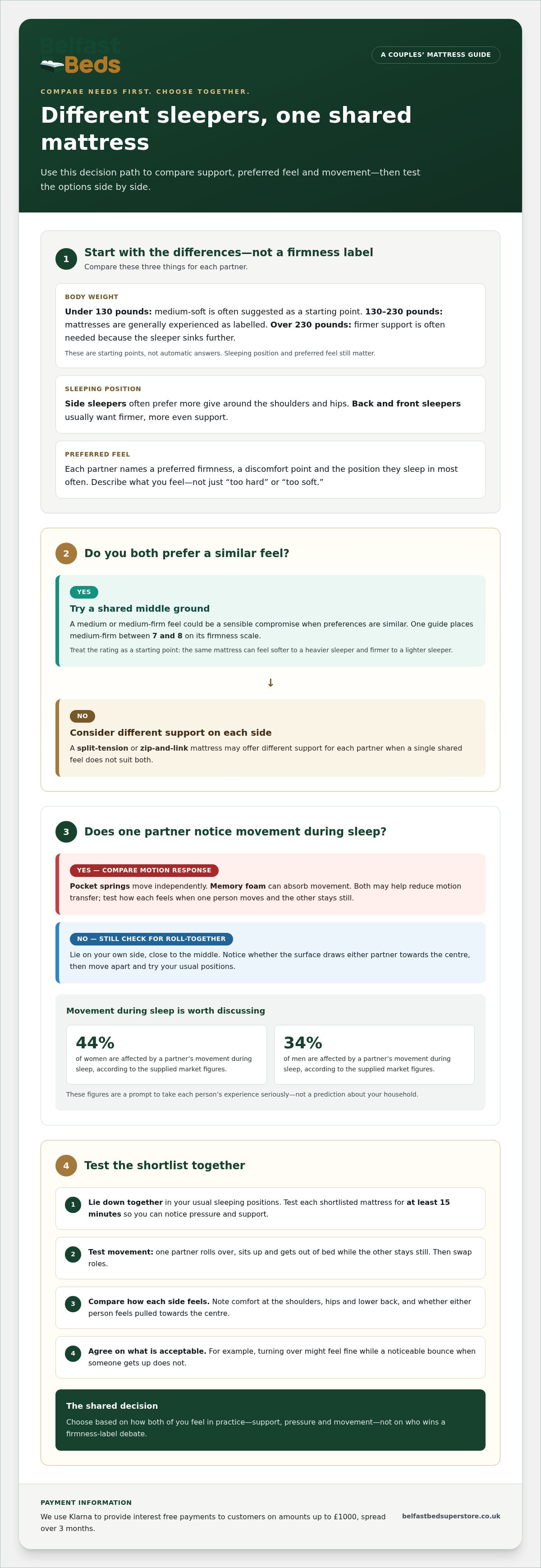
Start by comparing what each of you needs, rather than choosing by a firmness label alone. The same mattress can feel softer to a heavier sleeper and firmer to a lighter sleeper. A middle-ground feel that suits one person could leave the other feeling unsupported or pressed against a hard surface. Treat comfort ratings as a guide, then consider body weight, sleeping positions and preferences together. Convincing your partner on a mattress choice is easier when you describe specific needs, not just a preferred label.
Weight helps explain why a shared mattress can feel so different. Lightweight sleepers under 130 pounds are often advised to consider medium-soft comfort, while average-weight sleepers between 130 and 230 pounds generally experience mattresses as labelled. Sleepers over 230 pounds often need firmer support because they sink further into the mattress. These categories are useful starting points, not automatic answers. A sleeper’s position and preferred feel still matter, so compare how each person feels on the same surface.
Your usual sleeping position affects where you need cushioning. Side sleepers often prefer more give around the shoulders and hips, where a very firm surface can feel uncomfortable. Back and front sleepers usually want firmer, more even support, so the body feels held rather than sinking unevenly. If one partner sleeps on their side and the other on their back, name those positions before discussing firmness. This turns “too hard” or “too soft” into a clearer conversation about pressure and support.
Use a real difference between partners as a prompt, not a prescription. One example pairs a person weighing eleven stone with a partner weighing sixteen stone. Their bodies may respond differently to the same tension, even if both initially prefer a similar feel. Each partner can describe comfort at the shoulders, hips and lower back. Then compare notes while lying in natural sleeping positions. Test each shortlisted mattress for at least 15 minutes, allowing time to notice pressure and support.
Agree on what matters most before settling on a compromise. Each of you can name a preferred firmness, a discomfort point and the position you sleep in most often. If a mattress leaves one partner restless, disrupted nights may affect everyday patience and conversations. If convincing your partner on a mattress choice feels difficult, focus on what each person feels rather than who is right. The aim is a shared decision that respects both sleepers, not a debate one person has to win.
2. How Can You Reduce Partner Disturbance?
Pocket-sprung mattresses and memory foam can help reduce motion transfer for couples. Pocket springs move independently, while memory foam can absorb movement, limiting how much motion travels across the sleep surface.
Look beyond the mattress description and test how it responds when both partners move. Lie down together in your usual sleeping positions, then have one person roll over, sit up and get out of bed. Notice whether the other person feels each movement. Swap roles afterwards, since one partner may be more sensitive to movement. This simple comparison can reveal whether the surface feels steady or carries movement across the mattress.
Check for roll-together as well as movement transfer. Lie on your own side, close to the middle, and see whether the surface draws you towards your partner. Then move apart and try each person’s usual position. If either sleeper feels pulled into the centre, discuss that sensation rather than relying only on a firmness label. A mattress can feel comfortable while still transferring noticeable movement when someone changes position.
Construction matters. In a pocket-sprung mattress, springs respond independently, so one partner’s movement is less likely to disturb the other than on a connected spring system. Memory foam can absorb movement too, which may help if a partner shifts frequently. Compare how each option feels when one person moves and the other stays still. Focus on the disturbance you actually notice, not just the material or its description.
Partner movement is a real concern for couples: the supplied market figures state that 44% of women and 34% of men are affected by a partner’s movement during sleep. Use that as a prompt to take each person’s experience seriously, not as a prediction about your household. If one of you wakes easily, let that partner lie still while the other changes positions. Then reverse the test. You’ll get a clearer comparison than by taking turns lying alone.
Agree on what counts as acceptable movement before you choose. For example, you might decide that turning over feels fine, but a noticeable bounce when someone gets up does not. Compare pocket springs and memory foam against that shared standard. Testing together gives you a practical way to judge comfort, support and movement transfer on the same surface.
3. Best Mattress for Couples: What Should You Look For?
Compare pocket-sprung, hybrid and memory foam mattresses by feel, support and movement. Pocket springs respond individually, hybrids combine supportive springs with comfort foam layers, and memory foam can absorb movement. Lie together and compare how each surface supports you, rather than choosing by construction alone. Your sleeping positions and body types matter just as much.
A medium or medium-firm mattress can provide a practical middle ground when you prefer similar firmness. One guide places medium-firm between 7 and 8 on its firmness scale. Treat that rating as a starting point: a heavier sleeper may sink further, while a lighter partner may experience the same surface as firmer. Compare how comfortably each person can settle into their usual position before deciding that one firmness suits both.
Room can help too. A king mattress gives each person more space than a standard double, which may make a partner’s movements and comfort preferences feel less intrusive. Choose the largest size that fits comfortably in your bedroom while leaving room to move around. Measure the available floor space and consider the bed’s position, nearby furniture and access before settling on a size, especially if you are coordinating your sleep setup with elegant statement pieces like Cattelan Italia furniture for sale.
Test the mattress with a suitable pillow, rather than resting your head flat on the surface. A pillow affects how your neck and shoulders feel, particularly when you lie in your natural sleeping position. For example, a side sleeper can compare the mattress and pillow together, then repeat the test on their back. This helps you judge the complete sleep setup, including the support your pillow provides.
There’s no single UK price for a couples’ mattress: the cost depends on size, construction, materials and features. Compare options with the same dimensions and type, then weigh the differences against the support and comfort each partner needs.
Before buying, read the retailer’s trial and returns terms closely. Compare the trial length, eligibility conditions, mattress-care requirements, collection arrangements and any stated return charges. Make sure both partners understand what happens if the mattress feels unsuitable after delivery, rather than assuming every trial works the same way.
Finish with a shared test: lie in your usual positions, try the pillow you plan to use and compare the feel on both sides. A mattress that gives each sleeper enough room and suits both bodies is a more useful compromise than choosing by a firmness label alone.
4. Dual-comfort mattresses for different preferences
A shared bed doesn’t have to mean identical comfort on both sides. Dual-tension mattresses can provide different levels of support within one mattress, while zip-and-link beds join two separate mattresses in one bed frame. These options suit couples where one person prefers a firmer feel and the other wants more cushioning. First, describe each preference clearly: for example, “firm support” on one side and “softer comfort” on the other.
With a dual-tension mattress, different spring counts create different support levels across the mattress. This can keep the bed as one piece while giving each sleeper a feel that better matches their needs. Check where the tension changes and lie on both sides, particularly if either person sleeps close to the middle. The goal is a comfortable fit for each sleeper, not simply a feature that sounds useful.
A zip-and-link setup takes a more separate approach. Two mattresses zip together, so one side can be firm and the other soft within the same bed frame. This can make sense if your preferred tensions are far apart. Two side-by-side mattresses may leave a gap, so a connecting strap or single fitted cover can help hold them together. Try lying near the join as well as on your own side.
Can a mattress topper help when partners prefer different firmness? Yes. A topper placed on one side can soften that side without changing the other, offering a straightforward way to adjust comfort. For example, if one partner likes the mattress but the other feels too much pressure, a topper on the less comfortable side may create a softer surface. It changes the feel above the mattress rather than creating a separate support system.
Compare the options by deciding what needs to change. If both partners want the same mattress feel but different support, consider dual tension. If you need distinct firm and soft surfaces, consider zip-and-link. If one side only needs extra softness, a topper may be enough. Each person should lie in their usual sleeping position and assess pressure points, comfort and the transition between sides. That practical test makes it easier to find a shared solution.
Before choosing, agree on the main issue each option needs to solve. One partner might need firmer support, while the other wants softer comfort layers. Keep those needs in view when testing, and don’t let the mattress label replace how each side actually feels. A design that gives both sleepers a suitable surface can turn a difficult compromise into a more comfortable shared choice.
5. Consequences of a mattress that does not suit both partners
A poor mattress fit can turn sharing a bed into a nightly compromise that only one person accepts. One sleeper may wake with pressure around the shoulders, while the other feels the surface is too soft. If either partner regularly changes position to get comfortable, the other may notice the movement. Over time, the issue is not just one uncomfortable moment but a repeated mismatch that makes settling together harder.
Snoring can compound the problem. The supplied market figures state that 42% of women and 20% of men are kept awake by a partner’s snoring. A mattress cannot address snoring itself, but it can still matter if discomfort or movement also interrupts sleep. Separate the causes: note whether waking follows noise, a partner moving, or pressure from the sleep surface. That distinction helps you decide what the mattress choice can realistically improve.
Repeated poor nights can also affect how you feel during the day. A tired partner may have less patience for everyday decisions, including discussing a replacement bed. That doesn’t mean a mattress mismatch causes relationship conflict; it does mean both people’s comfort deserves a fair hearing. For example, if one person calls a mattress “too firm” and the other calls it “supportive,” ask where each feels pressure and in which sleeping position.
A fair compromise should combine needs rather than erase one person’s preference. Write down what each partner experiences: one may want a firmer feel, while the other needs more cushioning. Then agree on the main problem to solve, such as feeling unsupported, waking when the other turns or being uncomfortable near the middle. A clear example is more useful than deciding that one person is simply “fussy.”
After sharing the bed, each partner can describe what interrupted their rest, where they felt discomfort and whether the other’s movement played a part. Compare those observations before changing firmness or adding a topper. If the problem is movement, focus on how the mattress handles movement; if it is pressure, reassess the feel and support. This keeps the decision grounded in what you both notice.
Don’t treat a quick purchase as proof that you’ve reached an agreement. A mattress that suits only one sleeper may leave the original disagreement unresolved, while a considered choice gives both partners a role. Return to your shared priorities, test the options together and discuss what would make each side comfortable. The key is simple: neither partner should have to accept ongoing discomfort as the price of sharing a bed.
Belfast Bed Superstore: Hypnos Mattresses
Belfast Bed Superstore offers Hypnos Mattresses for couples comparing comfort and support. You can also explore Sealy, Relyon and Dunlopillo Mattresses, then focus on the feel that suits both sleepers.
We use Klarna to provide interest free payments on amounts up to £1000, spread over 3 months. This gives you a way to spread payment while considering your shared mattress choice.
Explore the mattress options at Belfast Bed Superstore online or in the Cambridge showroom, where you can try a wide selection together.
Make your next step a shared decision
Choosing together doesn’t mean either person has to give up what matters most. Treat your next conversation as a chance to agree on the feeling you both want at bedtime, then make the decision around that shared goal. Convincing your partner on a mattress choice is easier when you listen to what each of you needs and keep the discussion focused on comfort rather than winning.
Belfast Bed Superstore offers Hypnos Mattresses, Sealy Mattresses and Relyon Mattresses for you to compare as you decide what feels right for both sleepers. Talk through your priorities and give each person a say in the final choice. A thoughtful decision can make your bedroom feel more restful for you both.
Contact Belfast Bed Superstore today to explore the mattress options together. Your next shared choice can be a comfortable one.
Frequently Asked Questions
Best Mattress for Couples: What Should You Look For?
Look for a mattress that supports both sleepers without creating a compromise one person dislikes. Compare how each of you feels after lying in your preferred position, then discuss pressure points, ease of turning and whether you feel supported near the edge. If one person prefers springs and the other foam, test a hybrid as a possible middle ground rather than deciding by material name alone.
Can one mattress suit two people with different needs?
Yes, one mattress can suit two people if its support and comfort work for both. Start by naming each person’s main need, such as cushioning at the shoulder or a firmer feel beneath the waist. Then try the same option together and compare those specific sensations. If one shared surface cannot meet both needs, a dual-tension design or separate mattresses joined in one frame may be worth considering.
How Can You Reduce Partner Disturbance?
Choose a surface that limits how much movement travels across the bed, and test it with both partners present. One person can turn over while the other stays still, then you can swap roles. Notice whether the disturbance comes from the movement itself, mattress bounce or the other person getting out of bed. This helps you focus on the type of movement your mattress needs to handle.
What If You Both Like Different Mattress Firmness?
Don’t settle on a firmness label until you’ve identified what feels wrong for each person. For example, one partner might want more support while the other needs extra softness around the shoulders. Test a dual-tension mattress, a zip-and-link setup or a topper on one side. Compare how each option feels in your usual positions, then choose the arrangement that addresses both comfort preferences.
What If You and Your Partner Sleep Differently?
Compare the support you need in your actual sleeping positions, not just the position you use at bedtime. A side sleeper can focus on shoulder and hip pressure, while a back sleeper can notice whether their body feels evenly supported. If you change positions during the night, test more than one posture. Discuss those differences before choosing, so neither person’s needs get lost in a general firmness preference.
What if my partner and I need completely different firmness?
Consider two mattresses joined within one bed frame if a single firmness cannot work for you both. Zip-and-link options allow a firmer mattress on one side and a softer one on the other. Lie near the join as well as on your own side to assess the transition. If you prefer one continuous mattress, dual-tension designs offer another way to create different support across the bed.
Why do my partner and I find the same mattress so different?
Your bodies may respond differently to the same surface because weight affects how deeply you sink. Sleeping position and comfort preference also change how firmness feels. For instance, a mattress may feel supportive to a back sleeper but put too much pressure on a side sleeper’s shoulder. Compare what you feel and where, rather than assuming one person’s impression is the correct one.


