

What if that nagging lower back pain isn't just a sign of getting older, but a signal that your bed is literally collapsing beneath you? We often find that customers in Cambridge visit our showroom wondering exactly how to tell if your mattress is sagging or if they're just imagining the dip in the middle. It's incredibly frustrating to wake up feeling stiff and unrefreshed, especially when your mattress looks perfectly fine on the surface. You might feel like you're rolling into a trench or struggling to find a level spot to rest; these aren't just minor inconveniences, they're signs of structural fatigue.
We've put together this 2026 home diagnostic guide to help you identify true mattress failure and understand when your bed is compromising your spinal health. You'll learn the exact methods to prove a sag exists using simple household tools like a string and ruler. We'll also explain the vital difference between a harmless body impression and a deep sag that qualifies for a warranty claim. If a new bed is needed, we make the transition simple by offering interest free payments through Klarna for amounts up to £1000, spread over 3 months, ensuring high quality rest stays affordable.
Key Takeaways
- Learn exactly how to tell if your mattress is sagging using simple DIY diagnostics like the string test to spot structural failure before it compromises your spinal health.
- Understand the critical difference between normal body impressions in natural-fill beds and a structural "nest" that qualifies for a manufacturer's warranty claim.
- Discover how to perform the "Floor Test" to ensure your bed frame or slats aren't the hidden culprit behind your morning stiffness and rolling into the middle.
- Find out why toppers are only a temporary fix for a collapsed mattress core and how we help you upgrade to sag-resistant technology from brands like Sealy.
- Take advantage of our professional old bed removal service and spread the cost with interest free payments via Klarna for amounts up to £1000, spread over 3 months.
What is Mattress Sagging and Why Does it Happen?
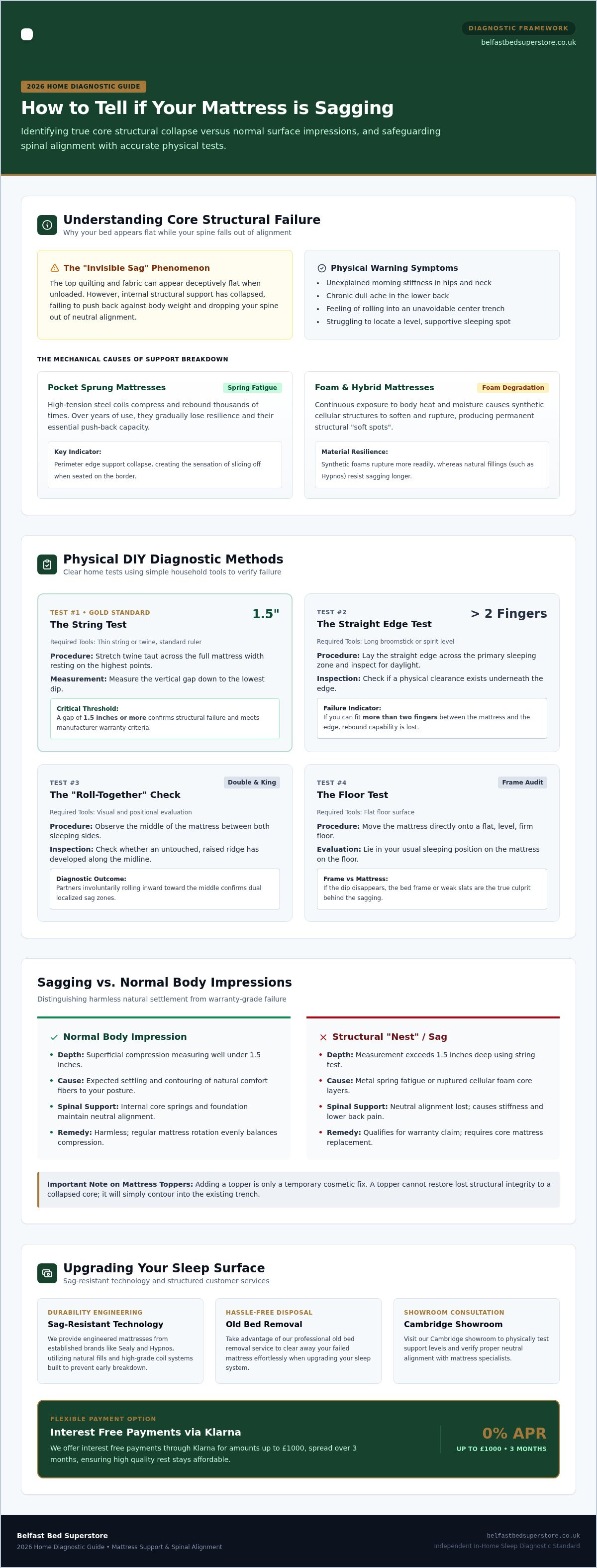
When we talk about mattress sagging, we are describing a fundamental loss of structural integrity within the core support layers of your bed. It's a common issue that often goes unnoticed because of the "Invisible Sag" phenomenon. This happens when the surface of your bed appears perfectly flat to the naked eye, but the internal support has actually collapsed. Many visitors to our Cambridge showroom ask us how to tell if your mattress is sagging when they can't see a visible dip, yet they're waking up with unexplained stiffness every morning.
This structural failure is rarely about the fabric or the top quilting. Instead, it's about the materials deeper inside that are responsible for keeping your spine in a neutral position. Understanding mattress construction and lifespan is key to spotting these issues early. If your bed no longer pushes back against your weight, your spine will fall out of alignment, leading to chronic lower back pain and a restless night. We believe that identifying these mechanical failures is the first step toward reclaiming your physical well-being.
The Science of Spring Fatigue
In pocket sprung mattresses, the primary cause of sagging is spring fatigue. High-tension steel coils are designed to compress and rebound thousands of times, but over years of use, they eventually lose their resilience. Spring fatigue is the gradual loss of a coil's ability to return to its original height. This loss of "push-back" means the mattress can no longer support the heavier parts of your body, such as your hips and shoulders. In lower-quality models, you might notice the edge support failing first, making you feel like you are about to slide off the bed when sitting on the side.
Foam Degradation and Soft Spots
Foam mattresses, including memory foam and hybrid models, suffer from a different type of breakdown. Constant exposure to body heat and moisture causes the cellular structure of the foam to soften and eventually rupture. This leads to "soft spots" in the areas where you carry the most weight. While synthetic foams are prone to this cell breakdown, natural fillings found in brands like Hypnos tend to resist sagging for much longer due to their inherent durability. If you are struggling to find a level spot to sleep, it's a clear indicator of how to tell if your mattress is sagging at a molecular level. To help you replace a failing bed without stress, we offer interest free payments through Klarna for amounts up to £1000, spread over 3 months.
5 DIY Methods to Test if Your Mattress is Sagging
Identifying a failing mattress isn't always as simple as looking for a giant hole in the middle of your bed. Often, the structural collapse is subtle and happens deep within the core layers. If you've been waking up with a stiff neck or a dull ache in your lower back, you're likely already experiencing the effects of poor alignment. We often suggest that our neighbors in Cambridge perform a few simple home checks to confirm how to tell if your mattress is sagging before the lack of support causes long-term discomfort.
How to Perform the String Test
The string test is the gold standard for uncovering "invisible sags" that the naked eye might miss. To start, take a piece of thin string or twine and stretch it perfectly taut across the full width of your mattress, from one side to the other. Ensure the string is resting on the highest points of the mattress surface. Using a standard ruler, measure the vertical gap between the string and the deepest part of the dip. Most manufacturers consider a dip of 1.5 inches or more to be a structural failure. This clear measurement is often exactly what you need to support a warranty claim or decide it's time for an upgrade.
Another effective method is the Straight Edge test. If you don't have string, a long broomstick or a spirit level works just as well. Lay the straight edge across the sleeping area and look for daylight underneath. If you can fit more than two fingers between the mattress and the stick, the internal materials have likely lost their ability to rebound. This lack of resistance is a primary driver of morning pain, as noted in Harvard Health guidance on mattress support and back pain.
Couples should also look for "The Ridge" and the "Roll-Together" effect. In many double or king-size beds, a firm ridge forms in the exact center where no one sleeps, while the two sleeping sides sink over time. If you and your partner constantly gravitate toward the middle of the bed during the night, gravity is simply pulling you into the collapsed core of the mattress. You can also use the Hand Pressure test by pushing firmly into various spots across the surface. A healthy bed should offer consistent resistance; if some areas feel like a sponge while others feel like a brick, the support is gone.
The Sensory Check: Feeling for Support
Sometimes your ears and hands are better judges than your eyes. We recommend literally crawling across the mattress surface. As you move, feel for "dead zones" where the springs or foam seem to offer zero push-back. Listen closely as you move; squeaks, groans, or metal-on-metal grinding sounds are early warning signs that your pocket springs are fatigued and failing. Finally, try the Edge Support test. Sit on the very edge of the bed as if you're putting on your shoes. If the side collapses completely and you feel like you're sliding off, the perimeter reinforcement has failed.
If your home tests confirm that your bed is no longer doing its job, don't let the cost of a replacement keep you awake. We want to make high-quality sleep accessible, so we provide interest free payments through Klarna for amounts up to £1000, spread over 3 months. You can also visit our Cambridge showroom to feel the difference between a sagging mattress and the robust support of a new model.
Sagging vs. Body Impressions: What is Normal?
We often meet customers in our Cambridge showroom who are concerned about the "hollows" forming where they sleep. It's understandable to feel worried when your new investment doesn't look like it did on the first day. However, it's vital to distinguish between a structural failure and the natural settling of comfort layers. When you're learning how to tell if your mattress is sagging, the first thing to check is the depth and the nature of the indentation.
The 1.5-Inch Rule
In the bedding industry, we use a specific measurement to define a defect. A "body impression" is typically a dip of less than 1.5 inches. This is actually a positive sign that the mattress is contouring to your unique shape, providing better pressure relief. Understanding this depth threshold is the most accurate way how to tell if your mattress is sagging rather than just providing personalized comfort. If the unweighted dip exceeds this 1.5-inch threshold, it's usually classified as a structural sag. This distinction is a key part of Sleep Foundation's guide to mattress sagging, which explains how internal components can fail over time. To document this for a claim, we suggest using the string test to get an accurate measurement of the "nest" that has formed.
Settling of Natural Fillings
Luxury brands like Relyon use generous layers of wool, cotton, and silk. These natural materials are incredibly breathable and comfortable, but they do compress slightly as they settle into your sleeping position. This "break-in" period is perfectly normal. In fact, we discuss this in detail in our Relyon Mattresses Review 2026. To keep the surface even, we recommend regular rotation and, if the model allows, flipping the mattress. This helps the fillings settle uniformly across the entire surface rather than just in one spot. If your mattress features a pillow-top, a bit of regular "plumping" can also help restore its loft.
If your home checks reveal a dip that's deep enough to cause discomfort, it might be time to consider a replacement. We want to ensure you get the sleep you deserve without financial strain. That's why we offer interest free payments through Klarna for amounts up to £1000, spread over 3 months. This allows you to upgrade to a more supportive model while managing your budget comfortably.
Is Your Bed Frame the Real Culprit?
Sometimes, a mattress is blamed for a crime it didn't commit. We often see customers who are convinced their bed is failing, but the issue actually lies beneath it. A broken slat or a collapsed divan base can perfectly mimic the symptoms of a failing mattress. Before you assume your mattress is the problem, it's worth investigating the foundation. If the support system underneath has given way, even the most expensive mattress will feel like it's sinking.
One of the most effective ways to diagnose this is the "Floor Test." If you've been wondering how to tell if your mattress is sagging or if it's the frame, try moving the mattress directly onto a flat, hard floor for a night. If the dip disappears and the support returns, your mattress is likely fine, and your bed frame is the true culprit. This simple check can save you from replacing a perfectly good mattress prematurely, which is a tip we always share with our neighbors in Cambridge.
Checking Slat Health
Wooden bedsteads with slats are popular, but they require regular maintenance to stay supportive. We recommend checking that the gap between your slats is no more than 7cm. Gaps wider than this allow the mattress to bulge through the openings, leading to premature structural failure. Look for slats that are bowed downwards or have visible cracks; these offer no upward tension to support your weight. Ensuring your bed frame is in top condition is a key part of our Bedroom Furniture Cambridge Guide. If you find your slats are failing, it's often the reason why you feel like you're rolling into a trench.
Divan Base Integrity
If you have a divan, the issue might be a "dipping" wooden lid. Over time, the timber frame inside a solid-top divan can crack or warp under consistent pressure. You should also check your castors or glides. If one has collapsed or isn't fitted correctly, your entire sleep surface will be unlevel, creating a phantom sag. Interestingly, a sprung divan base can actually extend the life of a pocket sprung mattress by acting like a giant shock absorber for the springs above.
If your base has failed, we can help you find a sturdy replacement that restores your comfort. We offer interest free payments through Klarna for amounts up to £1000, spread over 3 months, making it easier to invest in a solid foundation. You can browse our range of divans and bedsteads at our Cambridge showroom to see which base provides the best support for your mattress.
Replacing Your Sagging Mattress in Cambridge
Once you've followed our diagnostic steps on how to tell if your mattress is sagging, you might be tempted to try a quick fix. It's a common mistake to think a thick mattress topper or flipping the bed will solve the problem. In reality, a topper will simply follow the dip of the collapsed core, much like a new carpet following the contours of a hole in the floor. Since structural failure happens in the support layers, the only way to restore your spinal health is to replace the unit with a model designed for longevity.
We invite you to visit our Cambridge showroom to experience the difference that modern support technology makes. Testing various tensions in person allows you to feel exactly how a new core should push back against your weight. It's the best way to ensure your next investment provides the years of restful sleep you deserve. We take pride in being a local specialist, helping our neighbors move from a state of morning stiffness to total domestic comfort.
Sag-Resistant Brands to Consider
When you're ready to upgrade, we recommend looking at brands that prioritize internal stability. Sealy is a fantastic choice, particularly their Posturepedic range which features targeted lumbar support to prevent the middle of the bed from dipping. You can find more details on these specific models in our Sealy Mattresses 2026 Buying Guide. Alternatively, Hypnos mattresses utilize traditional hand-tufting. These functional ties pass through the entire mattress, keeping the natural fillings securely in place and preventing them from shifting or bunching over time.
Financing Your New Sleep System
We understand that a high-quality mattress is a significant investment in your well-being. To make the process as smooth as possible, we provide interest free payments through Klarna. This service allows you to spread the cost of your new bed for amounts up to £1000. Your payments are spread over 3 months, making it much easier to manage your budget while securing the support your back needs.
Our service doesn't stop at the checkout. We offer a full Cambridge delivery and professional assembly service to ensure your new sleep system is set up perfectly from day one. To make the transition even easier, we can handle your old bed removal. This saves you the hassle of coordinating with the local council and ensures your old, sagging mattress is disposed of responsibly while you start enjoying your improved lifestyle immediately.
Reclaim Your Best Night's Sleep
Understanding how to tell if your mattress is sagging is the first step toward ending those mornings of stiffness and back pain. By using simple checks like the string test and verifying your bed frame's integrity, you can decide whether your current setup is truly supporting your health. We don't want you to settle for a restless night when a supportive, sag-resistant solution is within reach.
If your diagnostic checks confirm it's time for an upgrade, we're here to help every step of the way. You can browse our sag-resistant Hypnos and Sealy collections at Belfast Bed Superstore and take advantage of our local Cambridge expertise. We make the transition effortless with professional assembly and old bed removal. Plus, we provide interest free payments through Klarna for amounts up to £1000, spread over 3 months, and offer a 30-night sleep trial for your peace of mind. We look forward to helping you wake up feeling refreshed and ready for the day ahead.
Frequently Asked Questions
Can a mattress topper fix a sagging mattress?
A mattress topper cannot fix a sagging mattress because it simply conforms to the existing dip in the support layers. While it might add a temporary layer of softness, it won't restore the structural integrity of a failed core. We often see customers in Cambridgeshire trying this as a quick fix, but the only real solution is replacing the unit. We offer interest free payments through Klarna for amounts up to £1000, spread over 3 months, to help.
How many inches of sag is acceptable for a warranty claim?
Most manufacturers, including brands like Hypnos and Sealy, require a permanent, unweighted indentation of at least 1.5 inches to approve a warranty claim. This measurement must be taken when the bed is empty using a straightedge and a ruler. If your home diagnostics show a depth beyond this threshold, it's a clear indicator of how to tell if your mattress is sagging rather than just experiencing normal comfort layer settling that occurs during the break-in period.
Does flipping my mattress stop it from sagging?
Flipping or rotating your mattress won't stop an existing sag, but doing so regularly from the day of purchase can help prevent uneven wear. Many modern mattresses are "non-turn," meaning you should only rotate them 180 degrees to distribute pressure. If the internal springs or foam cells have already collapsed, flipping the mattress will only provide a temporary change in feel before the structural dip becomes apparent on the other side, often within just a few nights.
How long should a high-quality pocket sprung mattress last before sagging?
A high-quality pocket sprung mattress from a reputable brand like Relyon should typically last between seven and ten years before showing signs of structural fatigue. The National Bed Federation recommends replacement after eight years to ensure your body receives the correct support. If you've had your bed longer than this, understanding how to tell if your mattress is sagging becomes essential for maintaining your physical comfort and preventing the morning stiffness often associated with aging sleep equipment.
Why do I feel like I am rolling into the middle of my bed?
Feeling like you're rolling into the middle of the bed is a classic symptom of a collapsed mattress core or a failing support foundation. This often happens when the internal springs lose their tension in the areas where you sleep most frequently. In double or king-size beds, a firm ridge can form in the center, creating a slope that pulls sleepers toward the deepest part of the dip. We recommend checking your base integrity alongside the mattress itself.
Is it normal for a new mattress to have body indentations?
It's perfectly normal for a new mattress to develop slight body indentations within the first few weeks of use. This is simply the comfort layers, such as wool or cotton fillings, settling and contouring to your unique shape. As long as these impressions are less than 1.5 inches deep, they are a sign of the mattress breaking in rather than a structural failure. We find that regular rotation helps these natural materials settle more evenly across the surface.
Can a bad bed frame cause a brand-new mattress to sag?
A faulty bed frame is a frequent cause of premature mattress sagging. If your slats are spaced more than 7cm apart or if the center support rail has collapsed, the mattress will bulge through the gaps and lose its level surface. We always recommend checking your base's health before installing a new mattress to ensure you don't void the manufacturer's warranty. A solid foundation is essential for protecting the lifespan of your new sleep system in Cambridge.
How do I measure mattress sag without special tools?
You don't need professional equipment to measure a dip at home. Simply stretch a piece of string tightly across the width of the mattress and use a standard ruler to measure the gap between the string and the deepest part of the surface. We suggest performing this check on an unweighted bed to get an accurate reading. If the measurement exceeds 1.5 inches, it's a definitive sign to visit our Cambridge showroom to discuss a supportive replacement.


