

That "extra firm" mattress you bought to save your back might actually be the reason you're struggling to tie your shoelaces without wincing every morning. It's a common mistake; many of our neighbours here in Cambridge come to us feeling frustrated because they've confused a hard sleeping surface with the actual structural support their body craves. We understand how draining it is when morning stiffness takes an hour to fade and interrupted sleep leaves you reaching for the kettle before you've even stood up straight. You deserve a bed that works with your anatomy, not against it.
In this 2026 guide, we'll help you discover the best mattress type for spinal alignment by breaking down the precise technologies that restore a neutral posture while you rest. We promise to clear up the confusion between "firmness" and "support" so you can finally choose between pocket springs, latex, or memory foam with total confidence. We'll explore how different sleep positions require specific reactive materials and explain why testing these options in person with a local expert is the safest way to ensure long-term comfort. It's time to stop tossing and turning and start waking up feeling truly refreshed and pain-free.
Key Takeaways
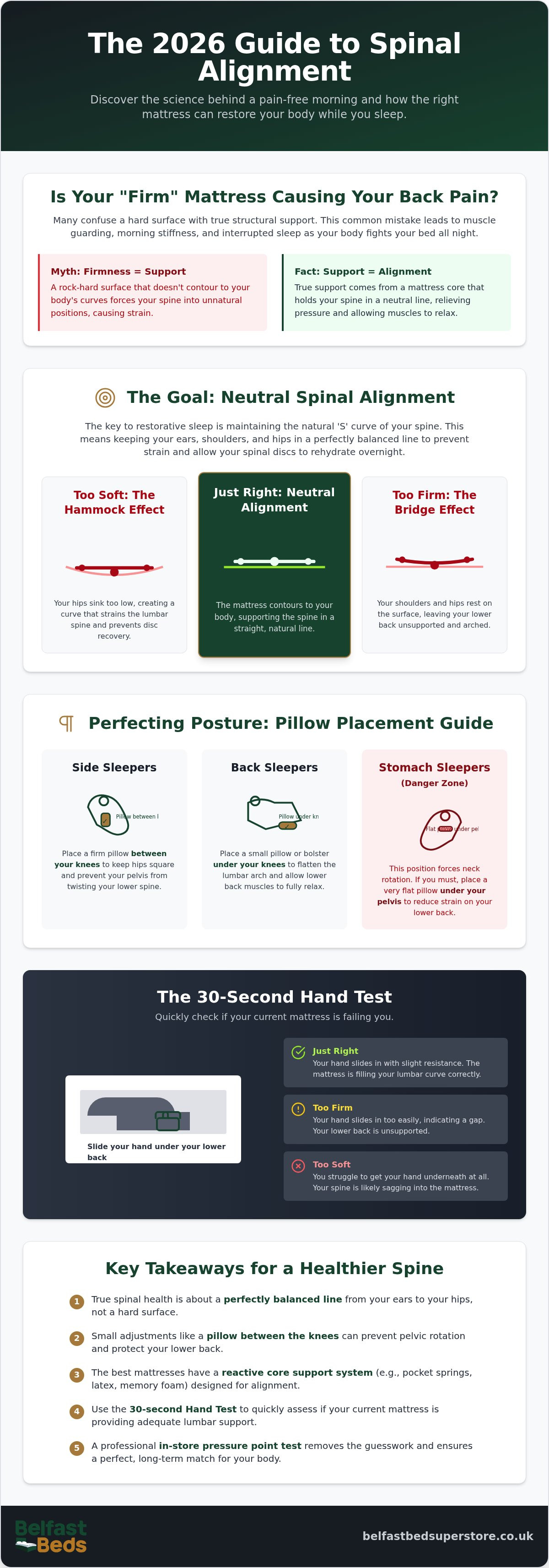
- Understand that true spinal health means keeping your ears, shoulders, and hips in a perfectly balanced line to stop morning stiffness before it starts.
- Discover how small adjustments, like placing a pillow between your knees, can prevent pelvic rotation and protect your lower back while you sleep.
- Learn why the best mattress type for spinal alignment focuses on reactive core support rather than just a hard surface feel.
- Master the 30-second "Hand Test" to quickly check if your current mattress is providing enough support for your lumbar arch.
- Find out how a professional pressure point test in our Cambridge showroom removes the guesswork and risk from choosing your next bed.
The Science of Sleep: Why Spinal Alignment is Your Back’s Best Friend
Think of your spine as a delicate architectural masterpiece. When you're standing with good posture, your spine follows a natural "S" curve that keeps your body balanced. Neutral spinal alignment is the state where the spine maintains its natural curves without external pressure. When you lie down, the goal is to keep your ears, shoulders, and hips in a perfectly straight line. If your mattress is too soft or too firm, it forces your spine out of this natural alignment, leading to a night of physical stress rather than recovery.
When your spine is out of position, your body doesn't just switch off. Your muscles enter a state known as "guarding." They stay semi-contracted all night, working overtime to protect your spinal cord from the strain caused by a sagging or rigid bed. This constant tension leads to ligament strain and the primary symptom we see with our neighbours in Cambridge: morning stiffness. If you feel like you need an hour and three cups of tea just to move comfortably, your bed has likely spent the night fighting your anatomy. Finding the best mattress type for spinal alignment is the first step toward waking up feeling limber and refreshed.
The Role of Intervertebral Discs at Night
Your spinal discs are the unsung heroes of your mobility. These fluid-filled shock absorbers spend all day being compressed by gravity as you walk, sit, and move. Nighttime is their only opportunity to rehydrate and recover through a process called imbibition. Proper alignment is the essential catalyst for this recovery. If you're sleeping on a bed that creates a "hammocking" effect, the uneven pressure prevents these discs from soaking up the nutrients and fluids they need. This is especially vital as we get older. Age-related changes mean our discs lose some of their natural resilience, making precision support a necessity rather than a luxury.
Signs Your Alignment is Off
Your body is excellent at sending warning signals before a minor ache becomes a chronic problem. One of the most common signs is waking up with lower back "niggles" that disappear once you've been upright for twenty minutes. This suggests the pain isn't an injury, but a result of poor overnight posture. You might also notice yourself adopting the "kickstand" position. This happens when you instinctively hike one leg up toward your chest to relieve pressure on your lower back. While it feels better in the moment, it's a clear sign your mattress isn't providing a neutral base. Understanding the science of sleeping positions can help you identify these subconscious habits. Frequent tossing and turning is rarely just a personality trait; it's usually your body's desperate attempt to find the support it's missing. Choosing the best mattress type for spinal alignment ensures your body can finally stop searching and start resting.
Perfecting Your Posture: Pillow Placement for Every Sleeping Style
Finding the best mattress type for spinal alignment is a massive win for your back, but your pillow is the final piece of the structural puzzle. Think of your pillow as a mattress for your neck. If it's the wrong height or in the wrong place, it can undo all the good work your bed is doing. For side sleepers, we often recommend the "pillow sandwich." By placing a firm pillow between your knees, you keep your hips square. This simple trick prevents your top leg from pulling your pelvis forward, which otherwise twists your lower spine all night long.
Back sleepers face a different challenge. Gravity often pulls the lower back into an exaggerated arch. Placing a bolster or a rounded pillow under your knees flattens that lumbar arch against the mattress, allowing your muscles to fully relax. If you're a stomach sleeper, you're in what we call the "danger zone." This position forces your neck to turn at a sharp 90-degree angle for hours. To mitigate damage, try placing a very flat pillow under your pelvis to lift your hips and reduce the strain on your lower back. Some people believe the "no-pillow" myth is a cure for neck pain, but your spine has a natural cervical curve that needs support. Without it, your head tilts at an awkward angle, leading to those familiar morning headaches.
Choosing the Right Pillow Loft
Pillow "loft" is just a fancy word for height, and getting it right is a science. You can measure your ideal loft at home by checking the distance from the tip of your shoulder to the side of your neck. A pillow should fill this gap exactly. We've found that latex pillows are often superior for spinal stability because they don't flatten out like feather or down. They provide a consistent reactive lift that keeps your head level all night. For more details on how these materials work, you can read our Dunlopillo mattresses guide which explores the benefits of latex in depth. As noted by Harvard Health on mattress choice, the right combination of surface and support is what ultimately settles back pain.
The Pelvic Tilt Correction
If you're still feeling a slight gap under your waist when lying on your back, try a small rolled-up towel. It provides just enough extra lumbar support to keep the spine neutral. Side sleepers who feel their chest collapsing can use a full body pillow to keep their top shoulder from dipping inward. To be sure your setup is working, try this "Side-Lying Alignment Check" with a partner:
- Lie on your side in your usual sleeping position.
- Have your partner stand behind you and look at your spine from the base of your skull to your tailbone.
- If your spine looks like a straight, horizontal line, your pillow and mattress are working together.
- If your hips or shoulders are dipping, you may need to adjust your pillow loft or consider a more supportive mattress.
If you aren't sure whether your current pillows are helping or hurting, you can always pop into our Cambridge showroom to test our range of supportive pillows alongside our mattresses.
Beyond Firmness: Mattress Technologies Engineered for Orthopaedic Support
Many of our neighbours in Cambridge assume that a rock-hard bed is the only way to save a bad back. In reality, a surface that’s too rigid can be just as damaging as one that’s too soft. The best mattress type for spinal alignment isn't about how "hard" the bed feels; it's about how the internal core responds to your specific body weight. While "firmness" describes the initial sensation against your skin, "support" refers to the mechanical resistance that keeps your spine from bowing. A truly supportive mattress provides a reactive push-back that keeps your vertebrae in their natural S-curve.
Sealy has spent decades perfecting this balance through their Sealy Posturepedic range. Their technology focuses heavily on the "centre third" of the mattress. Since roughly 50% of your body weight is concentrated in your torso and hips, this area needs reinforced support to prevent the "sink" that ruins alignment. Medical professionals, including orthopedic surgeons, emphasize that maintaining proper spinal alignment during sleep is non-negotiable for preventing chronic issues and allowing muscles to recover overnight.
If you prefer a more traditional feel, hand-stitched pocket springs from Relyon or Hypnos offer a different kind of precision. Unlike open coils that move as a single unit, pocket springs work independently. This allows the mattress to contour around your shoulders and hips while pushing back firmly against your waist. Hypnos takes this further by using breathable natural fillings like wool and cotton. These materials provide exceptional pressure relief without the "quicksand" feeling that can sometimes compromise spinal integrity in cheaper foam alternatives.
Posturepedic vs. Pocket Sprung
Sealy’s reactive coils are designed to sense your body’s weight and respond with proportional resistance. This makes them a fantastic choice for those who move frequently during the night. In contrast, pocket springs offer better motion isolation if you share a bed with a restless partner. For a deeper look at which tech suits your bedroom, check our Sealy Mattresses Buying Guide. Relyon’s Somerset craftsmanship also includes genuine side-stitching, which reinforces the mattress edges. This ensures you have edge-to-edge support and don't feel like you’re rolling off when you sleep near the side of the bed.
Latex vs. Memory Foam for Alignment
Latex is often the best mattress type for spinal alignment for sleepers who hate feeling "stuck." Latex provides "instant recovery" properties, meaning it pushes back the moment you move to keep your spine neutral. Memory foam can sometimes take a few seconds to adjust to your new position, which might leave your spine in a compromised state as you turn. Overheating is another factor; when you're too hot, you toss and turn more, which breaks your alignment. Natural latex and the hand-crafted layers found in our Relyon Mattresses Review highlight how temperature-regulating materials lead to a steadier, more aligned night of rest.
The 30-Second Alignment Check: Is Your Current Bed Failing You?
You don't need a medical degree to figure out if your bed is the culprit behind your back pain. Most of our neighbours in Cambridge only realise their mattress has reached its expiry date when the morning stiffness becomes unbearable. To help you decide if it's time for an upgrade, we've put together a few simple home diagnostics. If your bed fails these tests, finding the best mattress type for spinal alignment should be your next priority.
First, try the "Hand Test." Lie on your back and try to slide your hand under the small of your back. If your hand slides through with no resistance at all, the bed is too firm and isn't contouring to your lumbar curve. Conversely, if you can't get your hand in at all, the bed is likely too soft. Next, look for the "Partner Roll-Together." If you and your partner find yourselves gravity-fed toward the centre of the bed, the internal spring system has likely collapsed. Even a premium mattress loses roughly 25% of its original support after 7 to 8 years, so age is a major factor to consider.
Identifying the 'Valley' Effect
It's vital to distinguish between natural "settlement" and structural sagging. Most high-quality mattresses will show slight body impressions where the natural fillings have compressed; this is normal. However, if you place a broomstick across the surface and see a visible gap of more than an inch, you have a structural "valley." This sagging forces your spine into a permanent, painful "C" shape all night. Don't forget to check your base, too. An old, dipping divan or a broken slat on your bedroom furniture in Cambridge can ruin the performance of even the most expensive new mattress.
Morning vs. Evening Pain
A simple way to diagnose a "bad bed" is to track when your pain occurs. If your back feels like it's on fire at 7 AM but the discomfort is gone by 10 AM once you've moved around, your bed is the primary suspect. Your muscles are likely spending the night "guarding" against poor alignment. When you visit us to find the best mattress type for spinal alignment, we always suggest testing beds when you're a bit tired. This allows your muscles to relax fully so you can see how the mattress truly supports your frame without your body compensating for the surface.
If your current bed failed the broomstick or hand test, it's time to see what a supportive surface feels like. You can browse our orthopaedic mattress collection online or visit our showroom for a proper test drive.
Finding Your Match: Professional Sleep Consultations in Cambridge
Clicking "buy" on a mattress based on a few online reviews is a bit like buying a pair of spectacles without an eye test. While the internet is great for research, it can't tell you how a specific spring system feels under your unique frame. We’ve seen many neighbours in Cambridge struggle with "bed-in-a-box" purchases that felt great for a week but eventually led to the same old morning back pain. The best mattress type for spinal alignment is one that you’ve actually laid on, allowing your muscles to relax while a professional checks your posture in real-time.
When you visit our showroom, we offer a "pressure point" test to help you see your alignment from a new perspective. We look at how your shoulders and hips sink into the surface and whether your spine maintains that essential neutral line we discussed earlier. It’s about removing the guesswork. To make the transition even easier, our 30-night sleep trial acts as the ultimate risk-reducer. It gives your body and spine plenty of time to adjust to a new level of support, ensuring your investment in your health is a sound one.
Testing Brands Side-by-Side
One of the biggest advantages of visiting a local specialist is the ability to compare the world’s leading brands in a single afternoon. You can move from the reactive, zoned support of Sealy to the luxurious, hand-crafted layers of Hypnos or the traditional Somerset excellence of Relyon. Our team focuses on matching mattress tension to your specific height and weight rather than pushing the most expensive model. We pride ourselves on being friendly local experts who value your long-term comfort over a quick transaction.
Logistics and Local Support
We believe the path to better sleep should be as stress-free as the rest itself. That’s why we don't just drop a heavy box at your front door. Our own trained team provides a white-glove delivery service across Cambridgeshire and East Anglia, which includes professional assembly in your room of choice. We can even take your old bed away for recycling, so you aren't left with any heavy lifting. To help make spinal health an affordable priority, we also offer interest-free finance options that spread the cost of your new sleep system.
If you're ready to leave morning stiffness behind, come and see us for a chat. You can visit our Cambridge showroom to experience these technologies first-hand or browse our orthopaedic range online to see our latest collections. We’re here to help you find the best mattress type for spinal alignment and get you back to waking up feeling truly refreshed.
Waking Up Pain-Free Starts with the Right Support
Your journey to a pain-free morning doesn't have to be a guessing game. By understanding that spinal health is a partnership between mattress technology and your sleeping position, you've already taken the biggest step toward better rest. We've explored how the best mattress type for spinal alignment is one that provides reactive support for your torso while allowing your shoulders and hips to contour naturally. Whether you choose the independent precision of pocket springs or the reinforced centre-third of a Posturepedic model, the goal is always a neutral, balanced spine.
As a family-run Cambridge specialist established in 1990, we're here to help you navigate these choices with honest, expert advice. We're proud to be an official Sealy Posturepedic stockist and offer a 30-night sleep trial guarantee to ensure your new bed is exactly what your back needs. If you're ready to stop tossing and turning, browse our expert-approved mattresses for back support or visit us in person to feel the difference for yourself. You deserve to wake up feeling refreshed, limber, and ready for the day ahead.
Frequently Asked Questions
Is a firm mattress always better for spinal alignment?
A firm mattress isn't always the right choice for everyone. While it provides a solid base, a surface that's too rigid can't contour to your body's natural curves, often leaving your lower back unsupported. The best mattress type for spinal alignment is one that offers reactive support tailored to your weight, ensuring your spine stays neutral rather than being pushed out of place by a surface that is too hard.
How do I know if my pillow is the right height for my spine?
You'll know your pillow is the right height if your head stays perfectly level with your spine. If your head tilts up or dips down, your neck muscles will stay tense all night. A good rule of thumb is to measure the distance from your neck to the edge of your shoulder; your pillow should fill that gap exactly to keep your cervical spine balanced and tension-free.
Can I improve my spinal alignment if I am a stomach sleeper?
Stomach sleeping is tough on the neck, but you can mitigate the damage with a few adjustments. Try using an extremely thin pillow for your head or even no pillow at all. Placing a flat pillow under your pelvis is a great way to lift your hips, which prevents your lower back from arching too deeply and keeps your spine in a much safer, more neutral position.
What is the best sleeping position for lower back pain?
Most experts recommend sleeping on your back or side to manage lower back pain effectively. If you're on your back, placing a pillow under your knees flattens the lumbar arch against the mattress. Side sleepers should place a pillow between their knees to prevent the pelvis from rotating, which is a major cause of overnight spinal twisting and morning stiffness.
How often should I replace my mattress to maintain good posture?
We recommend replacing your mattress every 7 to 8 years to ensure your posture doesn't suffer. Even the most well-made beds lose significant structural integrity over time, often losing about 25% of their support in under a decade. If you notice dips or find yourself rolling toward the centre, it's time to find the best mattress type for spinal alignment to protect your back's long-term health.
Does an adjustable bed help with spinal alignment?
Adjustable beds are fantastic for spinal health because they let you customise your support levels at the touch of a button. By elevating your head and feet slightly, you can achieve the "zero gravity" position. This takes the pressure off your vertebrae and allows your muscles to relax fully, making it much easier to maintain a neutral spine throughout the night.
What is the 'neutral spine' position exactly?
The neutral spine position is when your ears, shoulders, and hips are all in a straight line while you rest. In this state, your spine's natural S-curve is preserved without any parts being compressed or stretched by the mattress. It’s the "sweet spot" where your body can finally stop guarding against poor posture and start the deep recovery process it needs.
Can a mattress topper fix a sagging bed and improve alignment?
A mattress topper won't fix a sagging bed because it lacks the structural integrity to bridge a dip. While a topper can make a firm bed feel softer, it will simply follow the contour of a collapsed mattress. If your bed has structural "valleys," a topper is just a temporary fix; you'll need a new core support system to truly restore your spinal alignment.


