

A bed can fit through the front door and still get stuck on the way upstairs. Ensuring a new bed fits up the stairs means measuring the entire route, not just the doorway, and comparing the tightest points with the bed’s dimensions.
It’s easy to focus on the bedroom size, but narrow hallways, low ceilings and sharp turns can matter just as much. Measure the width and height of the route, including the stairwell and landing, then consider how much room the bed needs to pivot around corners. A UK king size mattress measures 150 × 200 cm, while a super king measures 180 × 200 cm, so size can make a real difference at a turn.
This guide explains how to measure from the entrance to the bedroom, assess awkward corners and bannisters, and consider mattresses and frames separately. You’ll also learn why bending a mattress isn’t always suitable and what to consider if a rigid base or large headboard looks difficult to manoeuvre.
Key Takeaways
- Measure the full route from the entrance to the bedroom, including narrow hallways, stair width, ceiling clearance and landings.
- Assess mattresses and bed frames separately: a flexible mattress and a rigid base may need different manoeuvring plans.
- Avoid bending, folding or twisting a mattress unless its manufacturer says it is suitable, as this can damage its internal structure.
- Check whether a divan base or frame separates into sections, which can make restricted access easier to manage.
- At tight turns, measure the space available to pivot and account for bannisters, headboards and other obstructions.
Can a mattress be folded or bent to fit?
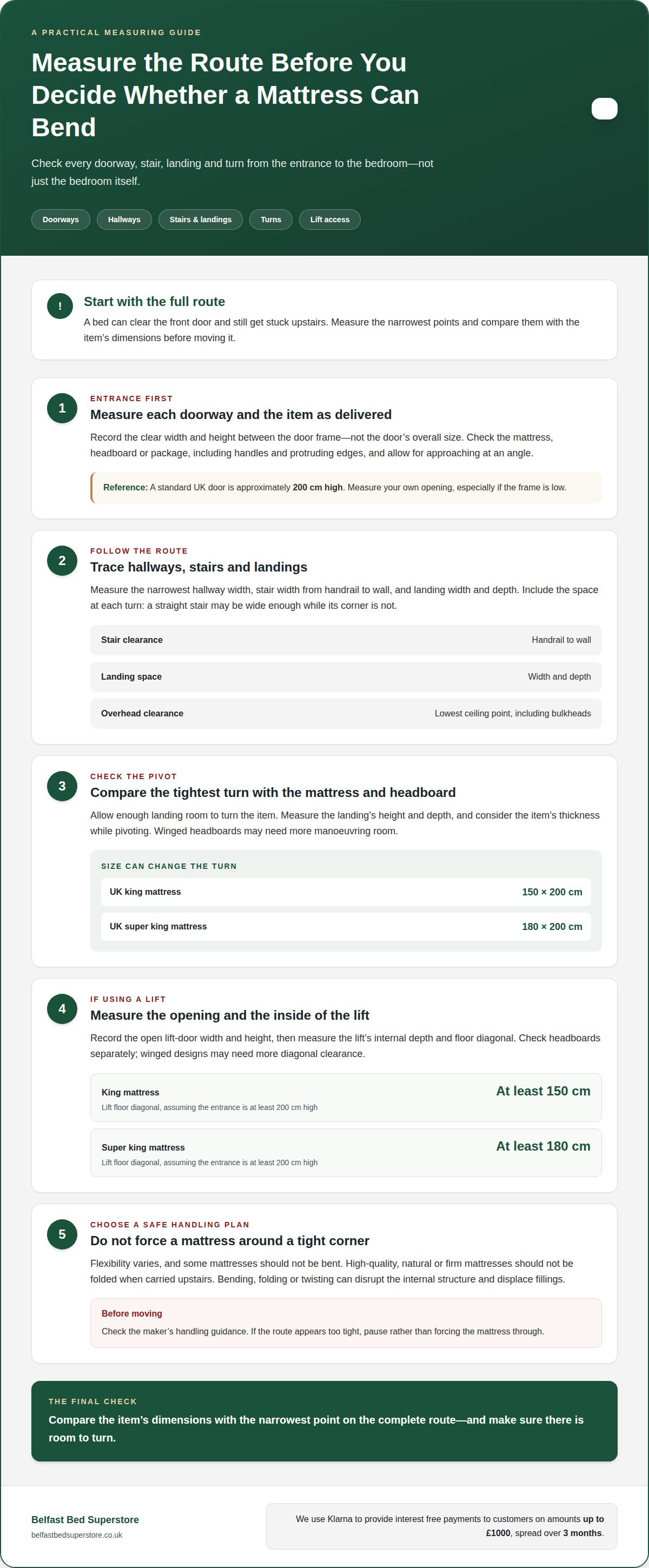
Measure the full route before considering whether a mattress can bend. Flexibility varies, and some mattresses should not be bent. Use these steps to check doorways, stairs, landings, ceilings and lifts against the item’s dimensions.
- Measure each doorway and any packaging. Record the clear width and height between the door frame, not the size of the door itself. Compare these with the mattress, headboard or boxed item in its delivery form, allowing for handles and protruding edges. A standard UK door is approximately 200 cm high, but measure your own opening, especially if its frame is low. Check that the item can approach the doorway at an angle without catching on the frame or nearby walls.
- Trace the hallway and staircase route. Measure the narrowest hallway width, staircase width from handrail to wall, and landing width and depth. Include the space at each turn, because an item that passes along a straight stair may not pivot at a corner. Measure the lowest ceiling clearance above the stairs, including any bulkhead. Check the ceiling clearance above the stairs, as an overhang can affect whether a mattress can be carried up.
- Check the turn against the mattress and headboard. Allow enough landing space for the mattress to turn, and check the route against its dimensions. Winged headboards may need more room to manoeuvre, so measure the landing carefully. Also measure the landing’s height and depth, and consider the item’s thickness while turning. These figures are clearance guides for the listed sizes, not substitutes for measuring your particular route and item.
- Measure lift access in three dimensions. Record the open lift-door width and height, then measure the lift’s internal depth and floor diagonal. A king mattress needs at least 150 cm of diagonal clearance inside a lift, assuming the entrance is at least 200 cm high; a super king needs at least 180 cm under the same entrance-height assumption. Winged headboards may need more diagonal clearance in a lift, so measure the headboard and lift before moving it.
- Decide whether bending is suitable. Some mattresses have flexibility, while others do not bend; high-quality, natural or firm mattresses should not be folded when carried upstairs. Bending, folding or twisting can disrupt internal structure and displace fillings. Check the maker’s handling guidance rather than forcing a mattress through a tight doorway. According to the UK Government, in order to provide 1 bedspace, a single bedroom has a floor area of at least 7.5m2 and is at least 2.15m wide.
Will Your New Bed and Mattress Fit Upstairs?
Plan how the mattress will travel before moving day to protect it and its internal structure. Compare its dimensions and handling requirements with the access route, and check the packaging if it will be delivered boxed.
- Measure the mattress and bed separately. Use a tape measure to record the mattress from head to foot, then side to side. Check the frame’s outside dimensions too, because its footprint can differ from the mattress. If the old bed is the same size, measure it as a useful comparison, but don’t assume the new model matches exactly. For reference, UK sizes include a single mattress at 90 × 190 cm, a small double at 120 × 190 cm, and a double at 135 × 190 cm.
- Keep a mattress flat unless its maker permits bending. Folding, twisting or sharply bending it can disrupt its internal structure and displace fillings. Damage may also affect the manufacturer’s guarantee. This matters especially for firm, natural or high-quality mattresses, which should not be folded when carried upstairs. If the route seems too tight, pause and consider another suitable access solution instead of forcing the mattress through.
- Consider the mattress format before ordering. Some mattresses are vacuum-packed and rolled, which can make them easier to handle through restricted access. A rolled mattress may need time to expand after unpacking, so follow the maker’s instructions for setup. Zip-and-link mattresses are available in all models and sizes from king size upwards. Their separate sections can be easier to move, but measure each part and check how the finished mattress joins together.
- Protect the mattress during the move. Fit a mattress bag or protective cover before carrying it to help guard against dust, moisture and scuffs. Secure the cover so it doesn’t slip over the carrying edges. Move slowly and have at least one other person help carry it upstairs. Agree when to lift, turn and pause, especially at landings, so neither person has to twist suddenly under the mattress’s weight.
- Compare the packed size with the route. A rolled or boxed mattress may have different dimensions from its full-size form, so check the package measurements as well as the mattress measurements. Confirm that the package can be carried through each doorway and turn without crushing or puncturing it. If the mattress arrives unrolled, plan the route before removing its protective wrapping. For a mattress selection suited to your bedroom, explore our mattress options.
Measuring the delivery route from the front door to the bedroom
Record the route from the entrance to the bedroom, noting each change in direction. An important part of ensuring a new bed fits up the stairs is comparing its dimensions with the tightest point along the way.
- Measure the route’s narrowest points. Start at the front door and measure the clear opening between the frame. Then check hallway pinch points, stair width from handrail to wall, and landing depth. Include fixed radiators, shelves and projecting handles. Write each measurement beside its location, such as “hallway beside radiator”. This gives the delivery team a route-specific record rather than just a doorway measurement.
-
Check Stair Ceiling Clearance
Measure the shortest vertical distance from the ceiling bulkhead to the stair directly below it. Repeat at the lowest point over the staircase, where an upright item may need to tilt. Compare the clearance with the bed component’s height and the angle needed to carry it. Check sloping ceilings too, as they can restrict movement even when the stairs are wide.
-
Measure Turns and Hallway Pinch Points
At each landing, measure the available depth, width and height around the bannister or newel post. Include how far the post projects and the gap between it and the inside wall. In narrow hallways, measure between fixed obstacles and account for doors that open into the route. These details help show whether the item can pivot without catching on a wall or frame.
- Allow room for the item to turn. Compare the landing measurements with the bed component’s length, width and depth, not just its narrowest edge. A long item may need space to pivot, and the angle of travel can require additional room beyond the straight-line width. Allow for a depth of up to 30 cm when assessing a product moving around a tight staircase turn. Note any spot where the item may need repositioning.
- Check the final approach into the bedroom. Measure the bedroom doorway and the space just inside it, including nearby walls or furniture that could obstruct a turn. Trace the route continuously: clearing the stairs is not enough if the item cannot pass through the last doorway. Record the clear opening with the door held in its delivery position, and note whether the bed must turn immediately after entering.
- Use the measurements to plan delivery. Keep widths, heights and depths in sequence, marking the tightest point, low ceilings and awkward turns. When ensuring a new bed fits up the stairs, these notes help identify where its orientation must change and which component needs the most room. Share practical access details with the delivery team before the item is brought inside.
Divan bases and ottoman frames delivered in sections
Choose a bed format that suits both your preferred sleep setup and your access route. A bed that separates into manageable sections may be easier to move than a rigid, assembled frame.
-
Choose a Bed That Moves in Sections
Check whether the divan base or bed frame separates into sections, then measure each section against the narrowest point upstairs. Some divan bases can be made as four-piece bases to help with access. Flat-pack frames may arrive as separate components, but check their packaged dimensions rather than assuming every frame breaks down. Ottoman designs vary, so establish which parts separate before planning the route.
-
Clear Obstacles Before Delivery
Move fragile ornaments, lamps and wall-hung items away from the entrance, hallway, stairs and landing before the bed arrives. Clear shoes, rugs and furniture that could restrict the carrying path or create a trip hazard. Keep doors open if they would otherwise narrow the route, and secure anything that might swing into the bed. A clear path gives the people carrying each section room to turn without striking walls or belongings.
-
Arrange Delivery Access
Review the delivery terms for room-of-choice access and any floor limits before arranging delivery. These conditions can affect whether the bed is carried to the bedroom or left elsewhere, so compare them with your home’s layout. A retailer may ask for a staircase video before delivery to assess access. Show the entrance, stairs, landings and tight turns in one steady recording, including low ceilings and bannisters.
- Compare options by how they come apart. A divan base delivered in sections can be easier to manoeuvre than a rigid base, but its largest piece still needs to clear every turn. Flat-pack bed frames usually require assembly, so consider the longest packed component as well as the assembled frame. An ottoman bed may have a separate base and lifting mechanism. Check which components travel separately and how the frame is assembled in the bedroom.
- Treat balcony or window access as a specialist alternative. If the internal route is blocked, assess the opening, outside access and space needed to position the bed safely. A balcony or window lift is not a simple substitute for carrying furniture upstairs: the item must fit through the opening and be controlled during the lift. Consider this only as a separately arranged specialist delivery option, with a suitable plan for the home.
Manoeuvring around tight corners and bannisters
- Measure each corner as a turning space. At every landing, record its depth, width and height, then note where the staircase changes direction. Include the distance from the inside wall to the newel post, not just the open floor. A long bed component needs room to pivot, and its thickness affects how close it can pass to the ceiling or wall. Compare each measurement with the item’s length, width and depth before deciding how to turn it.
- Check the bannister and its height. Measure the bannister’s height and note how far it projects into the landing. Include any handrail, post or decorative detail that narrows the passage. If lifting furniture over the bannister seems necessary, first establish whether it is secure and whether the drop is safe. Don’t treat the bannister as extra carrying space if the item could catch, put pressure on it or be difficult to control. For homeowners considering renovations to resolve tight access and stairwell pinch points, specialists like Arborfield Joinery supply bespoke stairs and doors designed to maximise space and accessibility.
- Plan the pivot before carrying long items. A mattress may need to be raised vertically to move around a tight staircase corner, but only use a position its construction can tolerate. Consider the available headroom, the landing’s shape and the people carrying it. A turn may need allowance for a depth of up to 30 cm. Move slowly and agree on the direction of each turn before lifting, rather than twisting the item suddenly against a wall.
- Compare rigid bases with sectional alternatives. Divan bases are rigid and may not fit through tight access corners. Some can be made as four-piece bases to help with access, so compare each section with the narrowest turn. A one-piece base may be blocked even when the mattress passes. For a bed frame, consider its largest component and how it must rotate around the newel post. The assembled bed’s footprint alone won’t show whether delivery is possible.
- Clear the landing and final approach. Move bedside tables, loose rugs and other furniture out of the turning area before carrying begins. Check that open doors won’t block the route, and leave space for the item to be repositioned between turns. If a divan bed suits the room, explore our divan bed options while considering how its sections will travel through your home. A clear landing makes it easier to pause and adjust the carrying angle.
Belfast Bed Superstore
Belfast Bed Superstore offers mattresses from Hypnos, Sealy, Relyon and Dunlopillo. If access affects your bed choice, use your route measurements to consider the mattress size and how it needs to travel upstairs. When discussing your options, mention details such as a narrow doorway or tight landing.
We use Klarna to provide interest free payments on amounts up to £1000, spread over 3 months. Keep access in mind alongside the comfort and support you want when choosing a mattress for your home.
To discuss mattress options that suit your needs, contact Belfast Bed Superstore.
Make your next bed choice with access in mind
Use your route measurements when choosing a bed, not as an afterthought. A mattress’s shape and construction can affect how it travels, so keep your notes handy as you consider the sleep feel and support you want. This makes ensuring a new bed fits up the stairs part of choosing a setup that suits your home.
Belfast Bed Superstore offers mattresses from Hypnos, Sealy and Relyon. As you weigh up your options, consider how each mattress will be carried and whether its handling requirements suit your access route. Share relevant details, such as a tight landing or narrow doorway, when you get in touch.
A comfortable bedroom starts with a bed that works for both your rest and your home. Contact Belfast Bed Superstore for advice as you plan your next step, and choose with greater confidence.
Frequently Asked Questions
What happens if my mattress will not go up my stairs?
Stop rather than forcing it, as pressure, twisting or folding can damage the mattress. Consider whether another route into the room is practical or whether a different mattress format would suit restricted access. A rolled mattress or zip-and-link design may be an option for a future order. If the mattress is already on site, keep it protected while deciding how to proceed.
How do I measure a bed frame, mattress and headboard for tight access?
Measure each item separately, including its longest, widest and thickest points. For a frame, measure both its assembled dimensions and the largest component if it comes apart. Include headboard wings, feet and protruding fittings, which can catch on a door frame. If the item is packed, record the package dimensions too. Compare these measurements with the narrowest doorway and turning space along the route.
Can a king-size bed mattress bend or flex to fit around a stair turn?
Some mattresses flex, but don’t assume a king-size mattress can be bent to negotiate a turn. Its construction determines how much movement it can tolerate, and bending, folding or twisting can disturb internal materials. Check the manufacturer’s handling instructions for that specific mattress before moving it. If the guidance rules out bending, plan another access method rather than forcing the mattress around the corner.
How do I check whether a bed will fit around a narrow stairwell or landing?
Measure the narrowest stairwell width and the landing’s usable depth, width and height. Then compare these with the item’s dimensions in the position it must take while turning. A long frame may need more pivot room than its width suggests. Include the bannister, newel post, ceiling slope and any door that opens onto the landing, as each can restrict the turning path.
Can bed frames be dismantled to get them up stairs?
Some bed frames are designed to be dismantled, while others are too large or rigid to separate easily. Check the assembly instructions or product details to see which parts can be removed and what tools are needed. Measure the largest component after dismantling, not just the assembled frame. Keep fittings together and labelled so the bed can be reassembled without confusion.
What should I do if a bed will not fit up the stairs?
Pause the move and avoid pushing the bed against walls, bannisters or door frames. Reassess which component is causing the blockage, then consider whether a frame can be dismantled or the item can use another safe route. Don’t remove a bannister or lift furniture through a window without suitable planning. If the bed hasn’t been ordered, factor access into your choice of design and format.
Do UK bed retailers offer room-of-choice delivery or access checks?
Delivery arrangements vary, so check the stated terms for room-of-choice service and access conditions. Belfast Bed Superstore provides two-person delivery to the room of choice, with free delivery limited to Cambridgeshire. If your home is elsewhere in Cambridgeshire or East Anglia, review the applicable delivery terms carefully. Keep route measurements and relevant access details together when arranging delivery.
Who pays if a bed cannot be delivered because it will not fit upstairs?
There isn’t one answer for every order. Responsibility can depend on the delivery terms, why access failed and what information was provided beforehand. For example, a route obstruction may be treated differently from an item that differs from its stated dimensions. Read the order terms for rules on failed delivery, redelivery or returns, and keep delivery correspondence with your purchase documents.


