
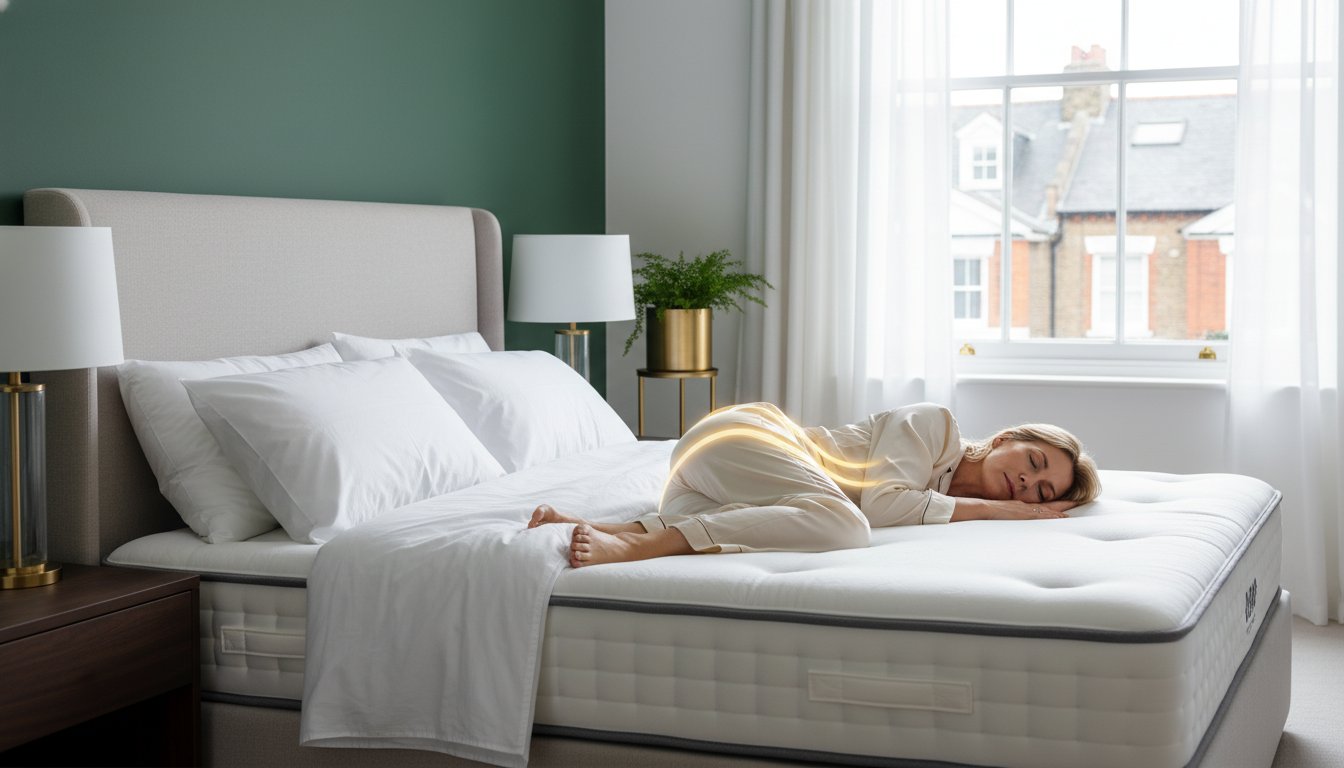
Could a mattress that feels "too soft" actually be the reason you're waking up with a throbbing hip every morning? Many of our neighbors here in Belfast come to us frustrated because their "comfy" bed leaves them with sharp pressure points and a stiff lower back by 6:00 AM. We understand that finding the right mattress for side sleepers with hip pain is about more than just a squishy top layer. It requires a precise combination of contouring comfort and reactive support to keep your spine aligned while protecting your joints.
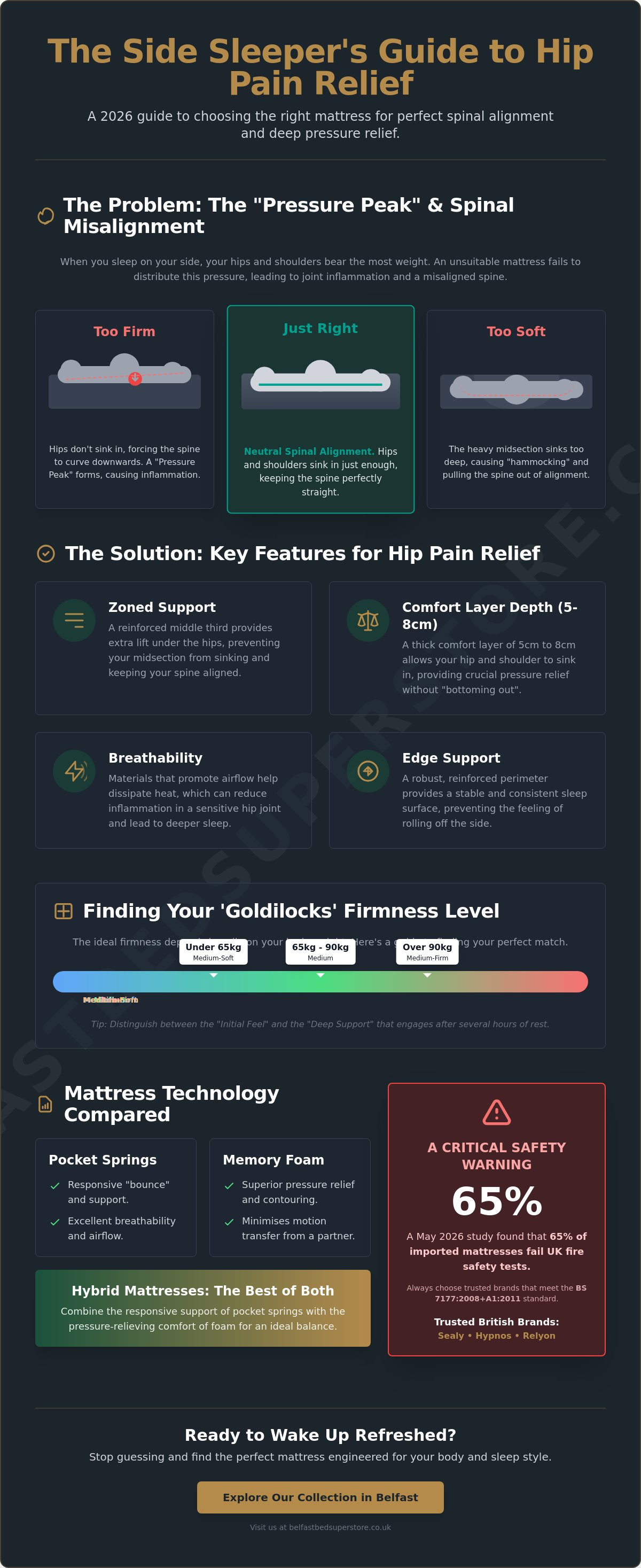
We know there's nothing worse than that sharp, digging sensation in your outer hip that keeps you flipping from side to side all night. Our goal is to help you reclaim your rest and ensure you wake up feeling light and refreshed. In this 2026 guide, you'll discover how to find a bed that offers deep pressure relief and long-lasting durability. We'll take a close look at trusted British brands like Sealy and Hypnos, while explaining why a May 2026 study found that 65% of imported mattresses fail UK fire safety tests. From the benefits of hybrid technology to the importance of the BS 7177:2008+A1:2011 standard, you'll learn everything needed to choose a bed that supports your health and your home.
Key Takeaways
- Understand the "Pressure Peak" and how specific cushioning protects your hip joints from inflammation while you sleep.
- Discover why the best mattress for side sleepers with hip pain features zoned support to keep your spine perfectly aligned.
- Compare the benefits of traditional pocket springs against modern memory foam to find your ideal balance of bounce and pressure relief.
- Learn how to perform the "Pressure Point Test" at home to verify if your current bed is causing your morning aches.
- Explore why heritage British brands like Sealy and Hypnos are specifically engineered to provide a better "morning after" experience.
Why Side Sleeping Causes Hip Pain (and How Your Mattress Can Help)
Side sleeping is by far the most popular of the common sleep positions in Northern Ireland. While it's great for digestion and reducing snoring, it presents a unique challenge for your joints. When you lie on your side, your hips and shoulders become the primary load-bearing points. This creates a "Pressure Peak" where the majority of your body weight is forced into a very small surface area. If you're using an unsuitable mattress for side sleepers with hip pain, this concentrated force pushes directly against the trochanteric bursa. This small, fluid-filled sac is meant to protect your hip joint, but hard surfaces cause it to become inflamed and painful.
We define pressure relief as the redistribution of weight away from the hip joint to larger surface areas of the body.
The ultimate goal for any side sleeper is to achieve neutral spinal alignment. This means your spine should form a straight, horizontal line from your neck all the way down to your tailbone. When your mattress provides the right level of "give," your hips can sink in just enough to keep your spine level, rather than being pushed upward or allowed to sag.
The Science of Spinal Alignment for Side Sleepers
If your bed is too firm, your hips simply cannot sink in. This creates a literal gap at your waist, forcing your spine to "hang" and curve uncomfortably toward the mattress. On the flip side, a mattress that's too soft causes "hammocking." This is where your heavy midsection sinks too deep, pulling your spine out of whack. A high-quality Sealy mattress is often engineered to prevent this by using zoned support. This technology allows the shoulders and hips to sink in tandem while keeping the lumbar region firmly supported.
Common Signs Your Current Mattress is Failing Your Hips
How do you know if your bed is the culprit? Many of our customers report waking up with "pins and needles" or a numb sensation in their legs. This is a clear sign of restricted blood flow and nerve compression. You might also find yourself habitually stuffing a pillow between your knees to try and level out your hips. Finally, check for visible dipping or sagging in the middle of your bed. A sagging mattress for side sleepers with hip pain is a recipe for a restless night and a painful morning after.
The Essential Features of a Mattress for Hip Pain Relief
Selecting the right mattress for side sleepers with hip pain involves looking past the initial "cloud-like" feel of a showroom bed. To truly eliminate those morning aches, you need a mattress engineered with zoned support. Most high-quality models now feature a reinforced middle third. This specific design choice provides extra lift where your weight is most concentrated, preventing your midsection from sinking too far and pulling your hip out of its socket. Without this targeted support, even the most expensive bed can leave you feeling misaligned by midnight.
The depth of the comfort layer is equally vital for pressure relief. For most side sleepers, we recommend a comfort layer between 5cm and 8cm thick. This depth allows your shoulder and hip to "sink" into the mattress while the support core underneath holds your spine steady. We also focus heavily on breathability. A mattress that traps heat can increase localized inflammation in a sensitive hip joint. Following established guidelines for sleep hygiene and comfort helps ensure your environment remains cool, which is essential for deep, restorative REM sleep. Finally, look for robust edge support. This ensures the entire surface remains stable, so you don't feel like you're rolling toward the floor when you sleep near the side.
Finding the 'Goldilocks' Firmness Level
Medium firmness is typically the sweet spot for side sleepers, but it's not a one-size-fits-all solution. Your body weight plays a massive role in how a mattress performs. If you weigh under 65kg, a "Medium-Soft" feel might be necessary to trigger the comfort layers. Conversely, sleepers over 90kg often need a "Medium-Firm" rating to prevent "bottoming out" against the support springs. It's helpful to distinguish between the "Initial Feel," which is what you feel the moment you lie down, and the "Deep Support" that kicks in after several hours of rest. You can test these different tensions for yourself at our local Belfast showroom to see which one truly cradles your joints.
Material Density and Pressure Redistribution
Density, not just firmness, determines long-term hip support. High-density foams and natural fillings are far superior to budget alternatives because they maintain their shape under constant pressure. While budget foams may feel soft initially, they often lose their "push-back" within a year, leading to the return of hip pain. Natural materials found in a Hypnos mattress, such as wool and silk, are inherently reactive. They breathe naturally and contour to your body's unique shape without the "stuck" feeling sometimes associated with cheaper synthetics. These premium materials ensure your mattress remains as supportive on night 1,000 as it was on night one.
Comparing Mattress Technologies for Side Sleepers
Choosing a mattress for side sleepers with hip pain often feels like a choice between two worlds: traditional British craftsmanship and modern material science. In 2026, the hybrid mattress has become the fastest-growing choice across Northern Ireland because it bridges this gap. These beds combine the familiar bounce of springs with the deep contouring of foam. However, the technology hidden beneath the fabric determines whether you'll wake up refreshed or reaching for the painkillers. Understanding these differences helps you make a confident choice for your long-term health.
- Pocket Sprung: The gold standard for independent movement. Each spring is wrapped in its own fabric pocket, allowing it to respond only when you apply direct pressure.
- Memory Foam: This material reacts to your body heat to soften and cradle your joints. While it offers unmatched pressure relief, some cheaper versions can trap heat, which might irritate an already inflamed hip.
- Latex: Think of this as memory foam's bouncy, eco-friendly cousin. It's naturally cooling and provides an "instant" response when you move, making it ideal if you tend to toss and turn.
- Hybrid: By using a layer of pocket springs topped with foam or latex, hybrids offer the "best of both worlds" for hip relief and spinal support.
Pocket Springs vs. Open Coil: Why it Matters for Pain
Open coil mattresses (sometimes called Bonnell springs) are all wired together. When your heavy hip pushes down, the whole row of springs moves with it. This creates "motion transfer" and a dipping effect that can leave your spine out of alignment. We always recommend a pocket spring count of at least 1,000 for a standard double bed. This ensures there are enough individual points of contact to support the specific curve of your hip. For those seeking the pinnacle of this technology, a Sealy mattress often uses specialized spring systems designed specifically for orthopaedic support.
Natural vs. Synthetic Fillings
Natural fillings like British wool, silk, and cotton are the hallmarks of a Hypnos mattress. These materials are naturally breathable and hold their "loft" (thickness) much longer than budget synthetic foams. If you prefer a more modern feel, look for mattresses infused with cooling gels. These are engineered to draw heat away from the body, which helps soothe joint inflammation throughout the night. Whether you choose natural or synthetic, the goal is to find a material that maintains its shape and support for years to come.
Top British Brands for Hip Support: Hypnos, Sealy, and Relyon
While many online guides focus on American "bed-in-a-box" brands, we believe the best mattress for side sleepers with hip pain is often found closer to home. British heritage brands have spent decades perfecting the art of spinal alignment and pressure relief. Brands like Hypnos, Sealy, and Relyon don't just sell furniture; they offer engineered sleep solutions that cater specifically to the needs of the human body. By choosing a manufacturer with a long-standing reputation in the UK, you're investing in a product that meets strict BS 7177:2008+A1:2011 safety standards while providing the deep, restorative rest you deserve. You can explore our range of Hypnos mattresses to see how these traditional methods translate into modern comfort.
Hypnos: The Master of Pressure Relief
Holding a Royal Warrant is a testament to quality, but Hypnos earns its reputation through technical innovation. Their ReActive™ pocket spring system is designed to sense your body weight and shape. As a side sleeper, this means the springs under your hip "give" more freely, while the springs under your waist provide active upward support. This prevents the "digging" sensation that often leads to bursitis or joint inflammation. Hypnos also uses abundant layers of British wool and cotton. These natural fillings regulate your temperature beautifully, ensuring that heat doesn't build up and aggravate sensitive pressure points. If you're looking for Hypnos mattresses for premium support, you'll find they offer a unique "weightless" sensation that is hard to replicate with synthetic materials.
Sealy and Relyon: Orthopaedic Innovation
Sealy is world-renowned for its Posturepedic technology. This system was developed alongside orthopaedic surgeons to ensure the middle third of the mattress provides extra reinforcement. For side sleepers, this is the "critical zone" where the heaviest part of your body rests. By adding this targeted support, Sealy ensures your hips don't dip too low, which is the primary cause of morning back stiffness. On the other hand, Relyon is the go-to for those who love a traditional feel. Their mattresses are often hand-tufted, a process that secures the internal fillings in place for years of consistent comfort. This prevents the "settling" that can lead to uncomfortable lumps and bumps. You can browse our full collections of Sealy mattresses and Relyon beds to find the specific model that fits your comfort preference.
Ready to experience the difference for yourself? You can visit our Belfast showroom today to test these leading British brands and find your perfect mattress for side sleepers with hip pain.
The 'Morning After' Test: Ensuring Long-Term Hip Comfort
The true test of any new bed isn't how it feels for five minutes in a showroom, but how you feel at 7:00 AM after a full night of rest. The 'morning after' experience should be one where you wake up refreshed, limber, and ready for the day. However, it's vital to remember the 30-night rule. Your body has likely spent years compensating for a sagging or unsuitable mattress, so your muscles and ligaments need roughly three to four weeks to adjust to correct spinal alignment. Don't be alarmed if you feel a little different during those first few nights; your body is simply relearning how to relax in a neutral position.
To verify you've chosen the right mattress for side sleepers with hip pain, you can perform a simple 'Pressure Point Test' at home. While lying in your usual side-sleeping position, have a partner try to slide their hand under the small of your waist. If their hand slides through too easily, the mattress is likely too firm, leaving your waist unsupported. If they can't get their hand under at all, you're likely sinking too deep. A perfect fit provides just enough resistance to show that the mattress is contouring to your curves while holding your spine steady. To keep this support consistent, we recommend rotating your mattress every two weeks for the first six months, then once every three months thereafter to prevent localized sagging.
Choosing the Right Accessories for Hip Pain
Even the best mattress needs the right supporting cast. A high-quality pillow is essential because neck alignment directly impacts your lower back and hips. If your pillow is too flat, your neck tilts, creating a chain reaction of tension that ends at your pelvis. Many of our customers find that a memory foam or latex pillow provides the consistent loft needed to keep the entire spine straight. We also suggest using a breathable mattress protector to maintain hygiene without trapping heat. Finally, ensure your bed frame is in good condition. A sturdy divan or a bedstead with slats no more than 7cm apart provides the solid foundation your mattress needs to perform its job properly.
Our 30-Night Sleep Trial Guarantee
We want you to be completely confident in your choice, which is why we offer a straightforward sleep trial on many of our leading ranges. This period allows you to test the mattress in the comfort of your own home, away from the pressure of a retail environment. If you find the tension isn't quite right for your specific hip pain needs, we make the process of swapping for a different firmness level simple and stress-free. Our goal is your long-term comfort, not a quick sale. You can visit our showroom or browse our full collection today to start your journey toward a pain-free morning.
Reclaim Your Rest and Wake Up Pain-Free
Finding the right mattress for side sleepers with hip pain doesn't have to be a guessing game. The secret lies in choosing a bed with zoned support and deep pressure relief to protect your joints and keep your spine aligned. By trusting heritage brands like Hypnos and Sealy, you ensure your body is cradled in comfort while receiving the reactive support it needs. We've been a family-run specialist since 1990, and we take immense pride in helping our Belfast neighbors find the restorative sleep they deserve.
You don't need to worry about making the wrong choice. Our expert 30-night sleep trial guarantee gives you the peace of mind to test your new bed at home. We also provide free national delivery and old bed removal to make your upgrade completely stress-free. It's time to stop tossing and turning and start waking up feeling refreshed and ready to take on the day. We're here to help you find the perfect fit for a better lifestyle.
Find your perfect pain-relief mattress at Belfast Bed Superstore
Frequently Asked Questions
What is the best mattress firmness for side sleepers with hip pain?
Medium firmness is the ideal choice for most people. It provides a balanced surface where your hip and shoulder can sink in just enough to keep your spine level. If a bed is too firm, it pushes against your joints; if it's too soft, your midsection sags and pulls your spine out of alignment. We find that about 80% of our Belfast customers find relief with a medium or medium-firm tension.
Can a mattress topper help with hip pain for side sleepers?
A mattress topper can provide a helpful temporary fix by adding a 5cm to 7cm layer of extra cushioning. This helps redistribute your weight and softens a bed that feels too hard against your outer hip. However, a topper cannot fix a mattress that is already sagging or dipping in the middle. If your support core has failed, a new mattress for side sleepers with hip pain is the only long-term solution.
Is a memory foam or pocket sprung mattress better for hip pain?
A hybrid mattress that combines both technologies is often the most effective solution in 2026. Memory foam excels at contouring to the shape of your hip to reduce pressure, while pocket springs provide the essential "push-back" support to keep your body from feeling stuck. This combination ensures you get the pressure relief of foam without losing the ease of movement provided by traditional springs.
How do I know if my hip pain is caused by my mattress?
You can usually tell the mattress is the problem if your pain is most severe when you first wake up but fades after 20 to 30 minutes of moving around. Another clear sign is if you find yourself sleeping better in hotels or on a spare bed than you do in your own room. If your mattress is older than 8 years or has visible indentations, it's likely failing to support your joints properly.
Should I use a pillow between my knees if I have hip pain?
Using a pillow between your knees is a highly effective way to reduce hip strain immediately. It prevents your top leg from dropping forward and pulling your pelvis out of its neutral alignment. This simple change keeps your hips stacked vertically, which reduces the "torque" on your lower back and hip bursa throughout the night. It's a great habit to maintain even after you get a new bed.
How long does it take for hip pain to go away after getting a new mattress?
Most of our neighbors report feeling a difference within the first 3 nights, but you should allow a full 30 nights for your body to adjust. Your muscles and ligaments have often spent years compensating for a poor sleeping surface. It takes time for this muscle memory to fade and for your body to fully relax into the correct spinal alignment provided by a supportive new mattress.
Are orthopaedic mattresses good for side sleepers?
Orthopaedic mattresses are excellent as long as they aren't "rock hard." Modern orthopaedic designs, like those from Sealy, focus on zoned support rather than just extreme firmness. These beds provide extra reinforcement in the middle third to support your weight while remaining soft enough at the ends to cradle your shoulders. This ensures you get the medical-grade support you need without creating new pressure points.
Does the weight of the sleeper affect the choice of mattress for hip pain?
Your body weight is a critical factor because it determines how much you compress the comfort layers. A sleeper under 60kg may find a "Medium" mattress feels too firm, while someone over 100kg might "bottom out" on a soft bed and hit the hard support core. We always recommend choosing a mattress density that matches your frame to ensure the pressure-relieving layers can actually do their job.


