

Did you know that search interest for pillows in the UK nearly doubled in early 2026 as more of us prioritize our physical well-being? Despite this, many people in Cambridge are still waking up with a stiff neck or a dull headache, wondering why their bedding isn't delivering the deep rest they deserve. If you've struggled with memory foam pillows that trap heat or go flat after just a few months, you aren't alone. We understand how frustrating it is to invest in your comfort only to feel let down by a product that doesn't support your body correctly.
We believe that everyone deserves to wake up feeling refreshed and pain-free. In this expert guide, you'll discover how to choose the perfect memory foam pillow to align your spine and improve your sleep quality. We will walk you through the latest cooling innovations, material safety standards, and how to find a durable solution that lasts for years. From understanding density to visiting our local showroom for a hands-on test, we're here to help you transform your nightly rest and find the support you've been searching for.
Key Takeaways
- Understand how visco-elastic foam responds to your body heat to provide a custom-moulded support system for your head and neck.
- Learn why "loft" is the most critical measurement for keeping your spine aligned and preventing those frustrating morning aches.
- Discover the ideal pillow height for your specific sleeping position, whether you’re a side sleeper needing extra height or a back sleeper seeking a lower profile.
- Compare the unique "sink" of memory foam pillows with the "bounce" of natural latex to decide which material offers the best night’s rest for you.
- See why a trip to our Cambridge showroom to test your pillow on a premium mattress is the most reliable way to guarantee long-term sleep satisfaction.
Understanding Memory Foam Pillows: Beyond the NASA Origins
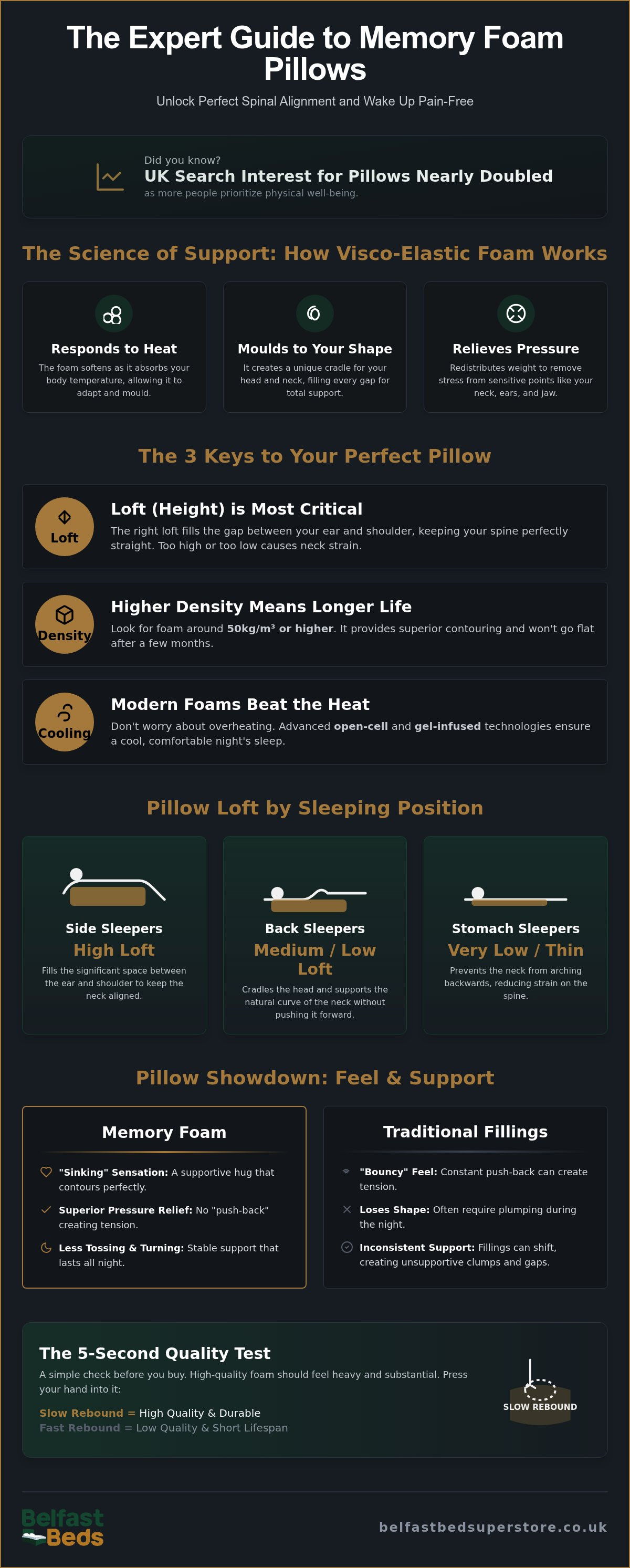
Most people know that memory foam started as a space-age solution. Originally developed in the 1960s to protect pilots and astronauts during high-pressure flights, the history of memory foam shows a fascinating shift from aerospace safety to everyday domestic luxury. Today, memory foam pillows use a highly refined version of this technology to solve a very terrestrial problem: waking up with a sore neck. Unlike standard foam or sponge, this material is visco-elastic. This means it doesn't just collapse under weight; it changes its shape based on both the heat and the pressure of your body. This creates a cradle that is entirely unique to your physical profile.
How Visco-Elastic Foam Actually Works
Inside every pillow is a complex molecular structure designed to react specifically to your environment. When you lie down, the foam doesn't just squash like a sponge. It softens in response to your body temperature. This allows it to flow around your head and neck, filling in the gaps that traditional pillows often leave behind. Ambient room temperature plays a big part in this experience. If your bedroom in Cambridge is particularly chilly during a winter frost, the foam might feel quite firm at first. It only begins to give as it absorbs your body heat. Visco-elasticity is technically defined as a material's ability to exhibit both viscous and elastic characteristics when undergoing deformation in response to applied heat and pressure.
The Pressure-Relief Advantage for Neck Pain
One of the biggest reasons our customers visit our showroom to find memory foam pillows is to escape the push-back of traditional fillings. Hollowfibre or feather pillows can often create tension against your skin because they constantly want to spring back to their original shape. Memory foam does the opposite. It redistributes your weight across the entire surface area of the pillow. This removes pressure from sensitive points like your ears, jaw, and neck muscles. Because your spine stays properly aligned throughout the night, you'll find yourself tossing and turning much less. You won't need to wake up to plump the pillow at 3:00 AM. While brands like Hypnos offer incredible natural fillings for those who prefer a traditional feel, memory foam provides a distinct sinking sensation. For first-time users, this can feel unusual. However, that sinking feeling is actually the foam contouring to your shape to provide deep, reliable support. It’s a supportive hug for your head that helps your muscles finally relax.
Choosing the Right Density: Firmness, Loft, and Cooling Tech
Choosing the right pillow is about more than just finding a soft surface to rest your head. It's a calculated decision based on your body's specific needs and sleeping posture. When you're browsing memory foam pillows, two terms will likely dominate your search: density and loft. Density, measured in kilograms per cubic metre (kg/m3), determines how much material is actually packed into the foam. Loft simply refers to the height of the pillow. Loft is particularly critical because it fills the gap between your ear and your shoulder. If the loft is too low, your head tilts down. If it's too high, your neck is craned upward. Finding that "goldilocks" height depends entirely on your shoulder width and the firmness of your mattress.
Low vs. High Density: Which Lasts Longer?
Higher density is almost always better for long-term health and financial value. A high-density pillow, typically around 50kg/m3 or above, provides superior contouring because it has more material to provide a consistent "memory" effect. While low-density options might feel enticingly soft at first, they often lose their shape within months, leaving you without support. High-quality foam should feel heavy and substantial. When you press your hand into it, the impression should remain for a few seconds before slowly disappearing. If the foam feels airy or "crumbly" like a kitchen sponge, it's likely a lower-grade material that won't provide the spinal alignment you need. You can find a detailed comparison of pillow materials that explains how these density variations impact your sleep over time.
Beating the Heat: Open-Cell and Gel-Infused Foam
One common worry for our Cambridge customers is whether memory foam pillows will feel too hot during the night. In the past, foam was notorious for trapping heat. However, 2026 formulations have solved this problem through advanced material science. Modern pillows now use an "open-cell" structure. This means the microscopic bubbles within the foam are interconnected, allowing air to flow through the pillow rather than getting trapped against your skin.
Gel-infused layers have also become a standard for premium comfort. In fact, gel-infused designs captured 37% of the premium market demand in 2025 because they actively pull heat away from the surface. Some of our latest stock even includes bamboo or charcoal infusions. These natural materials are excellent for moisture-wicking, ensuring your sleep environment stays fresh and hygienic throughout the year. If you're tired of flipping your pillow to the "cool side" every hour, we recommend you test these features in person at our showroom to feel the difference for yourself.
Memory Foam vs. Latex and Natural Fillings: The Comparison
Finding the right material for your head and neck often comes down to a choice between two distinct sensations: the "sink" and the "bounce". While memory foam pillows are famous for that slow-release cradle that moulds to your exact shape, natural latex offers a completely different experience. Latex is resilient and springy. Instead of taking a few seconds to adjust to your heat, it responds instantly to every movement. This makes it a fantastic choice for those who find the enveloping feel of foam a bit too restrictive or for "hot sleepers" who need maximum breathability.
Hypoallergenic properties are another significant advantage for memory foam. Because the material is so dense, it's naturally inhospitable to dust mites and other common allergens that thrive in traditional bedding. If you've spent years struggling with the "dusty" feel of old-fashioned down or feather pillows, switching to foam can provide immediate relief for your respiratory health and overall sleep hygiene.
Latex vs. Memory Foam: The Battle for Support
In our Cambridge showroom, we often encourage customers to try Dunlopillo mattresses alongside their matching latex pillows. Latex is a natural product harvested from rubber trees, giving it excellent eco-credentials compared to entirely synthetic foams. It's the ideal middle ground for people who move frequently during the night. You don't have to wait for the material to "reset" when you turn over; it supports you the moment you shift position. It’s durable, stays cool, and maintains its height for years without sagging.
Traditional Natural Fillings for the Classic Feel
There are times when foam isn't the answer for every sleeper. For those who love a traditional, breathable sleep surface, we often recommend natural fillings like those found in Hypnos accessories. Wool, silk, and cotton regulate temperature naturally by wicking moisture away from the skin. These materials have a wonderful synergy with hand-stitched mattresses, such as those in the Relyon range. While they don't offer the same "memory" effect as visco-elastic foam, they provide a luxurious, airy comfort that has stood the test of time. We believe that choosing between these materials shouldn't be a guessing game. It's why we invite you to lie back and feel the difference between a high-tech foam and a classic natural fibre in person.
Matching Your Pillow to Your Sleeping Position
Your sleeping position is the single most important factor when choosing between different memory foam pillows. It is a common mistake to buy a pillow based on how soft it feels to your touch rather than how it supports your neck while you are horizontal. Side sleepers, for instance, have a much larger gap to fill between their ear and the mattress than back sleepers. If this space is not properly occupied, your neck muscles stay under tension all night. This leads to that familiar morning stiffness. Conversely, front sleepers need almost no elevation at all to keep their spine from arching painfully backward.
The Shoulder Gap Calculation
To find your ideal loft, you should measure the distance from the base of your neck to the outside edge of your shoulder. This measurement tells you exactly how much support you need. However, you must also consider your mattress. If you sleep on a soft surface, like a Sealy Posturepedic, your shoulder will sink deeper into the bed. In this case, you actually need a pillow with a lower loft than someone on a firm mattress. The ultimate goal is to achieve a perfectly horizontal spine where your head is neither tilted up nor dipping down.
Spinal Alignment and the "Neutral Zone"
Achieving the "Neutral Zone" for your cervical spine is the secret to waking up refreshed. This is the position where your vertebrae are aligned and your muscles can fully relax. When your alignment is off, you might experience morning headaches or even pins and needles in your arms. High-quality memory foam pillows are excellent here because they lock your neck into this correct position once the foam has contoured to your shape. Unlike traditional pillows that shift and lose their loft during the night, memory foam stays consistent. This ensures you remain in the neutral zone from the moment you drift off until your alarm goes or the sun rises over Cambridgeshire.
We know that reading about loft and density is one thing, but feeling it is another. We invite you to visit our Cambridge showroom to test our range of pillows on a variety of mattress tensions to find your perfect match.
Finding Your Perfect Match at Belfast Bed Superstore Cambridge
We've all been there: clicking 'buy' on a sleek-looking product online, only to find it feels like a brick or a bag of feathers once it arrives at our door in Cambridge. At Belfast Bed Superstore, we believe that choosing memory foam pillows shouldn't be a gamble. As a family-run business serving East Anglia since 1990, we take pride in helping our neighbors find the specific support they need for a better quality of life. Our showroom isn't just a shop; it's a space where you can take your time to ensure your neck and spine are perfectly aligned before you commit.
The In-Store Testing Experience
When you visit us, our expert staff won't just point you toward a shelf. We'll encourage you to test our curated range from trusted brands like Sealy, Dunlopillo, and Relyon. Crucially, we'll help you test these pillows on a mattress that matches the tension of your one at home. This is the only way to accurately judge the loft and support levels we discussed earlier. Being in-store also allows you to experience the tactile feel of the foam and check for any slight off-gassing scent that some new foam products carry. It’s about total transparency and making sure you’re comfortable with every aspect of your purchase.
Our 2026 Comfort Guarantee
We understand that your body might need a few nights to adjust to a new material. That's why we offer a 30-night sleep trial on our qualifying products. If your new pillow doesn't provide the relief you expected, our team is here to help with an exchange. We value long-term satisfaction over a quick transaction, and we'll work with you until your morning neck pain is a thing of the past. Once you've found your perfect match, we can arrange local delivery and expert assembly across Cambridgeshire and the wider East Anglia region, taking the stress out of the logistics.
Ready to transform your sleep? We invite you to visit our Cambridge showroom to test our premium pillow range today and feel the difference that expert, local advice can make.
Start Your Journey to Pain-Free Mornings
Your path to a better night's rest starts with understanding that your pillow and mattress must work in perfect harmony. By matching your sleeping position to the correct loft and density, you can finally say goodbye to the stiff necks and headaches that have been holding you back. Modern memory foam pillows offer a level of bespoke contouring that traditional fillings simply cannot match, especially when paired with the latest breathable cooling technology we've discussed.
Our team at Belfast Bed Superstore has been providing expert local advice to Cambridge residents since 1990. We take pride in being more than just a shop; we're your neighbors, dedicated to improving your quality of life through better sleep. With our 30-night sleep trial guarantee and professional delivery and assembly across Cambridgeshire, you can shop with total peace of mind. You deserve to wake up feeling recharged every single morning. We encourage you to Browse our Premium Pillow Collection & Visit our Cambridge Showroom to find your perfect match. Let's work together to ensure your next night's sleep is your best one yet.
Frequently Asked Questions
How long do memory foam pillows actually last?
Most high-quality memory foam pillows will last between two and three years before they begin to lose their supportive structure. While a study showed the average person in the UK keeps a pillow for 3.2 years, the Sleep Council recommends a replacement every two years for hygiene reasons. You'll know it's time for a new one if the foam doesn't spring back quickly or if you start waking up with neck tension again.
Can you wash a memory foam pillow in a washing machine?
You should never put a solid memory foam pillow in a washing machine or tumble dryer. The mechanical agitation and heat can break down the delicate cell structure, causing the foam to crumble or lose its shape entirely. Instead, we recommend using a machine-washable protector and spot-cleaning the foam with a damp cloth and mild detergent. Always ensure the pillow is completely dry before putting the cover back on to prevent moisture buildup.
Why does my new memory foam pillow have a strange smell?
That distinctive scent is known as off-gassing and it's a natural byproduct of the manufacturing process for visco-elastic foam. It isn't harmful and usually dissipates within 24 to 48 hours if you leave the pillow in a well-ventilated room. To speed up the process, you can gently press down on the foam to push out trapped air. Choosing pillows with CertiPUR-US® certification ensures low VOC emissions and a much milder initial scent.
Are memory foam pillows good for people with allergies?
Yes, memory foam pillows are an excellent choice for allergy sufferers because their dense structure is naturally resistant to dust mites. Unlike traditional feather or down fillings, there is very little space for allergens to accumulate inside the foam. Many of our premium options are also OEKO-TEX® certified, meaning they've been tested for over 1,000 harmful substances. This provides a cleaner sleep environment for anyone dealing with asthma or sensitive skin in Cambridge.
How do I know if my pillow loft is too high or too low?
You can tell your loft is incorrect if your head isn't level with your spine while lying down. If your chin is tilted toward your chest, the loft is too high. If your head is tilting backward, it's too low. Your ear should be perfectly in line with your shoulder. We often suggest having a partner check your profile while you're on your mattress to ensure your neck remains in a neutral, relaxed position.
Do memory foam pillows get harder in cold weather?
Memory foam is temperature-sensitive, so it will feel firmer if your bedroom is cold. During a chilly Cambridge winter, you might notice your pillow feels quite hard when you first lie down. It will soften quickly as it absorbs your body heat and begins to contour to your shape. If you prefer a more consistent feel regardless of the room temperature, we recommend looking at "open-cell" formulations which are less affected by ambient weather changes.
What is the difference between solid and shredded memory foam?
Solid pillows consist of a single block of foam, providing a consistent, cradling feel that's ideal for targeted neck support. Shredded foam pillows are filled with thousands of tiny foam pieces, making them more breathable and adjustable. You can often add or remove the filling in a shredded pillow to customize the height. While solid foam offers a more traditional "memory" sensation, shredded options feel closer to a classic down pillow but with better support.
Is a memory foam pillow better than a latex one for neck pain?
Neither material is objectively "better," but they solve neck pain in different ways. Memory foam pillows are superior if you need a deep, still cradle that prevents you from shifting into poor positions. Latex is better if you move frequently, as it responds instantly to your changes without the "stuck" feeling. If your pain is caused by pressure points, the contouring of memory foam is usually the preferred solution. We recommend testing both at our showroom to see which feels right.


