
You reach for the alarm clock and feel that sharp, familiar tug in your lower spine before your feet even touch the carpet. For many of us, waking up with stiff hips and morning back spasms has become an unwelcome routine that clouds the rest of the day. We understand the hesitation you feel when looking for a new bed; it's daunting to face a sea of orthopaedic claims while worrying you might spend a fortune on something that actually makes the pain worse.
Finding the best mattress for a bad back and hips is actually about achieving a specific balance we call the "support-comfort sandwich." You need deep, reliable support to keep your spine aligned, paired with a gentle surface that cushions your joints. In this 2026 guide, we'll cut through the technical jargon to explain how different materials like pocket springs and latex work together. We'll help you identify the right feel for your sleeping position, ensuring you find a long-lasting, British-made mattress that lets you wake up feeling truly refreshed and pain-free.
Key Takeaways
- Learn why maintaining a neutral spinal curve is essential for recovery and how to ensure your hips sink in just enough for proper alignment.
- Debunk the "Firmness Myth" to understand why a mattress that is too hard can often make hip pain worse rather than better.
- Identify the best mattress for a bad back and hips by exploring the unique benefits of pocket springs and durable, supportive latex.
- Discover how your preferred sleeping position changes the level of pressure relief you need to avoid morning stiffness and spasms.
- Find out why a hands-on test at our showroom is the most reliable way to navigate the differences between quality brands like Hypnos and Sealy.
Why Your Mattress is the Secret to Soothing Back and Hip Pain
Waking up shouldn't feel like a physical chore. If you find that your morning starts with a groan and a series of slow stretches just to get moving, your bed might be working against you. While there are various clinical causes of low back pain, a mattress that has lost its integrity will turn a minor ache into a daily struggle. Understanding the mechanics of your body is the first step toward reclaiming your rest. It's about more than just a soft surface; it's about how your skeleton interacts with the layers beneath you.
The Science of Spinal Alignment
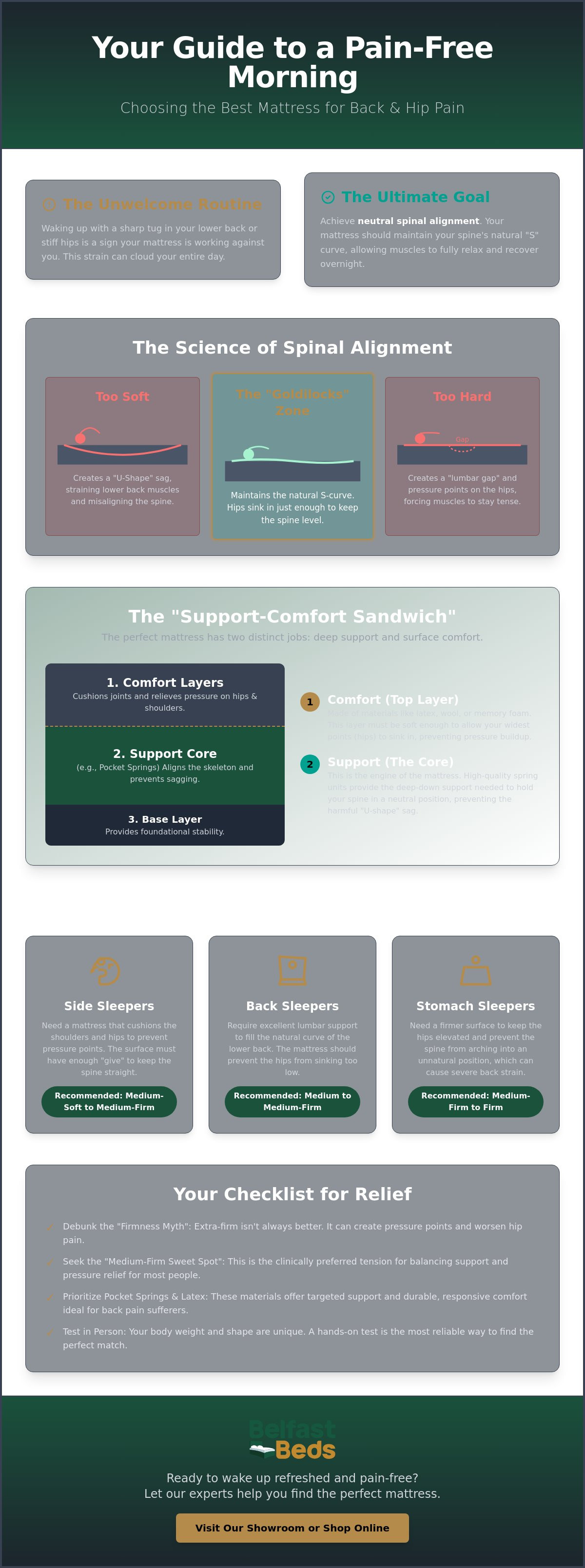
Your spine is designed to sit in a gentle "S" curve, not a straight line. When a mattress sags or lacks the right core tension, it creates a "u-shape" strain that pulls on your lower back muscles for eight hours straight. We often see customers who have a "lumbar gap" where their lower back isn't actually touching the mattress at all. This lack of contact means your muscles have to stay "on" all night to support your frame. To fix this, you need a surface that contours to your shape and fills that gap perfectly. Neutral spinal alignment is the essential key to achieving uninterrupted REM sleep.
The Hip Pressure Point Problem
Because the hip is the widest part of the human frame, it requires more "give" than your waist or legs. If you choose a bed that is too rigid, the "push-back" from the surface can lead to a nagging hip ache or even bursitis over time. This is why the best mattress for a bad back and hips must offer a combination of deep skeletal support and soft muscular pressure relief. You want your hips to sink in just enough to keep your spine level, without feeling like you're trapped in quicksand. It's a delicate balance that ensures your joints aren't taking the brunt of your body weight.
You'll see the word "orthopaedic" on many labels in 2026, but it's vital to know that this isn't a regulated medical term. Most of the time, it simply refers to a very firm feel. While brands like Sealy or Hypnos offer expertly engineered support, "firm" doesn't automatically mean "better." A bed that is too hard can be just as damaging as one that is too soft if it doesn't allow your pressure points to relax naturally. Finding the best mattress for a bad back and hips means looking past the marketing and focusing on how the materials actually cradle your specific shape.
Support vs. Firmness: Finding the Right Balance
Many people assume that a rock-hard mattress is the only solution for a bad back. This is the "Firmness Myth." In reality, an extra-firm surface can be a nightmare for your hips. It pushes against the joint rather than letting it settle, which can lead to inflammation and poor circulation. This creates pressure points that lead to tossing and turning throughout the night. The best mattress for a bad back and hips isn't necessarily the hardest one in the shop; it's the one that provides deep internal support while offering enough surface give to cushion your frame.
Think of your mattress as a two-part system. The core tension comes from the spring unit, which is responsible for holding your skeletal weight and preventing that "u-shape" sag we mentioned earlier. Resting on top of those springs are the comfort layers. These are materials like breathable wool, soft cotton, or responsive latex. These layers are there to soothe your muscles and joints, specifically the hips which need to sink deeper than the waist to keep your spine level. Your body weight plays a huge role in how these layers feel. A person with a higher BMI will need a firmer spring tension to stay level, whereas a lighter person might find that same mattress feels like a brick. Matching your weight to the correct tension ensures you don't bottom out or sit uncomfortably on top of the bed.
The Medium-Firm Sweet Spot
Clinical studies consistently favour a "medium-firm" feel for chronic back issues. This tension is often the "Goldilocks" zone for most sleepers. It's firm enough to support the lumbar region but soft enough to let the hips dip naturally into the comfort layers. When you get this balance right, your muscles can finally stop tensing and start recovering. Finding the best mattress for a bad back and hips often comes down to this specific interplay between the springs and the padding.
Zoned Support Technology
Modern engineering has introduced zoned support to help target specific pain points. This means the mattress is constructed to be firmer in the middle third where your lower back needs it most, and slightly more forgiving at the head and foot. For example, Sealy mattresses use their famous Posturepedic technology to provide this reinforced centre-third. It's a clever way to ensure your lumbar region is held securely while your shoulders and hips are treated to a softer touch. This targeted approach is particularly beneficial for those who struggle with lower back spasms in the morning. If you're unsure which tension suits your needs, it's often helpful to chat with a local sleep expert who can guide you through the options.
Best Mattress Types for Back and Hip Relief
Choosing the right construction is the next step once you understand the balance between support and comfort. We believe the best mattress for a bad back and hips should offer a blend of tradition and technology. While many modern "bed-in-a-box" brands rely heavily on synthetic foam, we often find that traditional craftsmanship provides a more nuanced level of relief for those with chronic aches. The way a mattress is built determines how it will react when you shift positions at 3:00 AM.
Pocket sprung mattresses remain a top recommendation for a reason. Because each spring is housed in its own fabric pocket, they move independently. This means when your hip sinks in, the surrounding springs stay upright to support your waist. Hybrid models take this a step further by adding a layer of foam or latex on top. This gives you modern pressure relief without losing the responsive bounce of a traditional spring. Natural fillings like wool and silk aren't just about luxury, either. These materials are incredibly breathable. If joint inflammation makes you feel hot at night, these fibres help keep your muscles at a steady temperature so they can stay relaxed.
The British Excellence: Hypnos and Relyon
Hypnos mattresses are world-renowned for their reactive pocket springs. These springs are designed to sense your body shape and weight, providing more support where the pressure is greatest. Similarly, Relyon mattresses often feature traditional hand-tufting. This process secures the fillings firmly in place, ensuring the support remains consistent across the entire surface for years to come. For sleepers who struggle with joint discomfort, these natural fibres are far superior to synthetic foams that can trap heat and worsen inflammation.
Latex vs. Memory Foam for Aches
Latex is a fantastic alternative for those who find memory foam too restrictive. It offers an immediate response and a "buoyant" feel, making it much easier to turn over during the night. If you have lower back stiffness, being able to shift positions without feeling "stuck" is vital for a good night's sleep. While memory foam provides deep contouring for extreme hip pressure relief, latex provides a faster "push-back" that keeps you on top of the mattress. Finding the best mattress for a bad back and hips often comes down to how much you value that ease of movement versus a deep, cradling sensation.
How Your Sleeping Position Affects Your Pain
How you settle down at night dictates exactly where your mattress needs to perform. Even the best mattress for a bad back and hips can feel uncomfortable if it isn't matched to your specific sleeping style. We often find that customers focus solely on the bed itself, but your posture is the final piece of the puzzle for a pain-free morning. Whether you curl up on your side or prefer to lie flat, your body has different requirements for pressure relief and support.
Most of us have a preferred "starting" position, but we often shift throughout the night to escape mounting pressure on our joints. If your mattress is too rigid or has started to sag, those shifts become more frequent, leading to fragmented sleep and a groggy morning. By understanding how your position interacts with the mattress layers, you can make a choice that supports your skeleton and lets your muscles finally relax.
Solutions for Side Sleepers
Side sleepers make up the largest group of people we help, yet this position is the most demanding on the hips and shoulders. Because your weight is concentrated on these narrow points, you need a surface with enough "give" to prevent the joints from being pushed out of alignment. We generally recommend that side sleepers look for at least 2 inches of sinkage for the hip bone to ensure the pelvis stays level. A mattress that is too firm creates an unnatural side-bend in the spine, forcing your muscles to work overtime to keep you level. To further improve your comfort, we suggest placing a slim pillow between your knees, which helps keep your hips squared and prevents the top leg from pulling your lower back into a twist.
The Back Sleeper’s Checklist
Back sleeping is often cited as the healthiest position for spinal alignment, but it only works if the mattress fills the small of your back. This area, known as the lumbar curve, needs consistent contact with the bed to prevent muscle strain. If you feel a gap when lying on your back, it's a sign that the mattress is either too firm or too old. You also want to avoid the "hammock" effect, where a soft mattress allows your midsection to sink too deep, pulling your spine into a curve. To find instant relief, try placing a small, supportive pillow under your knees. This slight elevation flattens the lower back against the mattress and takes the pressure off your discs. If you want to see how different tensions feel for your specific posture, you can explore our collection of orthopaedic beds to find your perfect match.
Front sleepers face the toughest challenge, as this position naturally arches the back and twists the neck. If you find it impossible to sleep any other way, you'll need a firmer mattress than most to prevent your hips from sinking too far. We often suggest using a very thin pillow, or no pillow at all, for your head to keep your neck in a more neutral line. Supplementing this with a flat pillow under your pelvis can help lift your hips and keep your spine from over-arching during the night. Balancing these small adjustments with a high-quality bed is the most effective way to wake up without that familiar morning ache.
Choosing Your Mattress at Belfast Bed Superstore
We’ve spent time looking at the science of spinal alignment and the importance of pressure relief, but the final step is experiencing these materials for yourself. Finding the best mattress for a bad back and hips isn't a decision you should have to make based on a website description alone. While we strive to provide the clearest information online, nothing compares to the "Real World" test. We invite you to visit us and take your time. Lie down in your natural sleeping position and feel how the layers react to your specific shape.
Our team acts as your friendly local experts, helping you navigate the subtle differences between world-leading brands. You might find that the hand-tufted feel of a Relyon mattress provides the exact tension you need, or perhaps the reactive springs of a Hypnos model offer better lumbar support for your frame. We don't believe in high-pressure sales. Instead, we’re here to guide you toward the choice that will truly improve your quality of life. For added peace of mind, we offer a 30-night sleep trial guarantee, ensuring you have the time to settle into your new bed at home.
The Value of Local Expertise in Cambridge
Buying a bed online is often a gamble for those suffering from chronic pain. You can't feel the "push-back" of a latex layer or the depth of a pocket spring through a screen. When you visit our Cambridge showroom, we recommend a 15-minute "test rest" for any model you’re seriously considering. This gives your muscles enough time to fully relax so you can identify any hidden pressure points. Once you’ve made your choice, we take care of the hard work. Our professional delivery team provides assembly services throughout Cambridgeshire, ensuring your new bed is set up perfectly in the room of your choice.
A Long-Term Investment in Your Health
We view a high-quality mattress as an investment in your daily well-being. To make premium comfort more accessible, we provide 0% finance options that allow you to spread the cost of your new bed. We also want your transition to better sleep to be as smooth as possible. Our recycling service can handle the removal of your old, unsupportive mattress, so you don't have to worry about the logistics of disposal. It’s all part of our commitment to being a dependable, transparent neighbour in the local community. Visit our Cambridge showroom to find your perfect mattress match today and start your journey toward pain-free mornings.
Start Your Journey to Pain-Free Mornings
Finding the best mattress for a bad back and hips doesn't have to be a guessing game. By focusing on the "support-comfort sandwich," you ensure your spine stays aligned while your hips receive the cushioning they need to stay pain-free. We've explored how British-made brands like Hypnos and Relyon use natural materials and reactive springs to target specific pressure points, as well as the simple pillow tricks that can instantly improve your sleep posture.
At Belfast Bed Superstore, we've been helping our neighbours in Cambridge since 1990. As official stockists of Sealy and other premium brands, we offer the professional expertise you need to make a confident choice. You can shop with total peace of mind thanks to our 30-night sleep trial guarantee and our white-glove delivery and assembly service across Cambridgeshire. It's time to stop settling for stiff joints and start investing in your long-term health.
Browse our Expert-Selected Mattresses for Back Pain
We look forward to welcoming you to our showroom and helping you reclaim the deep, restorative rest you deserve.
Frequently Asked Questions
Is a firm mattress always better for a bad back?
No, a rock-hard surface can actually worsen your pain by forcing your spine out of its natural alignment. While you need a supportive core, a mattress that is too firm won't allow your shoulders and hips to sink in, which creates painful pressure points. Most of our Cambridge customers find that a medium-firm tension provides the best balance of skeletal support and joint cushioning.
What is the best mattress for both lower back and hip pain?
The best mattress for a bad back and hips is typically a high-quality pocket-sprung or hybrid model that features zoned support. These beds are engineered to be firmer in the centre to support your lumbar region while remaining softer at the ends to cradle your hips. Brands like Sealy and Hypnos excel at this technology, ensuring your spine stays straight while your joints are protected.
How do I know if my hip pain is caused by my mattress?
You can usually tell your mattress is the culprit if your pain is most intense when you first wake up but improves once you start moving. Another sign is if you feel better when sleeping in a different bed, such as at a hotel or a friend's house. Check your current mattress for visible "valleys" or dips, as these indicate the internal support has failed and is no longer holding your hips level.
Can a mattress topper help with back and hip pain?
A topper can provide temporary relief if your current mattress is too firm, but it cannot fix a bed that is sagging. If the internal springs have lost their tension, adding a layer of foam on top will simply follow the dip in the mattress. It's often a short-term fix while you're looking for a more permanent, supportive solution for your Cambridgeshire home.
How often should I replace my mattress if I have back pain?
We recommend replacing your mattress every 7 to 10 years to ensure you're getting the support your body needs. Over a decade, the average mattress will have provided around 30,000 hours of use, and the internal materials naturally begin to fatigue. If you've noticed you're waking up with new aches or that the bed doesn't "bounce back" like it used to, it's time to consider an upgrade.
Which is better for hip pain: memory foam or pocket springs?
Both materials have benefits, but pocket springs are often preferred for their independent movement and ease of turning. Memory foam offers deep contouring which is great for pressure relief, but some people find it makes them feel "stuck." If you struggle with lower back stiffness, the responsive nature of a pocket-sprung Relyon mattress makes it much easier to shift positions without straining your muscles.
Do you offer a trial period if the mattress doesn’t help my pain?
Yes, we provide a 30-night sleep trial guarantee to give you total peace of mind. It can take a few weeks for your body to adjust to a new support system, especially if you've been sleeping on an unsupportive bed for years. If you find the tension isn't quite right for your back or hips, our local team is here to help you find a better match.
What is an orthopaedic mattress and do I need one?
An orthopaedic mattress is a term used by the industry to describe a bed with an extra-firm feel. It isn't a medical classification, but it's designed for those who prefer maximum support. You only need one if you find that softer tensions don't keep your spine level or if a healthcare professional has specifically recommended a firmer surface for your recovery.


